

当社のアーティストが、お客様のご希望のサイズと額縁に合わせて、キャンバスに手描きで制作する油彩画です。 ( プリント版に切り替え デジタル画像販売へ切り替え)





























作品のオリジナル比率に合わせた、当店の規定サイズからお選びください。

特定のフレームやスペースに合わせて、ご希望のサイズをご入力いただけます。選択されたサイズが元の画像の比率と異なる場合、アートワークをトリミングするか、手描きで要素を追加して絵画を拡張いたします。デジタルモックアップ を制作し、制作開始前にご確認(承認)をいただきます。
画面上のプレビューは、実際のトリミングや拡張を正確に反映しているものではありません。最終的な構図は、モックアップによってのみ正確にご確認いただけます。
カスタムサイズもご利用いただけますが、元の比率を維持するためには、あらかじめ用意されたリストからサイズを選択することをお勧めいたします。

Bottle, Glass, And Pipe
複製画サイズ一覧
Georges Braque’s “Bottle, Glass, and Pipe” (circa 1910-12) isn’t merely a depiction of everyday objects; it’s a carefully orchestrated visual puzzle, a testament to the radical experimentation defining early Cubism. Born in Argenteuil, France, in 1882, Braque's artistic journey began with a grounding in his family’s trade as house painters and decorators – an experience that instilled within him a profound understanding of materials and structure. This practical foundation proved invaluable as he moved beyond traditional representation, dismantling familiar forms to reveal their underlying geometric essence.
The painting immediately confronts the viewer with a deliberately chaotic composition. A dark wooden bowl dominates the center, containing a jumble of items: fragments of paper resembling a book, two cups stacked precariously, and a vase positioned at the lower right corner. It’s a scene brimming with suggestion – a moment frozen in thought, perhaps a study for a larger work or simply an exploration of visual relationships. The deliberate lack of spatial depth, a hallmark of Cubism, forces us to actively engage with the image, reconstructing the scene within our own minds.
Braque’s development of Cubism was inextricably linked to his collaboration with Pablo Picasso. Initially, both artists were experimenting with ways to represent objects from multiple viewpoints simultaneously – a revolutionary concept at the time. “Bottle, Glass, and Pipe” exemplifies this approach. The bowl itself is broken down into fragmented planes, suggesting its three-dimensional form while simultaneously presenting it as a collection of geometric shapes. The paper fragments, too, are dissected and rearranged, creating an illusion of depth and layering that defies conventional perspective.
This technique wasn’t born in isolation. Braque's early exposure to the work of Paul Cézanne profoundly influenced his thinking. Cézanne’s emphasis on geometric forms and his exploration of multiple viewpoints laid the groundwork for Cubism’s core principles. Braque meticulously studied Cézanne’s paintings, analyzing how he rendered space and form, ultimately adapting these ideas into his own innovative style.
Beyond its purely formal concerns, “Bottle, Glass, and Pipe” hints at a deeper symbolic resonance. The inclusion of tobacco – represented by the pipe – evokes themes of contemplation, leisure, and perhaps even melancholy. The presence of perfume, suggested by the violet hues and the delicate glass bottle, adds an element of sensuality and refinement. These seemingly mundane objects are elevated to a level of artistic significance through Braque’s deliberate arrangement and his masterful manipulation of form and color.
Furthermore, the painting's overall sense of disorder can be interpreted as a reflection of the rapidly changing world at the turn of the 20th century – a period marked by industrialization, urbanization, and social upheaval. Braque’s fragmented composition mirrors this feeling of disorientation and uncertainty, capturing the spirit of modernity with remarkable acuity.
WahooArt offers meticulously crafted hand-painted reproductions of “Bottle, Glass, and Pipe,” allowing you to bring this iconic work into your home or office. Our artists replicate Braque’s innovative techniques with the utmost care, ensuring that every detail – from the subtle nuances of color to the precise rendering of fragmented forms – is faithfully reproduced. Whether you're an art enthusiast, a collector, or simply seeking a unique and thought-provoking piece for your interior design, our reproduction provides an authentic representation of this seminal work of modern art.


1882 - 1963 , フランス

Discover the profound legacy of Georges Braque. Our expert guide explores the evolution of Cubism, from Analytic deconstruction to Synthetic innovation, offering deep insights for discerning art collectors and connoisseurs of modern masterpieces.
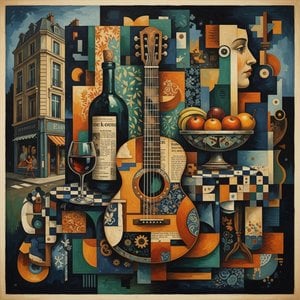
Master the vibrant world of Synthetic Cubism with our expert guide. Explore the revolutionary techniques of Picasso and Braque, from collage to color, and discover how this movement redefined modern art for collectors and connoisseurs alike.

Embark on a visual journey through the luminous world of stained glass art. Discover the exquisite craftsmanship, historical significance, and captivating beauty of masterworks from Art Nouveau to the Gothic era, curated for the discerning fine art enthusiast.

 設置イメージを確認
 送る
送る シェア
シェア
 詳細情報
詳細情報 ガイドを表示

 画像をダウンロード
 似ている作品
 X線調査
X線調査 スライドショー
 統計情報
統計情報
 続きを読む
続きを読む









 ガラスオプションは、110cm未満のサイズでのみご利用いただけます。


