The Enigmatic World of Fukuda Kodōjin
Fukuda Kodōjin remains a somewhat elusive figure in the landscape of contemporary Japanese art, a deliberate obscurity that only adds to the mystique surrounding his profoundly individualistic work. Born in Japan (the exact year is not publicly documented), Kodōjin has consistently eschewed self-promotion and biographical detail, preferring instead to allow his paintings—intricate, often monumental depictions of fantastical creatures and landscapes—to speak for themselves. This reticence isn’t born of aloofness, but rather a deep commitment to the meditative process of creation and a belief that the work should exist independent of personality cults or external narratives. He is currently living and actively painting, continuing a career spanning several decades, yet remains largely outside mainstream art-world attention despite growing international recognition among collectors and connoisseurs.
A Dialogue with Tradition: Influences and Early Development
While Kodōjin resists easy categorization, his artistic roots are firmly planted in the rich soil of Japanese tradition. The influence of
Nihonga, the style of traditional Japanese painting that emerged in the Meiji era as a reaction against Westernization, is readily apparent in his meticulous brushwork and use of mineral pigments. However, Kodōjin doesn’t simply replicate historical styles; he actively engages with them, deconstructing and reimagining their conventions. Early works reveal a fascination with
Ukiyo-e, the woodblock print tradition, particularly its dramatic compositions and bold color palettes. But where Ukiyo-e often focused on scenes of everyday life or popular entertainment, Kodōjin’s early paintings hinted at a burgeoning interest in mythology, folklore, and the hidden realms beyond human perception. He absorbed the spirit of classical Japanese painting—its emphasis on suggestion, atmosphere, and the beauty of impermanence—while simultaneously forging his own unique path.
The Creation of a Unique Cosmology
Kodōjin’s mature work is characterized by its otherworldly quality. His paintings are populated by bizarre yet compelling creatures – serpentine dragons with luminous scales, spectral foxes possessing ancient wisdom, and hybrid beings that defy easy classification. These aren't illustrations of existing myths, but rather inhabitants of a cosmology entirely of Kodōjin’s own making. Landscapes unfold in layers of translucent color, evoking both serene beauty and unsettling strangeness. He employs traditional Japanese techniques—the layering of
gofun, a pigment made from crushed oyster shells, to create luminous effects; the use of sumi ink for delicate shading and expressive line work—but pushes these methods to their absolute limits. The sheer scale of many of his paintings is also noteworthy, enveloping the viewer in a world that feels both vast and intimately detailed.
Technique and Process: A Meditative Practice
The creation of a Kodōjin painting is an intensely laborious process, often taking years to complete. He works on large sheets of handmade washi paper, building up layers of pigment with painstaking precision. His technique isn’t about rapid execution or spontaneous gesture; it's a slow, deliberate meditation—a gradual unfolding of form and color. Kodōjin grinds his own pigments, preparing each hue from raw minerals, ensuring complete control over the materials he uses. He often employs unconventional tools – brushes made from animal hair, sponges, even feathers – to achieve unique textures and effects. This dedication to process is integral to the meaning of his work; it reflects a reverence for nature, a commitment to craftsmanship, and a belief that art should be an embodiment of time and patience.
Historical Significance and Legacy
Fukuda Kodōjin’s significance lies in his ability to synthesize tradition and innovation, creating a body of work that is both deeply rooted in Japanese culture and strikingly original. He stands apart from many contemporary artists who engage with historical styles by appropriating or reinterpreting them; Kodōjin actively *lives* within the tradition, allowing it to inform and shape his vision without being constrained by its conventions. While he has deliberately avoided seeking widespread recognition, his paintings have garnered a devoted following among those who appreciate their subtle power and enigmatic beauty. He represents a rare example of an artist who has remained true to his own artistic path, creating a unique and compelling world that continues to captivate and inspire.
- His work challenges conventional notions of representation.
- He exemplifies the enduring power of traditional Japanese techniques.
- Kodōjin’s art offers a profound meditation on nature, mythology, and the human condition.

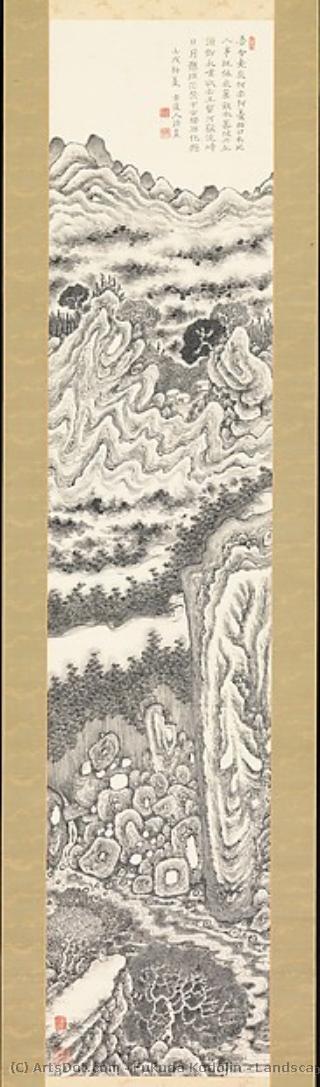
 1922
1922 147.0 x 31.0 cm
 プリント版に切り替え





 プレビュー
プレビュー
 シェアする
シェアする シェアする
シェアする
 詳細を見る
詳細を見る

 ダウンロード
 似ている作品
 X線調査
X線調査 スライドショー
 詳細を見る
詳細を見る






































 ガラスオプションは、110cm未満のサイズでのみご利用いただけます。


