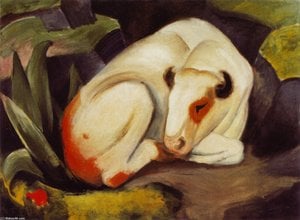
Acrylic On CanvasWallArtGerman Expressionism
 1911Early Modern
 50.0 x 70.0 cm
当社のアーティストが、お客様のご希望のサイズと額縁に合わせて、キャンバスに手描きで制作する油彩画です。 ( プリント版に切り替え デジタル画像販売へ切り替え)





























作品のオリジナル比率に合わせた、当店の規定サイズからお選びください。

特定のフレームやスペースに合わせて、ご希望のサイズをご入力いただけます。選択されたサイズが元の画像の比率と異なる場合、アートワークをトリミングするか、手描きで要素を追加して絵画を拡張いたします。デジタルモックアップ を制作し、制作開始前にご確認(承認)をいただきます。
画面上のプレビューは、実際のトリミングや拡張を正確に反映しているものではありません。最終的な構図は、モックアップによってのみ正確にご確認いただけます。
カスタムサイズもご利用いただけますが、元の比率を維持するためには、あらかじめ用意されたリストからサイズを選択することをお勧めいたします。

Red Dog
複製画のサイズ
Franz Moritz Wilhelm Marc (1880 – 1916), born in Munich, Germany, stands as one of the most influential figures in German Expressionism. His artistic journey began with a fascination for landscape painting under his father's tutelage but swiftly pivoted toward a deeper exploration of spirituality—a quest to distill the fundamental truths of existence into visual form.
Marc’s breakthrough came during his time at the Academy of Fine Arts in Munich, where he encountered Vincent van Gogh’s expressive canvases. This encounter profoundly impacted him, fostering an unwavering conviction that art possessed the capacity to transcend mere representation and evoke genuine spiritual experience. He believed that by capturing the essence of nature—particularly animals—artists could communicate a profound understanding of life's interconnectedness.
"Red Dog," painted in 1911, exemplifies Marc’s distinctive style – a cornerstone of Expressionism. Rejecting academic realism, he embraced bold color palettes and simplified forms to convey emotion rather than precise detail. Marc utilized tempera paint on canvas, a technique favored for its luminosity and ability to achieve vibrant hues. The artist meticulously applied thick layers of pigment, creating textured surfaces that mirrored the rugged beauty of the mountainous landscape.
Marc’s artistic endeavors unfolded against the backdrop of a turbulent era marked by social unrest and intellectual ferment. Expressionism emerged as a reaction to the perceived failings of bourgeois culture, seeking to express inner turmoil and confront existential anxieties. “Red Dog” reflects this spirit of rebellion, rejecting conventional aesthetic standards in favor of an uncompromising commitment to conveying psychological depth.
The painting’s central figure—a red dog—is laden with symbolic significance. Dogs have long been associated with loyalty, companionship, and instinctual wisdom within Western culture. Marc deliberately chose this animal to represent the primal forces of nature and, crucially, to embody spiritual harmony. The dog's upward gaze symbolizes aspiration toward transcendence, mirroring Marc’s own belief that art could illuminate the hidden realities of existence.
"Red Dog" transcends mere visual depiction; it invites contemplation and evokes a powerful emotional response. The dominant reds and oranges convey warmth, energy, and passion—reflecting Marc’s fervent desire to capture the vibrancy of life itself. Viewing this artwork is akin to stepping into a realm where form serves as conduit for feeling, prompting viewers to consider questions of beauty, truth, and the enduring power of artistic expression.


1880 - 1916 , ドイツ
Transform your photos into high-octane action anime masterpieces with WahooArt. Our expert artists blend AI innovation with traditional oil painting to create premium, hand-painted pop culture legacies for your home. Experience museum-quality craftsmanship and a 100% satisfaction guarantee.

Step into the spotlight with WahooArt's AI-driven transformation. Turn your photos into stunning, hand-painted anime oil masterpieces. Experience the perfect fusion of cutting-edge technology and museum-grade craftsmanship to create a timeless pop-culture legacy for your home.


 プレビュー
プレビュー
 シェアする
シェアする シェアする
シェアする
 詳細を見る
詳細を見る

 ダウンロード
 似ている作品
 X線調査
X線調査 スライドショー
 統計情報
統計情報 詳細を見る
詳細を見る









 ガラスオプションは、110cm未満のサイズでのみご利用いただけます。