


このページに掲載されている作品は著作権法によって保護されており、当社の許可なく同一の複製物を制作または販売することは法律で禁じられています。この保護は、以下のような国際条約に基づき執行されます。 ベルヌ条約 および、以下の条項に定められたものを含む各国の法律により、 米国著作権法 第17編。
この手法は、著作権で保護された作品の複製や複写を伴わないため、著作権法に完全に準拠しています。これは単なる模倣ではなく、創造的な再解釈です。元の作品からインスピレーションを受けつつも、それとは異なる、全く新しい絵画を生み出すものです。
スピーディーな制作と多彩な仕上げオプションが魅力の、ミュージアムクオリティなジークレー・キャンバスプリント。 ( 手描き複製画を注文する デジタル画像販売へ切り替え)
作品のオリジナル比率に合わせた、当店の規定サイズからお選びください。

額縁や壁のスペースに合わせて、ご希望の幅と高さを入力してください。プリントはカットすることは可能ですが、元の画像より大きくすることはできないため、異なる比率のサイズを選択された場合は、画像の一部が欠けることになります。印刷を開始する前に、内容を確認していただくためのデジタルモックアップをお送りいたします。このページに表示されている画像は、実際のカット後の状態を示すものではありません。実際の仕上がりはモックアップにてご確認ください。
Sans Titre
複製画サイズ一覧

Fouad Bellamine, a prominent figure in the Moroccan and international artistic landscape, possesses a practice that transcends mere representation to explore the very architecture of perception. Born in the imperial city of Fez, his early years were steeped in the rich textures of the madina, where watching his grandfather work as a weaver provided a foundational connection to pattern and craft. This deep-rooted cultural heritage, combined with an academic rigor developed at the École des Arts Appulated de Casablanca, allowed him to forge a unique visual language. Bellamine’s work is famously characterized by his philosophical stance on identity, famously asserting that “there is no Moroccan painting, there are only Moroccan painters.” This sentiment underscores his refusal to be confined by nationalistic labels, choosing instead to engage with universal themes of light, space, and the physical act of creation.
His artistic journey took him from the vibrant streets of Morocco to the intellectual hubs of Europe. After traveling through France, Yugoslavia, and Italy in the early 1970s, Bellamine’s exposure to Western art movements profoundly shaped his trajectory. His time in Paris, supported by a governmental scholarship at the Cité des Arts, became a period of intense theoretical and practical development. It was here that he pursued advanced studies in art history and theory at Saint-Denis University - Paris VIII, focusing his doctoral research on the concept of murality in contemporary painting. This academic pursuit of how art interacts with and constructs space became a cornerstone of his mature style.
In the works of Bellamine, the canvas is not merely a surface for pigment but a site of construction. His paintings often revolve around the motifs of arcs, arches, and vaults, elements that evoke both classical architecture and the rhythmic patterns found in Moroccan design. These forms are never static; they are brought to life through a dynamic interplay of light and gesture. For Bellamine, the movement of the body during the act of painting is inseparable from the creation of space itself. He utilizes light as a structural tool, using it to define volumes and reveal the hidden depths within his compositions.
The technique often involves a masterful use of mixed media, where rich textures invite the viewer into a state of contemplation. His palettes frequently employ vibrant tones—such as deep reds and warm oranges—to guide the eye through complex, nonfigurative landscapes. This approach creates a sense of tranquility and "calm silence," inviting an emotional response that is both meditative and profound. The following elements are central to his aesthetic development:
Bellamine’s influence extends far beyond the borders of Morocco, as his work has been integrated into some of the most prestigious collections in the world. His presence in institutions such as the Institut du Monde Arabe in Paris, the Mathaf Museum of Modern Art in Qatar, and the Sharjah Art Museum in the United Arab Emirates speaks to his global significance. In 2020, he achieved a historic milestone as the first Moroccan artist to be honored with a retrospective exhibition at the Mohammed VI Museum of Modern and Contemporary Art in Rabat, titled Entrée en matière.
Living and working between Paris and Rabat, Bellamine continues to bridge the gap between different cultural perspectives. His career, which includes roles as a teacher and lecturer, has allowed him to mentor new generations of artists while maintaining a rigorous personal practice. Through his dedication to nonfigurative painting and his profound inquiry into the nature of space, Fouad Bellamine remains a vital voice in contemporary art, reminding us that the act of painting is an eternal quest for light and meaning.

1940 - , Morocco

Elevate your artistic practice with our expert guide to mastering mixed media art. Discover professional techniques for layering, material integration, and creating structural depth to transform your creative vision into sophisticated, multi-dimensional masterpieces.

Discover the exquisite mastery of pastel and chalk in fine art. Explore how texture, light, and softness create depth in Impressionist masterpieces and learn to curate these velvety textures for sophisticated, luxury interiors with expert guidance.
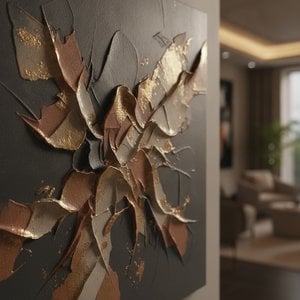
Elevate hospitality interiors with the sculptural depth of plaster and impasto art. Explore how tactile textures and relief techniques create immersive, luxurious environments for modern hotel design through expert curation and bespoke fine art commissions.
 設置イメージを表示
 シェアする
シェアする シェアする
シェアする
 詳細を見る
詳細を見る ガイドを表示

 ダウンロード
 似ている作品
 X線調査
X線調査 スライドショーを表示
 Q&A
Q&A
 統計情報
統計情報


 詳細を表示
詳細を表示






































 ガラスオプションは、110cm未満のサイズでのみご利用いただけます。


