A Bold Vision of Modernity: Exploring Fernand Léger’s “Untitled (8601)”
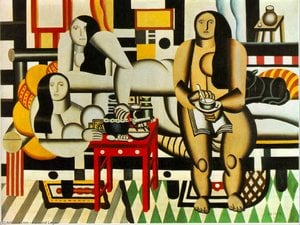
Fernand Léger's "Untitled (8601)" stands as a striking testament to the burgeoning modernist movement, capturing not merely an image but a feeling—the restless energy and simplified forms emblematic of a world transforming under the influence of industrialization. Painted sometime between 1925 and 1930, this canvas exemplifies Léger’s signature Tubism style, a radical departure from traditional representation that sought to distill visual experience into its most fundamental elements. The artwork's immediate impact is one of arresting clarity; black and white dominates the composition, punctuated by vibrant splashes of color—primarily reds, yellows, and greens—applied with thick impasto strokes that lend texture and dynamism to the scene.
- Subject Matter: Léger’s depiction centers around a stylized human face, rendered in monochrome, consuming an apple, banana, and grapes. These seemingly mundane objects are elevated into symbols of nourishment and vitality—a deliberate choice reflecting Léger's fascination with the relationship between humanity and technology.
- Tubism Technique: Tubism, developed by Léger alongside Pablo Picasso and Georges Braque, represents a pivotal moment in Cubist thought. It abandons illusionistic depth and perspective, instead fracturing objects into geometric shapes—cubes, cylinders, cones—that overlap and intersect to create a flattened surface. This technique prioritizes structural clarity over visual realism, mirroring the aesthetic principles of the machine age.
- Historical Context: Léger’s work emerged during the interwar years, a period marked by rapid industrial growth and anxieties about societal change. The artist consciously responded to these concerns by portraying machines not as monstrous threats but as instruments of progress—albeit viewed through an abstracted lens. “Untitled (8601)” embodies this optimistic vision, suggesting that even seemingly simple pleasures could be infused with the spirit of innovation.
The deliberate simplification of form isn’t merely stylistic; it speaks to a deeper philosophical impulse. Léger believed that art should communicate directly with the viewer's subconscious mind, bypassing intellectual analysis and tapping into primal emotions. The bold colors—particularly the reds—are strategically positioned to draw attention to the central figure and convey a sense of urgency and passion. They contrast sharply with the monochrome background, emphasizing the transformative power of color within an otherwise austere framework.
Symbolism: Beyond its formal innovations, “Untitled (8601)” is laden with symbolic significance. The fruits represent sustenance—both physical and spiritual—while simultaneously hinting at abundance and fertility. The face itself embodies humanity’s enduring quest for nourishment and connection to the natural world, albeit filtered through the prism of abstraction. Léger's masterful use of texture reinforces this message, inviting viewers to engage with the artwork on a visceral level.
Emotional Impact: Ultimately, “Untitled (8601)” transcends mere visual representation; it evokes a feeling of dynamism and optimism—a conviction that even in an increasingly mechanized world, beauty and vitality could persist. Léger’s uncompromising commitment to his artistic vision solidified his place as one of the most influential figures of modern art, inspiring generations of artists to explore new expressive possibilities. Reproductions of this captivating piece offer collectors and interior designers alike a glimpse into the heart of Tubism and its enduring legacy.



 プレビュー
プレビュー
 手描きの絵画を購入
 シェアする
シェアする シェアする
シェアする
 詳細を見る
詳細を見る

 ダウンロード
 似ている作品
 X線調査
X線調査 スライドショー
 詳細を見る
詳細を見る






































 ガラスオプションは、110cm未満のサイズでのみご利用いただけます。