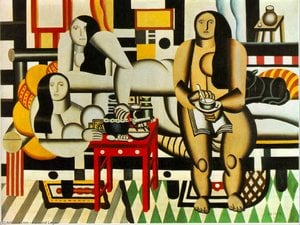
The Worker Sitting by Fernand Léger – A Geometric Ode to Labor and Observation
Fernand Léger’s “The Worker Sitting,” executed in 1926, stands as a cornerstone of Primitivism—a movement that sought to recapture the essence of raw emotion and instinct through simplified forms and bold colors. More than just a portrait, it's an emblem of Léger’s profound engagement with the burgeoning industrial landscape of his time, filtered through the lens of Cubist principles.
The artwork depicts a solitary workman seated on a chair, bathed in diffused light that emphasizes the flatness of the composition. Léger eschews traditional perspective, opting instead for overlapping geometric shapes—primarily squares and rectangles—to convey spatial relationships. These forms dominate both the chair itself and the backdrop, which features a prominent window framing an expanse of greenery. The deliberate asymmetry contributes to a dynamic visual rhythm, inviting contemplation rather than passive viewing.
Executed in ink on paper, Léger’s technique is characterized by thick, assertive outlines—the defining feature of Primitivism—that sculpt the figure and background with uncompromising precision. These lines aren't intended to mimic realistic contours; they serve as structural elements, constructing simplified forms that prioritize clarity and impact. The monochrome palette—a stark contrast between black and white—amplifies this effect, stripping away any illusion of depth or texture.
Beyond its formal qualities, “The Worker Sitting” resonates with a quiet dignity. Léger’s portrayal captures a moment of stillness amidst the bustle of industrial life – a posture suggesting reflection and observation. The workman's gaze directs towards the window, symbolizing perhaps an aspiration for connection with nature and a yearning for respite from the pressures of labor. Léger’s intention wasn’t to depict a specific individual but rather to embody the spirit of the working class—a subject he revisited repeatedly throughout his career.
As a precursor to Pop Art, Léger's work exemplifies a radical departure from academic conventions. He prioritized expressive simplification over meticulous detail, aligning with the broader artistic impulse to confront modernity head-on. “The Worker Sitting” remains an enduring testament to Léger’s ability to distill complex ideas into powerfully evocative visual language—a timeless image of human presence within the transformative forces shaping the twentieth century.



 プレビュー
プレビュー
 手描きの絵画を購入
 シェアする
シェアする シェアする
シェアする
 詳細を見る
詳細を見る

 ダウンロード
 似ている作品
 X線調査
X線調査 スライドショー

 詳細を見る
詳細を見る






































 ガラスオプションは、110cm未満のサイズでのみご利用いただけます。