スピーディーな制作と多彩な仕上げオプションが魅力の、ミュージアムクオリティなジークレー・キャンバスプリント。 ( 手描きの複製画を注文する デジタル画像販売へ切り替え)





























作品のオリジナル比率に合わせた、当店の規定サイズからお選びください。

額縁や壁のスペースに合わせて、ご希望の幅と高さを入力してください。プリントはカットすることは可能ですが、元の画像より大きくすることはできないため、異なる比率のサイズを選択された場合は、画像の一部が欠けることになります。印刷を開始する前に、内容を確認していただくためのデジタルモックアップをお送りいたします。このページに表示されている画像は、実際のカット後の状態を示すものではありません。実際の仕上がりはモックアップにてご確認ください。
The viaduct
複製画サイズ一覧
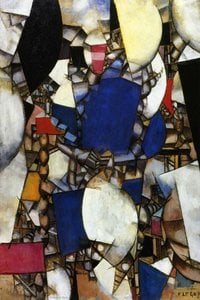
Fernand Léger's The Viaduct isn’t simply a depiction of an industrial scene; it is a bold declaration of faith in the machine age, rendered with his signature “Tubism” – a uniquely powerful evolution of Cubist principles. This painting transforms steel, brick, and the dynamism of transportation into a compelling visual symphony of form and color.
The composition is anchored by a robust, predominantly yellow building dramatically intersected by a viaduct – an elevated railway bridge. A speeding train on the right injects immediate energy and movement. Léger masterfully employs cylindrical forms, breaking down architectural elements and even human figures into simplified geometric shapes. These aren’t merely representations; they are *constructions*, emphasizing the underlying structural logic of the modern world.
Two subtly integrated human figures appear within this mechanical landscape – one positioned near the left edge and another closer to the center. They almost function as components within the larger machine, rather than independent observers, hinting at humanity’s evolving relationship with technology. A clock prominently placed in the top-left corner isn't a mere detail; it symbolizes Léger’s fascination with time, efficiency, and the rhythmic pulse of modern life.
Léger achieves his striking effect through flat planes of color – primarily yellows, reds, blues, and grays – and strong contrasts. He deliberately rejects traditional modeling techniques in favor of a more graphic, almost poster-like approach, enhancing the painting’s visual impact and immediacy.
Born in 1881, Léger lived through a period of rapid industrialization. Unlike many artists who mourned the loss of tradition, he wholeheartedly embraced it. He perceived beauty and heroism within machinery, believing it represented a new aesthetic possibility. Developing his distinctive style around 1910, he moved beyond analytical Cubism towards a more figurative and accessible form – “Tubism” – which focused on the inherent structural qualities of objects.
The Viaduct perfectly exemplifies this artistic evolution. It’s not just *about* industry; it's an attempt to capture its very essence, its underlying structure, and its profound impact on human experience. Léger’s work anticipated the Pop Art movement decades later with its embrace of everyday objects and mass-produced imagery.
The painting evokes a sense of dynamism and optimism, yet also carries an undercurrent of detachment. The anonymized figures suggest the individual’s place within the vast industrial system. It's a powerful statement about modernity – its energy, scale, and potential for both progress *and* alienation.
The Viaduct is more than just a painting; it’s a visual manifesto celebrating the beauty and complexity of the modern world – a testament to Fernand Léger’s visionary artistry. It invites viewers to contemplate not only what we build, but also how those creations shape our lives.
「The viaduct」はフェルナンド・レジェによるCubismの作品であり、その記録されたテーマにはcubist abstraction, industrial cityscape, geometric dynamism, modern urban life, leger's machine age, early 20th century, form and movement, simplified realityが含まれます。
「The viaduct」の技法はAcrylic On Canvasです。
フェルナンド・レジェ作「The viaduct」に関する統計情報は、作品の統計情報ページでご確認いただけます。こちらでは、作品の月間訪問数、アーティストの作品への訪問数、および最近の訪問者の国別・言語別の内訳をご覧いただけます。

1881 - 1955 , フランス

Explore the vibrant world of Fernand Léger. Discover how his 'Tubism' and Machine Age aesthetics redefined modern art, offering profound inspiration for discerning collectors seeking geometric beauty and industrial dynamism.

Explore the profound evolution of Cubist still life, from Cézanne's structural foundations to the fragmented brilliance of Braque and Léger. Discover how geometric abstraction redefined reality through a sophisticated lens of form, color, and modern artistic mastery.

Explore the profound intersection of industry and artistry. Discover museum-quality reproductions of Machine Age masterpieces by Léger and Rivera, curated for elite collectors seeking to infuse luxury interiors with the powerful, geometric soul of industrial progress.

 設置イメージを確認
 送る
送る シェア
シェア
 詳細情報
詳細情報 ガイドを表示

 画像をダウンロード
 似ている作品
 X線調査
X線調査 スライドショー
 統計情報
統計情報

 続きを読む
続きを読む









 ガラスオプションは、110cm未満のサイズでのみご利用いただけます。