A Dynamic Still Life: Exploring Fernand Léger’s Abstract Vision
Still Life with Two Fish by Fernand Léger is a captivating example of his distinctive style – a bridge between the analytical fragmentation of Cubism and the bold chromatic energy of Fauvism. This isn't a traditional rendering of inanimate objects; instead, it’s a vibrant reconstruction of form and color that challenges conventional representation.
Deconstructing the Subject
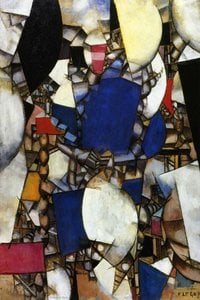
While titled “Still Life with Two Fish,” Léger deliberately obscures literal depiction. The composition *suggests* elements of a still life – perhaps fish alongside fragmented fruit or vessels – but these forms are broken down into geometric shapes and planes. This abstraction isn’t about hiding the subject, but rather about exploring its essential structure and presenting multiple perspectives simultaneously. The “fish” themselves aren't rendered naturalistically; they become building blocks within Léger’s constructed reality.
Style & Technique: Tubism in Action
Léger developed a unique style often referred to as "Tubism," characterized by the emphasis on cylindrical, machine-like forms. This is readily apparent here. The artwork features thick, expressive lines that define these shapes and create a sense of depth despite the flattened picture plane. His technique involves layering colors and planes, creating visual tension and dynamism. Brushstrokes are visible, adding texture and revealing the artist’s hand in the process – it's an energetic, almost impulsive application of paint.
Historical Context: A Modernist Vision
Fernand Léger was a key figure in the development of modern art during the early 20th century. Emerging from an initial Impressionistic phase, he embraced Cubism and then forged his own path.
His work reflects the increasing mechanization and industrialization of society, incorporating elements reminiscent of machinery and engineering into his compositions. This piece, created sometime between 1918-1923, embodies this shift towards a modern aesthetic, rejecting traditional artistic conventions in favor of a new visual language. Léger’s later work would even explore themes of the working class and industrial life directly.
Color & Emotional Impact
The color palette is striking – a bold interplay of orange, blue, green, yellow, and white. These contrasting colors aren't used to mimic natural hues but rather to create visual excitement and emotional resonance. The overall effect is energetic and slightly unsettling.
The dynamism inherent in the composition evokes a sense of movement and vitality, while the fragmented forms suggest a world that is constantly shifting and being reassembled.
Symbolism & Interpretation
While Léger largely moved away from overt symbolism, the choice of a still life subject – traditionally associated with themes of mortality and earthly pleasures – can be interpreted as a commentary on modern life. The abstraction itself could symbolize the fragmentation of experience in an increasingly complex world.
The vibrant colors, however, suggest optimism and a celebration of the energy of the machine age.
For Collectors & Designers
- This artwork is ideal for collectors seeking examples of early 20th-century Modernism and Cubist-influenced painting.
- Its bold colors and dynamic composition make it a statement piece suitable for contemporary interiors.
- The abstract nature allows for versatile placement, complementing various design styles from minimalist to eclectic.
- A high-quality reproduction would bring the energy and intellectual rigor of Léger’s vision into any space.