Ink On PaperWallArtCubism
 Late Medieval
 77.0 x 52.0 cm
オンラインプレビューをはるかに凌ぐ、高解像度で鮮明なデジタル画像をご購入いただけます。
各ファイルは、社内の専門家が高度なツールと熟練した手作業によるレタッチを用いて、細心の注意を払って準備されています。すべての画像において、卓越した鮮明度、正確な色彩再現性、そして繊細なディテールを保証いたします。
最終ファイルは、プロフェッショナルな編集・印刷環境ですぐにご利用いただけるよう最適化された状態で、72時間以内にメールにてお届けいたします。これは、一流のデザインスタジオ、出版社、ギャラリーから信頼されているものと同等の品質です。
個人での鑑賞、印刷、クリエイティブなプロジェクト用に、高解像度ファイルをダウンロードできます。 ( Switch to Print 手描きの絵画を購入)
WahooArt.com を選ぶことは、単に画像を手に入れることではありません。それは、プロの手によって精密に仕上げられ、満足保証が付いた高品質なデジタルアートワークを受け取ることを意味します。ご注文いただいた際に自動的に付随する内容は、以下の通りです:

ご注文から72時間以内に、高解像度のデジタル画像ファイルがメールでお手元に届きます。すぐにそのままご利用いただけます。

お客様の作品は、高度なAIツールと専門家による手作業の編集を組み合わせてプロフェッショナルに最適化されており、細部のディテール、鮮明さ、そして正確な色再現性を最大限に引き出しています。

ファイルを誤って削除したり、紛失してしまったりしましたか?ご安心ください。いつでも無料で再送いたします。

関税や手数料、配送料を気にすることなく、お気に入りのアートワークをすぐにお楽しみいただけます。デジタルダウンロードは常に免税です。

プロ仕様のツールとカラーマネジメント技術を用いることで、デジタル画像が元の色を最大限に忠実に再現することを保証いたします。

ご購入いただいたデジタル画像にご満足いただけない場合は、100日以内であれば、理由を問わず修正または100%の返金対応をさせていただきます。

ご満足いただけない場合は、デジタルファイルを受け取ってから100日以内であれば、理由を問わず全額返金いたします。

3枚購入で10%OFF - 5枚購入で15%OFF - 10枚以上購入で20%OFF。クリエイティブなプロジェクト、ギャラリー、エージェンシーに最適です。
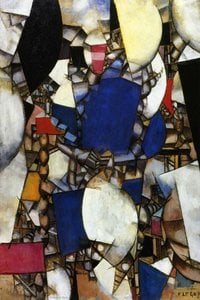
Fernand Léger's "People Framework (Manufacturers)" isn’t merely a depiction of an industrial scene; it’s a vibrant, almost aggressively energetic snapshot of the modern world as perceived through the lens of early 20th-century Cubism. Created around 1914, this black and white work transcends simple representation, offering instead a distilled essence of factory life – its dynamism, its geometric precision, and an underlying sense of both progress and potential alienation. Léger, deeply influenced by the burgeoning machine age, sought to capture not just what was being produced but also the very *feeling* of industrial activity, translating it into a powerfully abstract visual language.
The image immediately commands attention with its stark monochrome palette – a deliberate choice that amplifies the graphic quality and emphasizes the angularity of the composition. Bold, thick lines dominate, outlining every figure and architectural element with sharp precision, creating a sense of fragmented movement. These aren’t the delicate strokes of traditional painting; they are assertive, almost mechanical, mirroring the very structures Léger is depicting. The flattened perspective, characteristic of Cubism, further contributes to this feeling of spatial ambiguity – we're presented with multiple viewpoints simultaneously, forcing us to actively engage in constructing a sense of depth and space.
Léger’s approach is deeply rooted in the principles of Cubism, but he departs from its more purely analytical roots. While Picasso and Braque often dissected objects into geometric components, Léger integrated these elements into a cohesive, dynamic whole. The dominant shapes – rectangles, squares, and triangles – are simplified and abstracted, yet they retain a palpable sense of volume and weight. The scaffolding itself isn’t rendered realistically; instead, it's broken down into its fundamental geometric forms, suggesting the underlying structure of industrial construction. This simplification is not an abandonment of form but rather a strategic reduction to its essential elements, allowing Léger to convey movement and energy with remarkable efficiency.
The central figure – a man in a cap and jacket – isn’t presented as an individual; he's subsumed into the larger framework, becoming almost a component of the machine itself. He holds a rectangular frame, intersecting with the scaffolding, further emphasizing the interconnectedness of all elements within the scene. The lighting is deliberately flat and diffused, eliminating any sense of dramatic highlight or shadow. This lack of illumination contributes to the two-dimensional quality of the work, reinforcing its graphic nature and drawing attention to the lines and shapes that define it.
While “People Framework” avoids overt symbolism, it powerfully conveys a sense of dynamism and activity. The fragmented forms can be interpreted as a reflection of the complex and rapidly changing nature of modern industrial life – a world characterized by constant motion, relentless production, and an increasingly impersonal relationship between man and machine. Léger’s deliberate choice to work in monochrome further enhances this effect, stripping away any romantic notions of beauty or sentimentality and presenting a stark, unvarnished view of the working environment. The artwork isn't celebrating industrial progress; it’s offering a critical observation, prompting us to consider the human cost – and the inherent strangeness – of this new era.
This reproduction captures the essence of Léger’s vision with exceptional detail, allowing you to experience the raw energy and geometric precision of this iconic work. “People Framework (Manufacturers)” is more than just a painting; it's a window into a pivotal moment in art history – a testament to Léger’s pioneering spirit and his ability to translate the language of the machine age into a compelling and enduring visual statement.


1881 - 1955 , フランス


 プレビュー
プレビュー
 シェアする
シェアする シェアする
シェアする
 詳細を見る
詳細を見る

 ダウンロード
 似ている作品
 X線調査
X線調査 スライドショー
 Stats
Stats 詳細を見る
詳細を見る