Mechanical Compositions: A Vision of Industrial Harmony
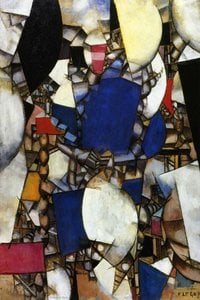
Fernand Léger’s “Mechanical Compositions,” created in 1923, stands as a cornerstone of Cubism and a fascinating reflection on the burgeoning influence of technology during the interwar period. More than just an assemblage of everyday objects—a cup, bowl, spoon, fork, knife, and chair—the painting embodies Léger’s ambitious project to reconcile the dynamism of the machine age with humanist ideals. This artwork isn't merely decorative; it’s a deliberate statement about how art could engage with the transformative forces reshaping society.
- Style: Léger firmly rooted his work in Cubism, albeit pushing its boundaries beyond Picasso and Braque’s initial explorations. He retained the fragmentation of form characteristic of Cubism but infused it with an energetic rhythm reminiscent of Futurism—a movement that championed speed, dynamism, and industrial progress.
- Technique: Léger employed a bold palette dominated by earthy tones punctuated by vibrant blues and reds. His brushstrokes were deliberately thick and expressive, conveying a palpable sense of physicality and immediacy. The artist meticulously rendered each object with geometric precision while simultaneously distorting its contours to emphasize movement and volume.
The painting’s historical context is crucial to understanding its significance. Léger emerged during a time when Europe was grappling with the rapid advancements of industrialization, fueled by innovations like the automobile and electricity. Artists were actively responding to these changes, attempting to capture their impact on human experience. Léger specifically sought to portray machines not as instruments of destruction but as catalysts for creativity and beauty—a utopian vision reflecting his belief in the potential for technology to elevate human consciousness.
Symbolism: Léger’s choice of objects – simple utensils representing domestic life juxtaposed against geometric forms symbolizing machinery – is laden with symbolic meaning. He wasn't simply depicting what he saw; he was conveying an underlying philosophical proposition: that humanity and machine could coexist harmoniously, enriching each other’s existence. The chair represents human presence, grounding the mechanical elements in a tangible reality. Léger deliberately simplified shapes to convey emotion and energy, prioritizing form over realistic representation.
Emotional Impact: “Mechanical Compositions” evokes a feeling of optimism and dynamism. Its bold colors and energetic brushstrokes communicate a sense of movement and vitality—a celebration of the new industrial landscape. The painting invites contemplation on how art can engage with technological advancements while retaining its capacity to inspire awe and wonder. It’s a piece that speaks to our fascination with both the beauty of nature and the power of innovation, reminding us that progress doesn't necessitate abandoning human values or artistic expression.
- Recommended for: Interior Designers seeking bold statement pieces; Art Collectors interested in pioneering Cubist works; Anyone captivated by the intersection of art and technology.