


このページに掲載されている作品は著作権法によって保護されており、当社の許可なく同一の複製物を制作または販売することは法律で禁じられています。この保護は、以下のような国際条約に基づき執行されます。 ベルヌ条約 および、以下の条項に定められたものを含む各国の法律により、 米国著作権法 第17編。
この手法は、著作権で保護された作品の複製や複写を伴わないため、著作権法に完全に準拠しています。これは単なる模倣ではなく、創造的な再解釈です。元の作品からインスピレーションを受けつつも、それとは異なる、全く新しい絵画を生み出すものです。
スピーディーな制作と多彩な仕上げオプションが魅力の、ミュージアムクオリティなジークレー・キャンバスプリント。 ( 手描き複製画を注文する デジタル画像販売へ切り替え)
作品のオリジナル比率に合わせた、当店の規定サイズからお選びください。

額縁や壁のスペースに合わせて、ご希望の幅と高さを入力してください。プリントはカットすることは可能ですが、元の画像より大きくすることはできないため、異なる比率のサイズを選択された場合は、画像の一部が欠けることになります。印刷を開始する前に、内容を確認していただくためのデジタルモックアップをお送りいたします。このページに表示されている画像は、実際のカット後の状態を示すものではありません。実際の仕上がりはモックアップにてご確認ください。
Woods
複製画サイズ一覧

Ethelbert White, born in the Middlesex town of Isleworth in 1891, remains a profound yet understated figure in the tapestry of early twentieth-century British art. His journey was one of remarkable versatility, moving between the delicate precision of wood engraving and the expansive, atmospheric realms of oil and watercolour. Trained at the St John’s Wood Art School under the guidance of Leonard Walker, White developed a technical foundation that allowed him to navigate various mediums with an effortless grace. While many of his contemporaries sought the loud provocations of pure abstraction, White found his true calling in the quietude of the natural world, capturing the subtle shifts of light and the serene essence of the English landscape.
His early career was marked by a daring engagement with the avant-garde. In 1913, alongside luminaries such as Mark Gertler and C R W Nevinson, White embraced the energetic spirit of the Futurist movement. This period of experimentation, which included a bold collaborative depiction of Hampstead Heath for the AAA exhibition, showcased a willingness to challenge traditional boundaries and explore new visual languages. Yet, even amidst these modernistic explorations, the seeds of his later, more contemplative style were already being sown. His work began to reflect the structural influences of Cézanne, blending a modernist sense of composition with an enduring reverence for the organic forms of nature.
Beyond his canvases, White carved a significant niche in the history of British printmaking. In 1920, he transitioned into the intricate world of wood engraving, a move that would redefine much of his artistic output. As a founding member of the English Wood Engraving Society in 1925, he became a central figure in a movement that championed the modern style advocated by Noel Rooke. His engravings were noted for their unusual scale and their ability to translate complex textures into stark, beautiful contrasts. One of his most celebrated achievements in this medium was his illustration for Richard Jefferies' The Story of My Heart in 1923, a work that critics often cite as a landmark in the publication of modern wood-engraved books in Britain.
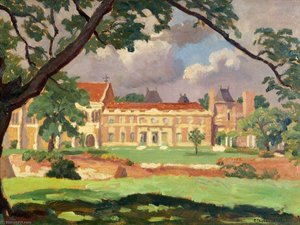
As his career progressed, White’s focus drifted back toward the expansive beauty of landscapes, though he never lost the precision learned from his printmaking years. His paintings—ranging from the lush, verdant Early Spring to the tranquil Woods—are characterized by a masterful command of tonal gradations and a restrained colour palette. He possessed a rare ability to convey deep emotion through subtle atmospheric effects, a quality that drew comparisons to the celebrated Paul Nash. Whether capturing the rugged coastlines of Cornwall or the soft light of an English garden, his work remains an invitation to pause and observe the quiet majesty of the earth.
Throughout his life, White’s presence in the British art establishment was both steady and respected. His memberships in prestigious organizations such as the following reflect his standing among the era's most significant creators:
By the time of his passing in 1972, Ethelbert White had left behind a body of work that serves as a bridge between the experimental fervor of the early twentieth century and a timeless, classical appreciation for the natural landscape. His ability to find the extraordinary within the ordinary continues to resonate, offering a sense of peace and a profound connection to the enduring beauty of the world around us.
1891 - 1972
 設置イメージを表示
 シェアする
シェアする シェアする
シェアする
 詳細を見る
詳細を見る ガイドを表示

 ダウンロード
 似ている作品
 X線調査
X線調査 スライドショーを表示
 Q&A
Q&A
 統計情報
統計情報
 詳細を表示
詳細を表示






































 ガラスオプションは、110cm未満のサイズでのみご利用いただけます。


