このページに掲載されている作品は著作権法によって保護されており、当社の許可なく同一の複製物を制作または販売することは法律で禁じられています。この保護は、以下のような国際条約に基づき執行されます。 ベルヌ条約 および、以下の条項に定められたものを含む各国の法律により、 米国著作権法 第17編。
この手法は、著作権で保護された作品の複製や複写を伴わないため、著作権法に完全に準拠しています。これは単なる模倣ではなく、創造的な再解釈です。元の作品からインスピレーションを受けつつも、それとは異なる、全く新しい絵画を生み出すものです。
スピーディーな制作と多彩な仕上げオプションが魅力の、ミュージアムクオリティなジークレー・キャンバスプリント。 ( 手描きの複製画を注文する デジタル画像販売へ切り替え)
作品のオリジナル比率に合わせた、当店の規定サイズからお選びください。

額縁や壁のスペースに合わせて、ご希望の幅と高さを入力してください。プリントはカットすることは可能ですが、元の画像より大きくすることはできないため、異なる比率のサイズを選択された場合は、画像の一部が欠けることになります。印刷を開始する前に、内容を確認していただくためのデジタルモックアップをお送りいたします。このページに表示されている画像は、実際のカット後の状態を示すものではありません。実際の仕上がりはモックアップにてご確認ください。
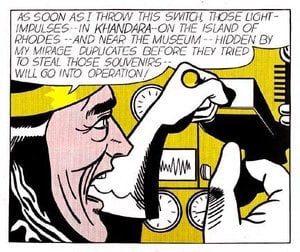
Mad scientist
複製画サイズ一覧
Edward Ruscha, a pivotal figure in the Pop Art movement, presents "Mad Scientist," a vibrant and intriguing work that encapsulates his signature style. Born in Omaha, Nebraska, Ruscha's artistic journey led him to Los Angeles where he honed his skills at the Chouinard Art Institute (now California Institute of the Arts). His exploration of American landscapes, typography, and vernacular language has cemented his place as an influential artist.
"Mad Scientist" depicts a man seemingly immersed in scientific experimentation. The central figure, clad in a lab coat, playfully sports a beaker atop his head – a whimsical touch that immediately establishes the painting's quirky and unconventional nature. He is surrounded by an array of scientific paraphernalia: microscopes, test tubes, hinting at a chaotic yet fascinating laboratory setting. Ruscha’s composition isn’t about meticulous realism; instead, it prioritizes visual impact and a sense of playful absurdity.
The painting firmly aligns with Pop Art principles. Ruscha employs bold colors—predominantly orange, blue, green, and yellow—to create a visually striking composition. The background features a colorful gradient that enhances the overall vibrancy and contributes to the piece's energetic atmosphere. Ruscha’s technique is characterized by its flatness and lack of traditional perspective, further emphasizing the Pop Art aesthetic which rejected academic artistic conventions in favor of imagery drawn from popular culture.
Emerging in the 1960s, Pop Art challenged the dominance of Abstract Expressionism. Artists like Ruscha sought to incorporate everyday objects and commercial imagery into their work, reflecting a shift towards consumerism and mass media. "Mad Scientist" can be interpreted as a commentary on the burgeoning scientific advancements of the era, perhaps with a touch of satirical humor regarding the perceived eccentricities often associated with scientists. The “mad” descriptor suggests a departure from conventional norms, embracing experimentation and unconventional thinking.
"Mad Scientist" evokes a sense of playful chaos and quirky fascination. The vibrant colors and unusual imagery create an engaging visual experience that is both humorous and thought-provoking. The painting’s appeal lies in its ability to blend the familiar (the lab coat, scientific equipment) with the unexpected (the beaker as a hat), resulting in a work that is instantly memorable and endlessly intriguing. It's a piece that sparks curiosity and invites viewers to embrace the unconventional.
「Mad scientist」は、デジタル画像ページにて直接ご購入いただける高解像度デジタル画像のダウンロードとしてご利用いただけます。
「Mad scientist」のスライドショーは、作品のスライドショーページでご覧いただけます。
「Mad scientist」は、Pop Artの作品です。この様式は、その作品が属する芸術的伝統を示しています。


1937 - , アメリカ合衆国

抽象表現主義を定義する10の傑作。ポロック、ロスコら巨匠たちの情熱と色彩の世界へ。各作品に込められた物語と技法を紐解き、至高のアート体験を。WahooArt.comで、ミュージアムクオリティの複製画や洗練されたインテリアアイデアを発見してください。
Master the high-impact world of contemporary abstraction. Discover how bold colors, textures, and modern movements like Abstract Expressionism can transform your space with premium, high-energy art curated for the design-conscious professional.

Journey through Wassily Kandinsky's 25 most iconic abstract paintings. Explore his revolutionary use of color, form & spiritual expressionism. Find museum-quality Kandinsky reproductions and elevate your home decor with WahooArt.com. Discover all masterpieces on WahooArt.com!

エドワード・ホッパーの傑作25選。アメリカ絵画を代表するモダンアート、孤独と光影の世界を紐解きます。名画「Nighthawks」や「ハウス・バイ・ザ・レールロード」など、美術史に残る作品群をWahooArtで高品質複製画としてお楽しみください。インテリアに深みを与えるアートプリントも多数。今すぐコレクションをご覧ください。

モンドリアン、マレーヴィチ…幾何学的抽象絵画を代表する傑作10選。各作品の背景や色彩構成、アーティストの情熱に迫ります。美術館品質の複製画はWahooArt.comで。オンラインでアートコレクションをご覧ください。

 設置イメージを確認
 送る
送る シェア
シェア
 詳細情報
詳細情報 ガイドを表示

 画像をダウンロード
 似ている作品
 X線調査
X線調査 スライドショー
 統計情報
統計情報
 続きを読む
続きを読む






































 ガラスオプションは、110cm未満のサイズでのみご利用いただけます。