
x


迅速な制作と多彩な仕上げオプションを備えた、ミュージアムクオリティのジークレーまたはキャンバスプリント。 ( 手描きの絵画を購入 画像を購入)
作品のオリジナル比率に合わせた、当店の規定サイズからお選びください。

特定のフレームやスペースに合わせて、ご自身でサイズを指定することも可能です。選択されたサイズが元の画像の比率と一致しない場合、作品をトリミングするか、鏡面反射または単色での塗りつぶしによって画像を拡張いたします。制作を開始する前に、ご確認用のデジタルモックアップをお送りいたします。
画面上のプレビューには、実際のトリミングや拡張は反映されませんのでご注意ください。最終的な構図を正確に確認できるのは、モックアップのみとなります。
カスタムサイズも承っておりますが、元の比率を維持するためには、あらかじめ用意されたリストからサイズを選択することをお勧めいたします。

Revolutions
複製画のサイズ
In the vibrant piece Revolutions, created in 2002 by the multifaceted Canadian artist Carole Taylor, the viewer is immediately swept into a whirlwind of color and texture. This work transcends the boundaries of traditional painting, presenting itself as an intricate tapestry or quilt that invites the eye to wander through a labyrinth of patterns. The composition is a masterful display of dynamic energy, where every shape and hue seems to pulse with its own internal rhythm. Taylor, whose background in journalism and television broadcasting has gifted her with a keen eye for narrative detail, utilizes the medium of fabric to create a surface that feels both tactile and alive. The interplay of various designs suggests a layered history, much like a collection of memories stitched together into a singular, cohesive vision.
The technique employed in Revolutions is one of profound complexity, blending the precision of pattern-making with the expressive freedom of painterly strokes. As the eye traverses the colorful landscape of the work, it encounters a rhythmic dance of shapes that evoke a sense of constant motion—a literal interpretation of the title. This movement is anchored by subtle, deeper layers of symbolism; tucked within the kaleidoscopic arrangement, two crosses emerge from the background. These elements introduce a spiritual or contemplative dimension to the piece, suggesting that beneath the surface-level excitement and the "revolutions" of color, there exists a foundation of faith, stability, or perhaps a reflection on the cyclical nature of life and belief. This juxtaposition of the exuberant and the sacred creates a tension that is both intellectually stimulating and visually arresting.
For the discerning collector or interior designer, Revolutions offers more than just aesthetic beauty; it provides a focal point of profound emotional resonance. The artwork possesses a rare ability to transform a space, injecting it with a sense of warmth, complexity, and intellectual depth. Its bold palette can serve as a courageous statement piece in a modern gallery setting, or it can act as a soulful, textured layer within a more traditional, curated room. To possess a reproduction of this work is to bring into one's home a fragment of Taylor’s unique perspective—a piece that celebrates the beauty of change, the intricacy of existence, and the enduring power of symbolic storytelling.

To encounter the work of Carole Taylor is to step into a world where the boundaries between observation and expression dissolve. Born Carol Goss in Toronto in 1945, her life has been a remarkable tapestry woven from threads of journalism, politics, and profound visual storytelling. Before she was recognized as a singular voice in the Canadian artistic landscape, Taylor commanded the screen as a captivating television host. Her early career, marked by her role as Miss Toronto 1964 and her presence on CFTO-TV’s After Four, instilled in her a meticulous eye for detail and an innate ability to engage with the human narrative. This journalistic foundation—honed through high-profile roles on programs like Toronto Today and as a pioneering female host for the investigative series W5—provided her with a unique lens through which to view the world, transforming her from a reporter of facts into a chronicler of emotions.
Her transition from the fast-paced world of international reporting—covering turbulent eras in Honduras, Chile, and Israel—to the contemplative realm of fine art represents a profound evolution of voice. The same curiosity that drove her to report from conflict zones now fuels her exploration of texture, color, and symbolism. Taylor’s artistic development is not a departure from her past but an expansion of it; she utilizes the precision of a researcher and the empathy of a storyteller to tackle weighty societal themes. Her work often eschews grand, sweeping narratives in favor of intimate, poignant portrayals that capture the very essence of the human experience, inviting viewers to look beneath the surface of contemporary life.
Taylor’s aesthetic is defined by a striking interplay of bold color palettes and intricate textures. In her celebrated works, such as Revolutions, she transcends the traditional limits of painting, creating pieces that feel more like tactile, living quilts or complex tapestries. This technique creates a sense of rhythmic motion, where every shape and hue seems to pulse with its own internal heartbeat. The viewer is often swept into a whirlwind of patterns that suggest a layered history, much like a collection of memories stitched together into a singular, cohesive vision. Her use of medium—often blending the precision of pattern-making with expressive, painterly strokes—creates a surface that feels both physically present and spiritually resonant.
Beyond the visual spectacle, Taylor embeds deep layers of symbolism within her compositions. Within the kaleidoscopic arrangements of her art, one might find subtle, grounding elements—such as the emergence of crosses from a vibrant background—that introduce a contemplative or spiritual dimension. This juxtaposition of the exuberant and the sacred creates a tension that is both intellectually stimulating and visually arresting. Her work serves as a bridge between the external world of social reality and the internal world of personal reflection, prompting a dialogue about the cyclical nature of life, faith, and stability.
The significance of Carole Taylor’s contribution to Canadian art lies in her unwavering dedication to social justice and her ability to translate complex political and social realities into visual language. This is perhaps most poignantly realized in her project The Little Black Book: Black Male Survival in America, a work driven by her journalistic research skills and her commitment to examining the challenges faced by marginalized communities. Through such works, she utilizes art as a tool for profound examination, much like the investigative journalism that defined her early career.
Her achievements extend far beyond the canvas, encompassing roles as a school chancellor and even as British Columbia's Minister of Finance. Yet, it is in the quiet, powerful moments of her artwork where her true legacy resides. She has mastered the art of making the invisible visible, using color to illuminate struggle and texture to give weight to memory. For the collector and the observer alike, Taylor’s body of work remains a vital, breathing testament to the power of observation, proving that the most profound truths are often found in the intricate patterns of our shared existence.

1945 - , Canada

Embark on a sophisticated journey through the tactile realm of textile art. Unveil the historical evolution from utilitarian craft to museum-grade masterpieces, exploring the intricate textures and legendary artists that redefine the boundaries of fine art.
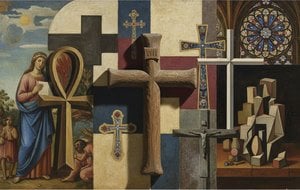
Delve into the profound symbolism of cross imagery in fine art history. From Renaissance masterpieces to sacred iconography, explore how religious motifs shape Western art through our expert cultural analysis and curated collection of museum-quality reproductions.

Explore the profound influence of geometry and line in fine art. Discover how structural composition creates visual impact, from Cubist mastery to Op Art precision, and learn to curate sophisticated, mathematically balanced collections for discerning art connoisseurs.
Discover the profound impact of composition on fine art. Explore how masters use geometry, light, and structural harmony to breathe life into masterpieces—an essential guide for discerning collectors seeking depth in every brushstroke.


最新の美術ニュース、限定オファー、そしてインテリアのアイデアをいち早くお届けします。
お客様のプロジェクトについてお聞かせください。当社の美術専門家が、お客様に合わせた3つのパーソナライズされた芸術提案をご提供いたします。
あなたにぴったりの3作品を無料で厳選いたします


 シェアする
シェアする シェアする
シェアする
 詳細を見る
詳細を見る

 ダウンロード
 似ている作品
 スライドショー


 詳細を見る
詳細を見る






































 ガラスオプションは、110cm未満のサイズでのみご利用いただけます。


