オンラインプレビューをはるかに凌ぐ、高解像度で鮮明なデジタル画像をご購入いただけます。
各ファイルは、社内の専門家が高度なツールと熟練した手作業によるレタッチを用いて、細心の注意を払って準備されています。すべての画像において、卓越した鮮明度、正確な色彩再現性、そして繊細なディテールを保証いたします。
最終ファイルは、プロフェッショナルな編集・印刷環境ですぐにご利用いただけるよう最適化された状態で、72時間以内にメールにてお届けいたします。これは、一流のデザインスタジオ、出版社、ギャラリーから信頼されているものと同等の品質です。
WahooArt.com を選ぶことは、単に画像を手に入れることではありません。それは、プロの手によって精密に仕上げられ、満足保証が付いた高品質なデジタルアートワークを受け取ることを意味します。ご注文いただいた際に自動的に付随する内容は、以下の通りです:

ご注文から72時間以内に、高解像度のデジタル画像ファイルがメールでお手元に届きます。すぐにそのままご利用いただけます。

お客様の作品は、高度なAIツールと専門家による手作業の編集を組み合わせてプロフェッショナルに最適化されており、細部のディテール、鮮明さ、そして正確な色再現性を最大限に引き出しています。

ファイルを誤って削除したり、紛失してしまったりしましたか?ご安心ください。いつでも無料で再送いたします。

関税や手数料、配送料を気にすることなく、お気に入りのアートワークをすぐにお楽しみいただけます。デジタルダウンロードは常に免税です。

プロ仕様のツールとカラーマネジメント技術を用いることで、デジタル画像が元の色を最大限に忠実に再現することを保証いたします。

ご購入いただいたデジタル画像にご満足いただけない場合は、100日以内であれば、理由を問わず修正または100%の返金対応をさせていただきます。

ご満足いただけない場合は、デジタルファイルを受け取ってから100日以内であれば、理由を問わず全額返金いたします。

3枚購入で10%OFF - 5枚購入で15%OFF - 10枚以上購入で20%OFF。クリエイティブなプロジェクト、ギャラリー、エージェンシーに最適です。

In the vibrant, shifting landscape of the late Italian Renaissance, few artists captured the tension between classical order and Mannerist artifice as delicately as Carlo Urbino. Born in the Lombard town of Crema around 1525, Urbino emerged from a period of profound intellectual ferment, where the rigid structures of the High Renaissance were beginning to dissolve into the more expressive, elongated, and dramatic forms of Mannerism. His journey was one of both artistic refinement and scientific inquiry, a path that saw him move through the influential circles of Venice and Milan, leaving behind a trail of frescoes and drawings that bridge the gap between the grace of the 16 th century and the burgeoning energy of the Baroque.
Urbino’s early development was deeply rooted in the aesthetic currents of the Veneto. Training amidst the luminous traditions of Venice, he absorbed a mastery of light and color that would later define his approach to composition. However, it was his connection to the Campi family—specifically the masters Antonio, Bernardino, and Giulio Cambi—that provided the stylistic scaffolding for his career. This lineage instilled in him a penchant for complex, often crowded arrangements and a fascination with the human form in motion. His work does not merely depict a scene; it orchestrates a visual drama, utilizing sfumato and dynamic gestures to guide the viewer’s eye through intricate religious narratives.
What truly distinguishes Carlo Urbino from his contemporaries was his profound intellectual curiosity, which extended far beyond the boundaries of the canvas. He was a true Renaissance man, possessing a mind that sought to find the underlying geometry in all things. This passion for structure led to a remarkable collaboration with the mathematician and engineer Camillo Agrippa. Together, they worked on the Codex Huygens, a monumental endeavor that explored the intersection of art, proportion, and the science of armaments. Through this work, Urbino demonstrated that his interest in perspective was not merely a tool for illusion, but a way to understand the very mechanics of the physical world.
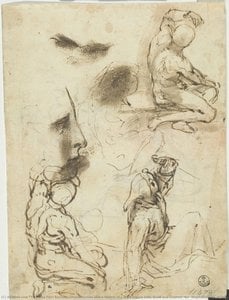
This scientific rigor is often visible in his preparatory drawings and sketches. Whether working with ink, sanguine, or pen, Urbino possessed an ability to distill complex anatomical truths into elegant lines. His studies for religious compositions were not merely blueprints but explorations of weight, balance, and tension. This duality—the ability to be both a dreamer of divine visions and a student of mathematical precision—allowed him to create works that felt both spiritually transcendent and physically grounded.
As his reputation grew, Urbino’s career found its most significant momentum in Milan, where he secured prestigious commissions from the era's most influential patrons. His work for Vespasiano Gonzaga and Alessandro Sforza placed him at the heart of Lombard political and religious life. In the sacred spaces of Milan, such as the Church of Santa Maria della Passione, his frescoes breathed life into the walls, showcasing a command of perspective that could transform a flat surface into an expansive, heavenly realm. His contributions to the St. Joseph’s Chapel remain a testament to his ability to handle large-scale religious iconography with both solemnity and grace.
The breadth of his artistic output can be seen in several key areas of his career:
By the time of his death in 1585, Carlo Urbino had helped establish a stylistic bridge that would support the weight of the coming Baroque era. He left behind an oeuvre that serves as a vital link in the history of Italian art—a legacy defined by the seamless integration of the eye's beauty and the mind's logic. His ability to navigate the transition from the balanced ideals of the Renaissance to the emotive complexity of Mannerism ensures his place as a pivotal figure in the evolution of European painting.

1525 - 1585 , Italy


 プレビュー
プレビュー
 プリントを購入
 シェアする
シェアする シェアする
シェアする
 詳細を見る
詳細を見る

 ダウンロード
 似ている作品
 X線調査
X線調査 スライドショー
 詳細を見る
詳細を見る