
当社のアーティストが、お客様のご希望のサイズと額縁に合わせて、キャンバスに手描きで制作する油彩画です。 ( プリント版に切り替え デジタル画像販売へ切り替え)





























作品のオリジナル比率に合わせた、当店の規定サイズからお選びください。

特定のフレームやスペースに合わせて、ご希望のサイズをご入力いただけます。選択されたサイズが元の画像の比率と異なる場合、アートワークをトリミングするか、手描きで要素を追加して絵画を拡張いたします。デジタルモックアップ を制作し、制作開始前にご確認(承認)をいただきます。
画面上のプレビューは、実際のトリミングや拡張を正確に反映しているものではありません。最終的な構図は、モックアップによってのみ正確にご確認いただけます。
カスタムサイズもご利用いただけますが、元の比率を維持するためには、あらかじめ用意されたリストからサイズを選択することをお勧めいたします。

Madonna in Glory
複製画のサイズ
Carlo Dolci's "Madonna in Glory," painted around 1670, is not merely a depiction of the Virgin Mary; it’s an immersion into the heart of Florentine Baroque piety. This intimate portrait, likely intended for private devotion, reveals a masterclass in restrained emotion and meticulous technique – qualities that cemented Dolci's reputation as one of Florence’s most revered artists during his era. The painting immediately draws the viewer in with its dark, atmospheric background, punctuated by the subtle shimmer of stars, creating an immediate sense of solemnity and spiritual contemplation. The composition centers on Mary’s face and upper body, framed within a vertical format that emphasizes her dignified presence and directs our gaze upwards towards the halo encircling her head – a potent symbol of divine grace and holiness.
Dolci's style is distinctly Baroque, yet profoundly rooted in Florentine tradition. Unlike the grand, theatrical displays favored by artists in Rome, Dolci eschewed sweeping narratives for quiet intensity. His focus remained firmly on conveying spiritual depth through carefully rendered details and a restrained palette. The use of line is particularly noteworthy; precise lines define Mary’s face, her flowing robes, and even the folds of drapery, lending an incredible sense of volume and realism to the image. Shapes are predominantly organic – the curves of the clothing mimic natural forms, while subtle modeling creates a believable illusion of three-dimensionality.
The color palette is dominated by deep blues and purples, evocative of twilight or the mysteries of faith. These somber hues are masterfully contrasted with highlights of gold and pink within the halo and in Mary’s skin tones, creating a luminous effect that draws attention to her as the focal point. Dolci's technique relies heavily on layering translucent glazes – a hallmark of Baroque painting – to build up color and luminosity gradually. This painstaking process results in surfaces that possess an almost velvety quality, rich with subtle variations in tone and texture. The use of atmospheric perspective further enhances the sense of depth, fading the background into darkness while maintaining clarity for the central figure.
Beyond its technical brilliance, “Madonna in Glory” is laden with symbolic meaning. The halo itself represents Mary’s status as the Mother of God and a conduit to divine grace. Her gaze, directed upwards, suggests contemplation, prayer, or perhaps an acknowledgement of God's presence. The overall mood of the painting speaks volumes about Dolci’s deeply held faith – a devotion that permeated his artistic practice. It’s believed he painted a half-figure of the Savior wearing the Crown of Thorns every year during Passion Week, demonstrating a profound engagement with religious themes and a desire to evoke a similar sense of reverence in his viewers.
Carlo Dolci’s work represents a significant contribution to Florentine Baroque art. His dedication to detail, combined with his ability to convey profound spiritual emotion, earned him considerable acclaim during his lifetime. He wasn’t driven by the ambition of large-scale projects; instead, he focused on intimate portrayals of religious subjects, often repeating compositions in multiple versions – a practice that allowed him to refine his technique and explore subtle variations in expression. His daughter, Agnese Dolci, was also a talented painter who frequently copied her father’s works, ensuring the continuation of his artistic legacy. Today, “Madonna in Glory” stands as a testament to Dolci's skill and devotion, offering viewers a glimpse into the serene piety that defined one of Florence’s most enduring artistic figures.
Discover “Madonna in Glory” by Carlo Dolci on WahooArt.com and explore a meticulously crafted hand-painted reproduction of this Baroque masterpiece.


1616 - 1686 , イタリア

Embark on a profound journey through art history with our exploration of the most iconic depictions of the Virgin Mary. Discover the divine grace, symbolism, and masterful techniques found in Renaissance masterpieces and sacred iconography.

Explore the profound beauty of Marian iconography through an art historian's lens. Discover iconic masterpieces by Raphael and Renaissance masters, celebrating the divine grace and timeless elegance of the Virgin Mary in classical fine art.
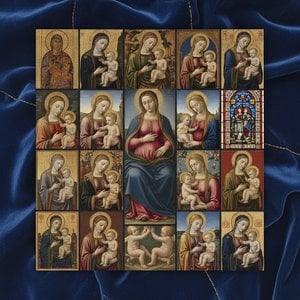
Embark on a sophisticated journey through art history with our curated guide to the most iconic Madonna and Child masterpieces. Discover the profound beauty, theological depth, and enduring legacy of these sacred Renaissance treasures.


 プレビュー
プレビュー
 シェアする
シェアする シェアする
シェアする
 詳細を見る
詳細を見る

 ダウンロード
 似ている作品
 X線調査
X線調査 スライドショー
 統計情報
統計情報


 詳細を見る
詳細を見る









 ガラスオプションは、110cm未満のサイズでのみご利用いただけます。


