

 PaintingWallArtContemporary Art
 2006Contemporary
 40.0 x 50.0 cm
 Penrith Regional Gallery - Home of the Lewers Bequest
このページに掲載されている作品は著作権法によって保護されており、当社の許可なく同一の複製物を制作または販売することは法律で禁じられています。この保護は、以下のような国際条約に基づき執行されます。 ベルヌ条約 および、以下の条項に定められたものを含む各国の法律により、 米国著作権法 第17編。
この手法は、著作権で保護された作品の複製や複写を伴わないため、著作権法に完全に準拠しています。これは単なる模倣ではなく、創造的な再解釈です。元の作品からインスピレーションを受けつつも、それとは異なる、全く新しい絵画を生み出すものです。
スピーディーな制作と多彩な仕上げオプションが魅力の、ミュージアムクオリティなジークレー・キャンバスプリント。 ( 手描きの複製画を注文する デジタル画像販売へ切り替え)





























作品のオリジナル比率に合わせた、当店の規定サイズからお選びください。

額縁や壁のスペースに合わせて、ご希望の幅と高さを入力してください。プリントはカットすることは可能ですが、元の画像より大きくすることはできないため、異なる比率のサイズを選択された場合は、画像の一部が欠けることになります。印刷を開始する前に、内容を確認していただくためのデジタルモックアップをお送りいたします。このページに表示されている画像は、実際のカット後の状態を示すものではありません。実際の仕上がりはモックアップにてご確認ください。
Australian Flag
複製画サイズ一覧
In the evocative work Australian Flag, the contemporary Wiradjuri artist Brook Andrew invites us into a profound meditation on national identity and the layered histories that define a continent. At first glance, the painting presents a familiar icon: the blue field of the Australian flag, punctuated by the Union Jack in the canton and the celestial brilliance of the Southern Cross. Yet, through Andrew’s masterful hand, this is not merely a reproduction of a state symbol; it is an interrogation of the very fabric of Australian existence. The composition breathes with a tension that exists between the established colonial emblem and the enduring presence of Indigenous narratives, creating a visual dialogue that is as much about what is seen as what is felt beneath the surface.
The technique employed in this piece captures a sense of both permanence and flux. The deep, resonant blue background serves as an expansive sky, providing a somber yet majestic stage for the stars to emerge. Each of the thirteen stars, representing the states and territories, is rendered with a clarity that commands attention, yet there is an unmistakable atmospheric quality to the brushwork that suggests the ephemeral nature of memory. For the discerning collector or interior designer, this painting offers a sophisticated focal point—a piece that possesses the gravity of historical commentary while maintaining a striking, clean aesthetic that complements both modern minimalist and classically inspired spaces.
To understand Australian Flag, one must look through the lens of Andrew’s broader practice, which often explores what he terms the “Colonial Wuba (hole)”—the messy, intertwined, and often fractured intersections of Western and Indigenous histories. The painting functions as a site of collision. By utilizing the most recognizable symbol of Australian sovereignty, Andrew forces a confrontation with the legacies of colonization and the complexities of modernism. The presence of the Union Jack is not merely a nod to heritage but a reminder of the structural power dynamics that have shaped the Australian landscape, while the Southern Cross remains an eternal witness to the land's original inhabitants.
This work resonates deeply with those who appreciate art as a tool for social reflection. It does not shy away from the weight of history; instead, it uses the familiar language of iconography to explore themes of historical amnesia and the reclamation of lost voices. The emotional impact is one of quiet intensity—a contemplative stillness that invites the viewer to look closer at the stars and consider the stories they hold. For an art lover, owning a reproduction of such a piece means possessing a fragment of a much larger, ongoing conversation about belonging, resistance, and the beautiful, turbulent process of nation-building.
Beyond its profound conceptual depth, Australian Flag is a triumph of color and composition. The balance between the dark, nocturnal blues and the bright, piercing whites of the stars creates a high-contrast visual rhythm that can transform the energy of a room. It serves as an intellectual anchor in a curated collection, offering a subject matter that is both globally recognizable and deeply personal to the Australian context.
Whether placed in a professional gallery setting, a corporate office seeking a piece of cultural significance, or a private residence designed for thoughtful reflection, this artwork stands as a testament to the power of contemporary art to reframe our understanding of the world. It is an invitation to look upward at the Southern Cross and inward at our shared, complicated history, making it an indispensable acquisition for those who seek art that is both visually stunning and intellectually transformative.
「Australian Flag」の原画はPenrith Regional Gallery - Home of the Lewers Bequestに所蔵されており、本作品は著作権により保護されていますです。
Brook Andrewの画業において、「Australian Flag」はMature Periodに制作されたものです。この時期を知ることで、同アーティストの他の作品との比較検討が可能になります。
「Australian Flag」はBrook Andrewによって制作されました。このページでは、Brook Andrewのオリジナル作品についてご紹介しています。

Born in the vibrant landscape of Sydney, Australia, in 1970, Brook Andrew has emerged as a profound and commanding presence in the global contemporary art scene. His work does not merely exist within a gallery space; it interrogates the very foundations of how we perceive history, identity, and the enduring legacies of colonialism. As an artist who masterfully navigates the intersection of Western historical narratives and Indigenous perspectives, Andrew creates a dialogue that is as much about reclaiming lost voices as it is about challenging the established canon. His artistic journey, which gained significant international momentum following his emergence in 1996, is defined by a relentless pursuit of truth through the deconstruction of visual archives.
The foundations of Andrew’s practice were laid during his formative academic years at the University of Western Sydney and the University of Denmark, later continuing his rigorous intellectual development at the University of Melbourne. These periods of study provided him with more than just technical proficiency; they instilled a conceptual depth that allows him to treat art as a site of archaeological inquiry. His ability to sift through the debris of history was further bolstered by prestigious recognitions, such as the Smithsonian Artist Research Fellowship in 2017. This opportunity allowed him to delve into vast archival resources, providing the raw material for his explorations into how much of our "official" history is constructed, and how much has been intentionally erased.
What distinguishes Brook Andrew from many of his contemporaries is his refusal to be tethered to a single medium. His practice is a fluid, interdisciplinary tapestry where video projection, sculptural forms, photography, and large-scale installations coalesce into singular, immersive environments. To walk through an Andrew installation is to enter a living archive. He utilizes the physical presence of sculpture to ground his work, while the ephemeral nature of video and light allows him to haunt the viewer with spectral histories. This multifaceted approach ensures that his art is not a passive object of observation but an active, sensory experience that demands critical reflection.
In works such as ‘Chandelier Friendly Fire’ from his evocative ‘Hope & Peace’ series, one can witness the breathtaking tension he creates between beauty and brutality. By utilizing objects that carry cultural weight—ranging from colonial artifacts to contemporary pop culture symbols—he forces a confrontation between the viewer and the complexities of social justice. His technique involves a sophisticated layering of textures and media, creating a sense of depth that mirrors the layered, often contradictory, nature of historical memory itself.
The historical significance of Brook Andrew lies in his ability to transform the gallery into a space of reclamation. His work serves as a vital bridge, connecting the traumatic legacies of the past with the urgent social justice movements of the present. By centering Indigenous perspectives within the framework of contemporary art, he disrupts the monolithic Western gaze and invites a more pluralistic understanding of Australian and global identity.
Throughout his career, Andrew has achieved remarkable milestones that cement his status as a pivotal figure in modern art, including:
Ultimately, Brook Andrew’s art is a testament to the power of visual storytelling to reshape our understanding of the world. He remains a vital, living force in the art community, continuing to push the boundaries of how we confront, remember, and ultimately reimagine the narratives that define us.

1970 - , Australia

Elevate your design projects with WahooArt's professional art customization. From background changes to bespoke oil reproductions, we provide freelance decorators with premium, hand-painted masterpieces tailored to any interior vision. Transform spaces with timeless, custom-tailored art.

Discover WahooArt's bespoke services for elite collectors. Masterfully execute custom sizing and background extensions to ensure every hand-painted oil reproduction fits your architectural space with absolute precision and compositional perfection.
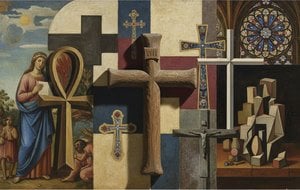
Delve into the profound symbolism of cross imagery in fine art history. From Renaissance masterpieces to sacred iconography, explore how religious motifs shape Western art through our expert cultural analysis and curated collection of museum-quality reproductions.

 設置イメージを確認
 送る
送る シェア
シェア
 詳細情報
詳細情報 ガイドを表示

 画像をダウンロード
 似ている作品
 X線調査
X線調査 スライドショー
 統計情報
統計情報 続きを読む
続きを読む









 ガラスオプションは、110cm未満のサイズでのみご利用いただけます。


