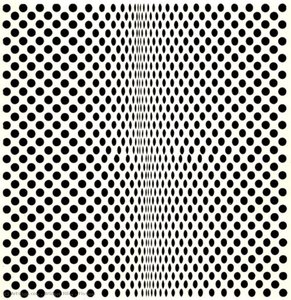
Bridget Riley: Exploring Perception Through Geometric Abstraction
Bridget Riley’s “Fade,” created in 1972, stands as a quintessential example of Op Art—a movement that revolutionized visual perception during the mid-century period. Born in Norwood, London, in 1931, Riley embarked on her artistic journey influenced by formative experiences observing the Cornish coast and captivated by the pioneering work of Victor Vasarely and Jackson Pollock. Her fascination with Seurat’s meticulous pointillist technique proved pivotal, shaping her distinctive approach to translating visual sensations onto canvas.
- Style: Geometric Abstraction – Riley eschewed representational imagery entirely, opting for a purely abstract composition centered around vertical stripes of varying widths and hues.
- Technique: Acrylic on Canvas – The artwork utilizes acrylic paint applied to stretched canvas, resulting in smooth surfaces that simulate the appearance of painted stripes. This technique emphasizes precision and control, mirroring Riley’s meticulous attention to detail.
- Historical Context: Emerging from the postwar era, Op Art challenged conventional notions of visual experience by exploiting optical illusions—creating a disconcerting yet stimulating effect on the viewer's eye. It reflected a broader cultural interest in exploring psychological phenomena related to perception and color.
Symbolism & Emotional Impact: The seemingly simple arrangement of stripes evokes feelings of order, balance, and subtle movement – mirroring Riley’s exploration of dynamism within static forms. “Fade” isn't merely a visual pattern; it invites contemplation on how our eyes perceive color and form simultaneously, prompting viewers to question their assumptions about reality. Its pastel palette contributes to its calming aesthetic while maintaining an energetic core.
The Influence of Georges Seurat: Pointillism’s Legacy
Riley's artistic development was profoundly impacted by the work of Georges Seurat—a French Impressionist who championed pointillism as a method for capturing light and color. Riley herself acknowledged Seurat’s influence, recognizing his innovative technique as crucial to her exploration of visual perception. Like Seurat, Riley meticulously applied tiny dots of pigment onto canvas, creating an illusion of depth and vibrancy without blending colors—a deliberate departure from traditional painting methods. This stylistic choice underscores Riley's commitment to pushing the boundaries of artistic expression and engaging viewers in a dialogue about how we perceive the world around us.
Collecting “Fade”: Reproductions & Artistic Appreciation
High-quality reproductions of Bridget Riley’s “Fade” offer an accessible pathway to experiencing the captivating beauty and intellectual depth of Op Art firsthand. When selecting a print, consider factors such as archival quality—ensuring that the artwork retains its vibrancy over time—and framing options—complementing the piece's aesthetic with thoughtful design choices. Beyond mere decoration, owning a reproduction of “Fade” serves as a celebration of Riley’s pioneering vision and her enduring contribution to modern art history.



 プレビュー
プレビュー
 手描きの絵画を購入
 シェアする
シェアする シェアする
シェアする
 詳細を見る
詳細を見る

 ダウンロード
 似ている作品
 X線調査
X線調査 スライドショー

 詳細を見る
詳細を見る






































 ガラスオプションは、110cm未満のサイズでのみご利用いただけます。