
 Dutch Golden Age
 64.0 x 76.0 cm
当社のアーティストが、お客様のご希望のサイズと額縁に合わせて、キャンバスに手描きで制作する油彩画です。 ( プリント版に切り替え デジタル画像販売へ切り替え)





























作品のオリジナル比率に合わせた、当店の規定サイズからお選びください。

特定のフレームやスペースに合わせて、ご希望のサイズをご入力いただけます。選択されたサイズが元の画像の比率と異なる場合、アートワークをトリミングするか、手描きで要素を追加して絵画を拡張いたします。デジタルモックアップ を制作し、制作開始前にご確認(承認)をいただきます。
画面上のプレビューは、実際のトリミングや拡張を正確に反映しているものではありません。最終的な構図は、モックアップによってのみ正確にご確認いただけます。
カスタムサイズもご利用いただけますが、元の比率を維持するためには、あらかじめ用意されたリストからサイズを選択することをお勧めいたします。

Still-Life
複製画のサイズ

In the golden light of the seventeenth-century Netherlands, a period defined by maritime prosperity and an unprecedented flourishing of culture, there emerged a painter whose work captured the very essence of domestic tranquility. Barent Vermeer (1659–1702), often whispered in the same breath as the legendary Johannes Vermeer, remains one of the most enigmatic figures of the Dutch Golden Age. Born in Haarlem around 1659, his life was characterized by a remarkable lack of drama; he lived the steady, unassuming life of a husband and father navigating the daily rhythms of Delft. Yet, beneath this veneer of ordinary existence lay an extraordinary artistic vision that transformed the mundane into the monumental.
Vermeer’s artistic evolution began under the watchful eye of his father, Jan Vermeer van Haarlem the Elder, a landscape painter who provided him with a rigorous foundation in perspective and the subtle gradations of tone. However, the young artist was not content to merely replicate the horizons of his father's work. He possessed a revolutionary instinct for capturing the ephemeral—the way light dances across a surface or how atmosphere settles within a room. By the time he joined the Haarlem Guild of St. Luke in 1681, he had established himself as a professional force, capable of translating the textures of reality into luminous oil paintings that breathed with life.
The true brilliance of Barent Vermeer lies in his unparalleled sensitivity to detail. While many of his contemporaries sought grandeur through mythological or religious narratives, Vermeer found divinity in the small, the tactile, and the everyday. His compositions are masterclasses in chiaroscuro and atmospheric depth, heavily influenced by the dramatic lighting effects of Willem Kalf. He absorbed elements of maritime painting to infuse his still lifes with a sense of weight and presence, making every object feel as though it occupied a tangible space within the viewer's own world.
To gaze upon a Vermeer still life is to experience a profound intimacy. His brushwork meticulously rendered:
This dedication to realism allowed him to elevate simple subjects—a bowl of fruit, a musical instrument, or a domestic arrangement—into profound meditations on existence. His work does not merely show us objects; it invites us to feel the temperature of the room and the stillness of the moment.
Though his life ended prematurely around 1702, Vermeer’s contribution to the Dutch canon remains indelible. He was a vital part of a movement that turned the collective eye of the Netherlands inward, celebrating the prosperity and quiet dignity of the burgeoning middle class. His ability to marry the technical precision of the Haarlem tradition with the atmospheric soul of Delft created a legacy that continues to captivate modern audiences.
Today, his works serve as a window into a vanished era of peace and meticulous craftsmanship. Through his eyes, we see the 17th century not as a distant historical period, but as a living, breathing world of light and shadow, where even the simplest object holds the potential for eternal beauty. His influence persists in the way we perceive the interplay between reality and art, reminding us that there is profound magic to be found in the quietest corners of our lives.

1659 - 1702 , Netherlands

Embark on a sophisticated journey through the Dutch Golden Age. Unveil the dramatic brilliance of Rembrandt’s chiaroscuro and the expressive landscapes of 17th-century masters in this authoritative exploration of light, shadow, and enduring artistic legacy.
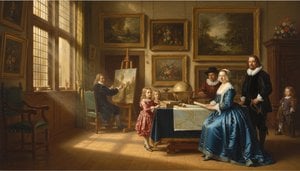
Embark on a journey through the Dutch Golden Age. Discover how masters like Rembrandt and Vermeer used chiaroscuro to manipulate light and shadow, creating timeless depth and spiritual resonance in art history's most captivating masterpieces.


 プレビュー
プレビュー
 シェアする
シェアする シェアする
シェアする
 詳細を見る
詳細を見る

 ダウンロード
 似ている作品
 X線調査
X線調査 スライドショー
 統計情報
統計情報 詳細を見る
詳細を見る









 ガラスオプションは、110cm未満のサイズでのみご利用いただけます。


