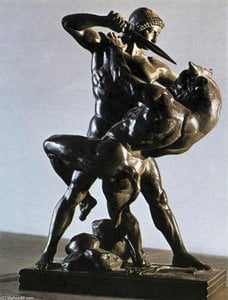
Sculpture BronzeSculptureRomanticism
 185419th Century
 100.0 x 81.0 cm
 オルセー美術館
迅速な制作と多彩な仕上げオプションを備えた、ミュージアムクオリティのジークレーまたはキャンバスプリント。 ( 手描きの絵画を購入 デジタル画像販売へ切り替え)
作品のオリジナル比率に合わせた、当店の規定サイズからお選びください。

特定のフレームやスペースに合わせて、ご自身でサイズを指定することも可能です。選択されたサイズが元の画像の比率と一致しない場合、作品をトリミングするか、鏡面反射または単色での塗りつぶしによって画像を拡張いたします。制作を開始する前に、ご確認用のデジタルモックアップをお送りいたします。
画面上のプレビューには、実際のトリミングや拡張は反映されませんのでご注意ください。最終的な構図を正確に確認できるのは、モックアップのみとなります。
カスタムサイズも承っておりますが、元の比率を維持するためには、あらかじめ用意されたリストからサイズを選択することをお勧めいたします。

Strength
複製画のサイズ
In the grand tapestry of nineteenth-century sculpture, few threads shine with as much raw, emotive power as the works of Antoine-Louis Barye. While he is celebrated globally as the pioneer of the animalier genre—a master who breathed life into the ferocity of lions and the grace of predators—it is in his masterpiece, "Strength," that we encounter the profound depth of his humanistic vision. Created in 1854, this breathtaking sculpture transcends the boundaries of mere anatomical study to touch upon the very essence of the human condition. It is a work that does not merely sit upon a pedestal but commands the space around it, inviting the viewer into a silent dialogue between vulnerability and fortitude.
The composition of "Strength" is a masterclass in the Romantic tradition, capturing a moment of profound intimacy through a striking physical contrast. At its heart, the sculpture depicts a man of immense physical presence, his musculature rendered with such breathtaking accuracy that one can almost sense the tension and vitality within the bronze. Yet, this display of raw power is not directed toward conquest or aggression; instead, it is channeled into the tender act of cradling a child. This juxtaposition—the rugged, powerful form of the man against the delicate, fragile weight of the infant—creates a poignant tension that defines the piece. It is a visual poem about the protective nature of true strength, suggesting that the greatest use of power lies in the preservation of life and the nurturing of innocence.
To behold a high-quality reproduction of "Strength" is to appreciate the meticulous technical heritage of Barye’s craft. Having begun his journey as an apprentice goldsmith, Barye brought an unparalleled precision to the medium of bronze. He utilized the lost-wax casting technique, a method that allowed him to achieve an extraordinary level of surface smoothness and tonal richness. In this piece, every sinew of the male figure and every soft contour of the child is captured with a fidelity that honors the artist's obsession with anatomical truth. For the discerning collector or interior designer, such a piece offers more than just decoration; it provides a tactile sense of history and a sophisticated focal point that anchors a room with its classical weight.
The historical context of 1854 adds another layer of resonance to the work. Emerging from an era where the rigid formalities of Neoclassicism were giving way to the passionate, turbulent energy of Romanticism, Barye’s "Strength" embodies this transition perfectly. It retains the disciplined anatomical structure learned from his mentors at the École des Beaux-Arts, yet it is infused with a new, expressive movement and emotional depth. The sculpture does not just represent a man and a child; it represents an ideal—the heroic capacity for tenderness amidst a world of struggle. This enduring symbolism makes the work an evergreen choice for those seeking to infuse their living spaces with themes of resilience, legacy, and the timeless bond of care.
For the art lover or the curator of fine interiors, "Strength" serves as a profound statement piece. Its presence in a gallery or a private study evokes a sense of permanence and intellectual depth. The dark, lustrous patina characteristic of Barye’s bronze work complements a wide array of sophisticated decor, from the heavy, traditional aesthetics of a classic library to the minimalist, clean lines of a contemporary loft. By integrating a reproduction of such a significant historical work, one brings into the home not just an object of beauty, but a piece of the nineteenth-century's most vital artistic revolution.
Ultimately, the impact of "Strength" lies in its ability to move the spectator. It is a work that rewards prolonged contemplation, revealing new nuances of light and shadow with every glance. Whether one is drawn to the technical brilliance of the musculature or the heart-wrenching tenderness of the subject matter, Barye’s creation remains an unparalleled testament to the idea that true strength is found in the capacity to protect, to hold, and to love.


1796 - 1875 , フランス

Discover the enduring elegance of bronze sculpture. From ancient Roman strength to Art Deco sophistication, explore our expert guide on collecting, casting techniques, and integrating timeless metal masterpieces into your fine art collection.

Discover the enduring allure of bronze sculpture. From the intricate lost-wax process to Neoclassical masterpieces, our expert guide offers connoisseurs deep insights into evaluating patina, historical significance, and integrating metal fine art into sophisticated collections.

Discover the enduring allure of bronze sculptures at WahooArt.com. From classical lost-wax casting to modern metal masterpieces, explore museum-quality artworks designed to elevate luxury interiors. Expert curation, authenticity guaranteed, and worldwide shipping for discerning collectors.


 シェアする
シェアする シェアする
シェアする
 詳細を見る
詳細を見る

 ダウンロード
 似ている作品
 スライドショー
 統計情報
統計情報 詳細を見る
詳細を見る






































 ガラスオプションは、110cm未満のサイズでのみご利用いただけます。