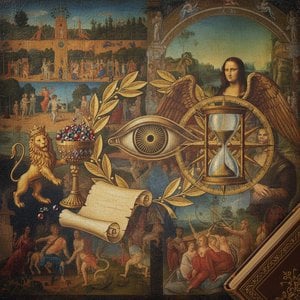
Alphonse Mucha: The Enchanting Architect of Art Nouveau
Alphonse Maria Mucha (1860 – 1939), born in Brno, Czech Republic, stands as a monumental figure within the Art Nouveau movement—a stylistic revolution that swept across Europe between 1890 and 1910. More than just an artist; Mucha was a visionary craftsman who meticulously constructed elaborate decorative panels and posters, transforming surfaces into canvases of flowing lines and luminous color palettes.
His formative years were marked by academic training at the Academy of Fine Arts in Prague, where he initially embraced traditional painting techniques. However, disillusioned with the rigidity of artistic conventions, Mucha swiftly abandoned these pursuits for a path of independent experimentation—a decision that would ultimately propel him to international acclaim.
Paris beckoned in 1887, offering Mucha the fertile ground for cultivating his distinctive Art Nouveau aesthetic. Influenced by Impressionism and Symbolism, he honed his skills under masters like Gustave Moreau and Pierre-Auguste Renoir, absorbing their innovative approaches to color and composition.
Mucha’s signature style is instantly recognizable: undulating curves dominate every element of his artwork—from the graceful draperies of female figures to the spiraling stems of floral arrangements. These lines aren't merely decorative; they embody a profound sense of movement, mirroring the dynamism inherent in nature and conveying an irresistible allure.
- Technique: Mucha excelled at etching and lithography—processes that allowed him to reproduce his designs with remarkable precision and vibrancy. He skillfully utilized halftone printing to achieve subtle gradations of color, creating textures that captivated viewers’ senses.
- Color Palette: Mucha favored pastel hues—particularly shades of pink, lilac, and peach—which he applied with meticulous care. These colors emanated a dreamy luminescence, enhancing the ethereal quality of his compositions.
- Symbolism: Recurring motifs in Mucha’s oeuvre carried profound symbolic significance. Flowers represented fertility and rebirth; birds symbolized aspiration and freedom; and stars embodied divine grace—elements meticulously interwoven into his artworks to communicate complex ideas.
Consider “The Slavonic Uprising,” Mucha's magnum opus, a monumental decorative panel commissioned for the Slavonic Exhibition in Prague. It brilliantly blends Czech nationalistic iconography with Art Nouveau’s stylistic elegance. The depiction of Slavic women—clad in flowing robes and adorned with floral garlands—represents resilience and beauty amidst turbulent times.
Mucha's influence extends far beyond the realm of decorative arts; his posters revolutionized advertising, captivating audiences with their mesmerizing visuals and poetic narratives. His work continues to inspire designers and artists today, demonstrating the enduring power of Art Nouveau’s visionary spirit—a testament to Mucha’s unparalleled mastery as “the enchanting architect of Art Nouveau.”
よくあるご質問
アルフォンス・ミュシャ作「Zodiac」の輝度はどのくらいですか?
アルフォンス・ミュシャ作「Zodiac」 の記録された輝度は Bright Balance です。
「Zodiac」を手がけたアーティストは誰ですか?
「Zodiac」はアルフォンス・ミュシャの作品とされています。
「Zodiac」は、アルフォンス・ミュシャが繰り返し描いてきた主題の中でどのような位置を占めているのでしょうか?
アルフォンス・ミュシャの作品に繰り返し現れるテーマにはrenoir, moreau, symbolism, czech identity, decorative artが含まれますが、「Zodiac」ではwoman, crown, clock, birds, stars, floral patterns, flowing linesに焦点を当てています。