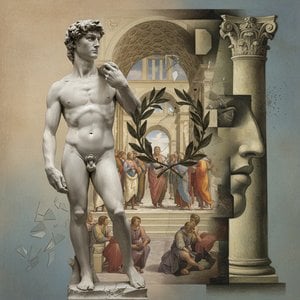
Mario Ceroli: Sculptor of Memory and Light
Mario Ceroli (born 1938) stands as a prominent figure in contemporary Italian sculpture, recognized for his distinctive approach to form and material—particularly ceramic—that explores profound themes of memory, history, and cultural identity. Born in Castel Frentano, Abruzzo, Ceroli’s artistic journey began with formative years spent studying in Rome, where he honed his craft and developed a singular visual language.
Early influences included the monumental works of Auguste Rodin and Constantin Brâncuși, whose exploration of expressive gesture and simplified forms resonated deeply within Ceroli's creative sensibility. However, it was his engagement with Minimalism that truly propelled him toward a groundbreaking aesthetic—characterized by pared-down geometries and an unwavering focus on materiality.
Ceroli’s artistic breakthrough arrived in the early 1970s with his relationship with actress Daria Nicolodi and the birth of their daughter, Anna. Tragically, Anna’s untimely death in a traffic accident profoundly impacted Ceroli's work, fueling an introspective period marked by experimentation with ceramic—a medium he would champion throughout his career.
His sculptural explorations delve into complex narratives rooted in personal experience and collective history. Often employing large-scale installations that transform architectural spaces, Ceroli seeks to evoke emotional resonance through subtle shifts in form and texture. Recurring motifs include fragmented figures and abstracted landscapes—representations of loss, transformation, and the enduring power of memory.
Ceroli’s sculptures have garnered international acclaim, appearing at prestigious institutions such as the Museum of Modern Art in New York City and the Mississippi Museum of Art in Jackson, Mississippi. Notably, his monumental “Bocca della verità” (Truth Mouth) resides on the Luigi Einaudi campus of the University of Turin—a testament to his commitment to public art and architectural dialogue. Furthermore, a sculpture by Ceroli graces the Vatican Museums, underscoring his enduring legacy as one of Italy’s most influential sculptors.
Ceroli's artistic vision continues to evolve, driven by an unwavering dedication to experimentation and conceptual rigor. He remains active in creating new works that grapple with contemporary concerns—reflecting a sculptor who has successfully navigated the shifting landscape of art history while maintaining an uncompromising commitment to his own distinctive aesthetic.
Ceroli’s formative years were shaped by exposure to the monumental sculptures of Rodin and Brâncuși, artists whose mastery of expressive form and simplification profoundly influenced Ceroli's artistic sensibilities. These encounters instilled in him a conviction that sculpture could communicate emotion and intellect with equal effectiveness.
His embrace of Minimalism represented a decisive break from representational art—a deliberate reduction to essential geometric shapes and materials designed to heighten perceptual awareness. This stylistic choice underscored Ceroli’s belief that the most powerful artworks transcend literal depiction, engaging viewers on an emotional and intellectual level.
The tragic loss of his daughter Anna served as a catalyst for Ceroli's artistic introspection—prompting him to explore themes of grief and remembrance through ceramic sculpture. He utilized this medium to investigate the psychological impact of trauma and the ways in which memory shapes our understanding of experience.
Ceroli’s sculptures have achieved recognition on an international scale, securing prominent positions within renowned museums such as MoMA and the Mississippi Museum of Art. His monumental “Bocca della verità” exemplifies his ability to transform architectural spaces into immersive environments—inviting contemplation and fostering dialogue about ethical dilemmas.
His enduring contribution to Italian art is cemented by his presence at the Vatican Museums, where one of his sculptures stands as a symbol of artistic innovation and spiritual reflection. Ceroli’s work continues to inspire artists and scholars alike—demonstrating the lasting power of sculpture to convey complex ideas and emotions.