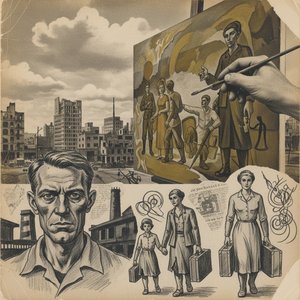
Lee Jong-keun (1927-2022): A Survivor's Lens on Hiroshima and Artistic Resilience
Lee Jong-keun, born in Hiroshima, Japan in 1927, stands as a poignant testament to human endurance amidst unimaginable tragedy. His life’s narrative intertwines with the indelible mark of World War II’s atomic bombing—a formative experience that profoundly shaped his artistic vision and fueled an unwavering commitment to remembrance. More than just a survivor, Lee Jong-keun was a respected professor at Changwon National University in South Korea, dedicating himself to education while simultaneously channeling his trauma into captivating photography.
Early Life & The Bombing Experience
Lee’s childhood unfolded amidst the backdrop of Japanese colonial rule, an experience that instilled within him a deep understanding of displacement and identity. At the age of sixteen, he witnessed firsthand the devastating consequences of nuclear warfare when Hiroshima was obliterated by the atomic bomb—an event that irrevocably altered his life trajectory. Accounts from Lee recount a harrowing morning: a sudden yellow light piercing through his eyes accompanied by the searing heat of burning hair as he sought refuge under a bridge amidst the rubble and cries for help. This visceral encounter became the catalyst for his artistic exploration, prompting him to grapple with themes of loss, memory, and resilience—themes that would permeate his photographic oeuvre. He described vividly the terror and confusion of that moment, emphasizing the overwhelming sensory experience of witnessing such destruction.
A Journey into Photography & Artistic Expression
Lee’s formal education culminated in a Bachelor's degree in Electronics and Radio Engineering from Kyunghee University in Yongin, Korea, equipping him with technical skills that complemented his artistic sensibilities. However, it was photography that truly captivated his imagination and became his primary medium of expression. Influenced by the humanist spirit of Ansel Adams and Henri Cartier-Bresson, Lee embarked on a path to capture moments of profound beauty and sorrow—often focusing on landscapes imbued with symbolic significance reflecting the scars of history. His distinctive style characterized by meticulous composition and subtle tonal variations aimed to convey not merely visual information but also emotional depth. He meticulously studied the techniques of masters like Adams and Cartier-Bresson, absorbing their philosophies about capturing essence and conveying emotion through images.
Notable Works & Artistic Legacy
Lee Jong-keun’s artistic output centered around a series titled “Abstract Letter,” which explored the intersection between language, emotion, and visual representation. These photographs served as powerful meditations on themes of solitude, contemplation, and the enduring human spirit—particularly in response to confronting difficult truths about the past. His work at Lee Ungno Museum showcased his dedication to preserving Korean artistic heritage and sharing his personal story with audiences worldwide. Furthermore, he actively participated in discussions surrounding Hibakusha stories, advocating for recognition of the experiences of Korean survivors of Hiroshima and promoting peace initiatives. The series “Abstract Letter” became a cornerstone of his artistic legacy, demonstrating his ability to distill complex emotions into simple visual forms.
Concluding Reflections: Memory as Art
Lee Jong-keun’s legacy extends beyond his photographic achievements; it resides in his unwavering dedication to honoring the memory of Hiroshima and conveying its impact on individuals and communities. Through his art—characterized by sensitivity, precision, and a profound understanding of human emotion—he transformed personal trauma into a vehicle for artistic contemplation and social engagement. His work serves as an enduring reminder that confronting history can inspire creativity and foster empathy—a testament to the transformative power of remembrance itself. He believed that art could serve as a conduit for conveying difficult truths and fostering dialogue about shared experiences, cementing his place as a significant voice in Korean cultural history.