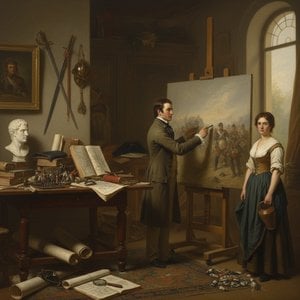
Early Life & Military Beginnings: Shaping an Artistic Vision
José Cusachs y Cusachs (19 July 1851, Montpellier – 1908, Barcelona) was a Spanish soldier and painter. == Biography == He was born in France, while his parents were travelling, but spent most of his life in the area between Barcelona and Mataró. I...
José Cusachs y Cusachs, born in 1851 amidst the travels of his parents in Montpellier, France, embarked on a life that uniquely blended the discipline of military service with the burgeoning passion for art. While his birthplace lies outside Spain’s borders, it was within the vibrant cultural landscape between Barcelona and Mataró that his formative years unfolded. This early exposure to both French and Spanish influences would subtly shape his artistic sensibility. In 1865, Cusachs entered the “Academia Militar de Artillería” in Segovia, a path seemingly at odds with the creative inclinations that simmered beneath the surface. His dedication led him to become a Captain, actively participating in the Third Carlist War – a period of political upheaval and conflict that would later profoundly inform his artistic subject matter.
The rigorous training inherent in military life instilled within Cusachs a sense of order, precision, and observation—qualities that would prove invaluable as he transitioned from soldier to painter. His love for horses, particularly those associated with cavalry regiments, became a defining characteristic, not merely as subjects but as symbols of strength, nobility, and the dynamic energy of Spanish life. This early immersion in the world of horsemanship wasn’t simply a personal preference; it was a foundational element that would permeate his artistic output.
From Battlefield to Canvas: Cusachs’s Realist Style & Academic Training
 Male portrait
Admire Josep Cusachs i’s 1881 oil portrait of an elderly man – a realistic & contemplative study in academic realism. Explore Spanish 19th-century art.
The year 1882 marked a pivotal turning point. After retiring with the rank of Commander, Cusachs fully dedicated himself to art, yet his military experience remained deeply interwoven with his creative pursuits. He didn't abandon the lessons learned in service; instead, he channeled them into a distinctive realist style. Recognizing the need for formal training, Cusachs sought guidance from Simó Gómez locally and then ventured to Paris to study under Édouard Detaille, a renowned expert in military art. This mentorship proved crucial, honing his skills in depicting accurate detail, dynamic compositions, and the emotional weight of battle scenes.
Cusachs’s artistic approach was firmly rooted in academic realism, prioritizing precise representation and technical mastery. However, he wasn't merely a replicator of reality; he infused his work with a sense of narrative and psychological depth. His paintings weren’t simply *about* military events; they conveyed the human experience within those contexts—the camaraderie, the fear, the bravery, and the often-unseen toll of conflict. This commitment to portraying authentic emotion set him apart from purely decorative or propagandistic depictions.
Capturing Spanish Life: Themes of Everyday People and Social Observation
 Peddler
Admire 'Peddler' by Josep Cusachs i, a captivating 19th-century realist painting of Spanish life. Explore this unique artwork & its historical context. Hand-painted reproduction available.
While military subjects initially dominated Cusachs’s oeuvre, his artistic vision soon broadened to encompass the wider spectrum of Spanish life. He possessed a keen eye for capturing the nuances of everyday existence, focusing on scenes featuring ordinary people engaged in their daily routines. His painting “Peddler,” for example, offers a captivating glimpse into 19th-century Spain, portraying not just a merchant but a character embedded within a specific social context. These works weren’t grand historical narratives; they were intimate portraits of a nation and its people.
Cusachs demonstrated a remarkable ability to imbue his subjects with dignity and humanity, even in the most humble circumstances. He wasn't interested in romanticizing poverty or idealizing rural life; rather, he presented an honest and often poignant depiction of reality. This social observation, coupled with his technical skill, resonated deeply with audiences seeking authentic representations of Spanish culture.
Cusachs and the Rise of Catalan Modernisme: A Cultural Context
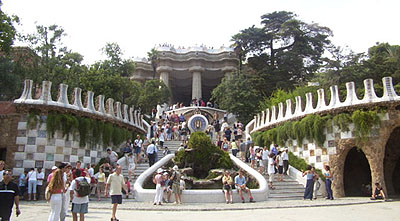 Wikipedia: Modernisme
Modernisme (Catalan pronunciation: [muðərˈnizmə], Catalan for "modernism"), also known as Catalan modernism and Catalan art nouveau, is the historiographic denomination given to an art and literature movement associated with the search of a new entit...
José Cusachs’s career unfolded during a period of significant cultural ferment in Catalonia—the rise of *Modernisme*. This movement, also known as Catalan Art Nouveau, was characterized by a fervent desire to reclaim and celebrate Catalan identity through art, architecture, and literature. While not strictly adhering to the stylistic flourishes often associated with Modernisme (such as organic forms and elaborate ornamentation), Cusachs shared its underlying spirit of national pride and cultural revival.
His focus on Spanish subjects, particularly those rooted in local traditions and everyday life, aligned with Modernisme’s broader goal of asserting Catalan distinctiveness. Furthermore, his success in gaining recognition both within Spain and internationally contributed to the growing prestige of Catalan art and culture. He wasn't a direct participant in architectural projects or decorative arts; however, his paintings served as powerful visual representations of the values that underpinned the Modernisme movement—a celebration of Spanish heritage and a commitment to artistic innovation.
Portraits as Reflections of Society: Notable Sitters and Artistic Technique
Beyond his genre scenes and military depictions, Cusachs excelled as a portrait painter. His ability to capture not only physical likeness but also the inner character of his sitters earned him commissions from prominent figures, including King Alfonso XIII and General Juan Prim. A particularly noteworthy portrait is that of Mexican President Porfirio Díaz, currently housed in the State Art Museum of Veracruz in Orizaba—a testament to his international reputation.
Cusachs’s portraits weren't merely exercises in technical skill; they were insightful studies of power, status, and personality. He employed a meticulous technique, paying close attention to detail and utilizing subtle nuances of light and shadow to create depth and realism. His 1881 oil portrait of an elderly man exemplifies this approach—a contemplative study that reveals not just the subject’s appearance but also a sense of wisdom and experience. He often entrusted landscapes within his portraits to other painters, acknowledging his own limitations in that area while ensuring the overall quality and artistic coherence of the work.
Legacy and Influence: Cusachs’s Place in 19th-Century Spanish Art
José Cusachs y Cusachs passed away in Barcelona in 1908 (some sources cite 1909), leaving behind a rich legacy as a significant figure in 19th-century Spanish art. His paintings, characterized by their realism, social observation, and technical mastery, continue to captivate audiences today. While perhaps not as widely celebrated as some of his contemporaries, Cusachs’s contribution to the portrayal of Spanish life and culture is undeniable.
His work offers a valuable window into the complexities of 19th-century Spain—a period marked by political upheaval, social change, and a growing sense of national identity. At WahooArt, we are proud to offer high-quality reproductions of Cusachs’s masterpieces, allowing art enthusiasts to experience the beauty and depth of his work firsthand. Whether you're drawn to his military scenes, genre paintings, or insightful portraits, Cusachs’s art provides a compelling glimpse into a fascinating era—a testament to the enduring power of observation, technique, and artistic vision. Explore our collection today and discover the captivating world of Josep Cusachs i.