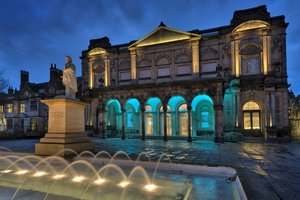
William Etty, 1787 – 1849

William Etty festményei: A 100 leghíresebb alkotás, rangsorolva

William Etty leghíresebb festménye a A Szirének és Ulissza, mely a Manchester Art Gallery található, Manchester városában. A Candaules, King of Lydia, Shews his Wife by Stealth to Gyges, One of his Ministers, as She Goes to Bed (1830) és a A görög rabszolga (1812) mellett ez alkotja azt a három műet mindenki felismer. Katalógusunkban 523 mű található William Etty alkotótól; az alábbi 100 alkotás a világ legnézettebbjei, amelyeknél megtudhatjuk a készítés évszámát, a művészét tároló múzeumot, valamint az alkotások jelentőségét.

A rangsorolásunkat a népszerűségi pontszám határozza meg, amely az egyes művek kereséseit, látogatottságát és megrendeléseit ötvözi. Frissítve: október 2026. Az ezen az oldalon található összes remekmű megrendelhető múzeumi minőségű, kézzel festett olajfestmény másolatként vagy fine art nyomtatásként, a választott méretben.

William Etty portréja
William Etty · 1787 – 1849
Született · meghalt
1787 – 1849, York
Mozgalom
Romanticism
A katalógusban szereplő művek
523
Legnépszerűbb
A Szirének és Ulissza
A legtöbb művel a
Anglesey Abbey

A 10 leghíresebb William Etty festmény

A Szirének és Ulissza szerzője William Etty
1

A Szirének és Ulissza

Olajfestmény vászonon · Manchester Art Gallery, Manchester

A brit romantika nagydemuklációjában William Etty A Szirének és Ulissza című műve a fenséges epikus elbeszélés erejének és az emberi vágyak nyers intenzitásának lélegzetelállító bizonyítékaként áll a művészettörténetben. Ez a monumentális olajfestmény közvetlenül a Homéros Odüsszeia szívébe repíti a nézőt, megörökítve azt a veszélyes pillanatot, amikor a hős, Ulissza, el kell viselnie a Szirének megveszésteljes, halálos dallamait. Etty nem csupán egy mitoszt ábrázol; életet lehened a mediterrán légkörbe is, olyan…

Candaules, King of Lydia, Shews his Wife by Stealth to Gyges, One of his Ministers, as She Goes to Bed (1830) szerzője William Etty
2

Candaules, King of Lydia, Shews his Wife by Stealth to Gyges, One of his Ministers, as She Goes to Bed

1830 · Oil

In the evocative masterpiece Candaules, King of Lydia, Shews his Wife by Stealth to Gyges, One of his Ministers, as She Goes to Bed, William Etty invites the viewer into a moment of profound moral transgression and voyeuristic tension. Painted around 1830, this work captures a pivotal scene from Greek legend, where the hubris of King Candaules leads to a breach of intimacy that would forever alter the course of…

A görög rabszolga (1812) szerzője William Etty
3

A görög rabszolga

1812 · Olajfestmény vászonon

William Etty 1812-es “A Greek Slave” című alkotása nem csupán egy női alak ábrázolása, hanem mély meditáció a kitartásról, a gyarlóságról és az emberi szellem örök erejéről. Ez a lenyűgöző olajképet – melynek mérete 43 x 43 cm – azonnal felhívja magára a drámai megvilágításával és a fókuszált kompozíciójával. Etty, a brit művészet kiemelkedő alakja, aki a nők ábrázolásában úttörő volt, elutasítva az idealizált szépséget, helyette egy szívhez közel álló,…

Vénusz és Cupido szerzője William Etty
4

Vénusz és Cupido

Olajfestmény vászonon

William Etty alkotása, “Vénusz és Cupido”, nem csupán klasszikus szépség ábrázolása; egy gondosan megmunkált narratíva, mely a mitológiában gyökerező érzelmeket, az érzékiségt és a romantika felívelő szellemet ötvözi. A festmény gazdag olajfestménnyel készült, a vászon pedig egy olyan világot teremt, ahol a bölcsesség és a szenvedély keverednek, egy élményt keltve, ami messze túlmutat a egyszerű megjelenítésen.

The Three Graces szerzője William Etty
5

The Three Graces

In this 1835 oil on millboard, the artist William Etty brings the mythological realm into immediate view. The Three Graces emerge from the shadows, their forms interlacing in a moment of quiet, divine presence. These three goddesses from Greek mythology—Aglaea, known as "Shining"; Euphrosyne, representing "Joy"; and Thalia, called "Blooming"—occupy the space with a sense of natural grace. They exist here not as distant statues, but as living entities caught…

Male Nude Sawing szerzője William Etty
6

Male Nude Sawing

Oil

The painting depicts a male nude figure engaged in the act of sawing. Positioned on the right side of the canvas, the figure is shown with his back turned to the viewer, a pose that reveals muscular definition and a sense of movement through a dynamic posture. His left arm is extended upwards, while his right arm is bent at the elbow, holding the saw. The background consists of a…

Nude Female Figure (1840) szerzője William Etty
7

Nude Female Figure

1840 · Oil

In the evocative masterpiece Nude Female Figure, painted in 1840, William Etty invites the viewer into a private, intimate moment that transcends mere observation to become an exploration of human vitality. The composition centers on the graceful silhouette of a woman, her back turned toward the observer, creating a sense of profound mystery and voyeuristic elegance. As she stands near a simple chair or bench, the light dances across the…

Self-Portrait (1823) szerzője William Etty
9

Self-Portrait

1823 · Oil On Paper · Yale Center for British Art, New Haven

William Etty painted this Self-Portrait in 1823 during his first visit to Venice. The work captures the artist in a moment of quiet study, depicted reading an opened letter. This correspondence is addressed to Walter—Monsieur Etty—at 31 Lombard Street, London, suggesting a personal connection to his brother during his Venetian sojourn.

John Thornton (1830) szerzője William Etty
10

John Thornton

1830 · Oil On Canvas · Merchant Adventurers’ Hall, York

The oil painting titled John Thornton is a formal portrait executed by the artist William Etty. Created in 1830, the work depicts John Thornton, a prominent Welsh sculptor. The subject is presented in a bust-length composition, focusing on the head and upper torso of the individual. This portrait captures the likeness of Thornton through a direct and steady gaze directed toward the viewer.

William Etty, festmények 11 és 100 között

The Bowman (1830) szerzője William Etty
#15

The Bowman

1830 · New Walk Museum - Art Gallery

A man stands caught in a moment of singular focus. His skin is not merely flesh but a canvas of deep red pigment, a visceral coating that clings…

Kérjen kézzel festett másolatot →
Self-Portrait (1825) szerzője William Etty
#19

Self-Portrait

1825 · Harvard Art Museums

In this Self-Portrait, the artist William Etty turns the gaze inward. Painted about 1825, the work captures a moment of quiet introspection. Born in York, United Kingdom, in…

Kérjen kézzel festett másolatot →
John Thornton (1830) szerzője William Etty
#21

John Thornton

1830 · Merchant Adventurers’ Hall

The oil painting titled John Thornton by William Etty presents a formal encounter with a man of significant presence. Created in 1830, this work captures the likeness of…

Rendelj egy reprodukciót →
Study of a Man's Head (1841) szerzője William Etty
#23

Study of a Man's Head

1841

In the quiet intimacy of this 1841 study, we find ourselves invited into a moment of profound, silent introspection. The subject, a man with flowing locks and a…

Vidd haza! →
Study of Female Nude (1830) szerzője William Etty
#26

Study of Female Nude

1830

In the quiet, evocative depths of William Etty’s Study of Female Nude, we encounter a moment frozen in time, where the boundaries between the physical form and the…

Vidd haza! →
Man with an Arrow (1820) szerzője William Etty
#27

Man with an Arrow

1820 · Scarborough Museums Trust

To gaze upon William Etty’s "Man with an Arrow" is to encounter a moment suspended between repose and potential action. The composition immediately draws the viewer into the…

Kérjen kézzel festett másolatot →
Sabrina and Her Nymphs (1841) szerzője William Etty
#30

Sabrina and Her Nymphs

1841 · New Walk Museum - Art Gallery

William Etty's "Sabrina and Her Nymphs," completed in 1841, is a captivating exploration of mythology, sensuality, and the raw power of Romantic emotion. This oil painting, measuring 60…

Vidd haza! →
Figure of a Seated Man (1830) szerzője William Etty
#31

Figure of a Seated Man

1830 · Fairfax House

To stand before a work like this Figure of a Seated Man is to be drawn into a moment suspended just beyond the reach of time. Painted in…

Vidd haza! →
Figure of a Seated Man (1830) szerzője William Etty
#32

Figure of a Seated Man

1830 · Fairfax House

This captivating portrait, titled Figure of a Seated Man, draws the viewer into an intimate space of profound thought. The subject, rendered with remarkable skill, is depicted seated,…

Vidd haza! →
An Israelite szerzője William Etty
#42

An Israelite

In this evocative portrait, a man is captured in a moment of profound introspection. Set against a dark, somber background, the subject is depicted in a contemplative pose,…

Rendelj egy reprodukciót →
Seated Female Nude (verso) (1845) szerzője William Etty
#43

Seated Female Nude (verso)

1845 · Courtauld Gallery

William Etty's “Seated Female Nude (verso)” offers a poignant glimpse into the artist’s process and his groundbreaking approach to depicting the human form. This preparatory sketch, rendered in…

Rendelj egy reprodukciót →
Head of a Monk (1842) szerzője William Etty
#68

Head of a Monk

1842

In the intimate realm of nineteenth-century portraiture, few works capture the profound stillness of the human spirit as effectively as William Etty’s Head of a Monk. Painted in…

Vidd haza! →
Prometheus (1820) szerzője William Etty
#69

Prometheus

1820

In the visceral masterpiece Prometheus, painted in 1820, William Etty invites us into a scene of profound mythological suffering and raw human vulnerability. The canvas captures the Titan…

Rendelj egy reprodukciót →
A Greek Slave (1812) szerzője William Etty
#71

A Greek Slave

1812

A Portrait of Strength and Vulnerability: Exploring William Etty’s “A Greek Slave” William Etty's "A Greek Slave," completed in 1812, stands as a remarkable testament to the Romantic…

Rendelj egy reprodukciót →

William Etty festményei időszakok szerint

A leggyakoribb témakörök, amelyeket William Etty festett

A négy leggyakoribb téma ezek között a mesterdarabok közül, mindegyik legkivágtebb példájával.

Hol láthatja William Etty festményeit

A 8 olyan múzeum, amely a legtöbb ezen az oldalon szereplő festményet őrzi.

Múzeumok Város William Etty művei Ebből a listából származó festmények
Anglesey AbbeyAnglesey Abbey 17 Academic Study Of A Male Nude, Seen From Behind, Academic Study Of A Male Nude As A Standard Bearer, A Bacchante and a Young Faun dancing in a Bacchic Setting
Fairfax House, YorkFairfax House York 4 S. A. Bayntum, MP for York (1830–1832), Figure of a Seated Man, Figure of a Seated Man
Rhode Island School of Design Museum of Art, ProvidenceRhode Island School of Design Museum of Art Providence 3 Male Head, Back View of a Standing Male Nude in a Boat, Seated Female Nude
York Art Gallery, YorkYork Art Gallery York 14 Male Nude -, Venus And Cupid -
Merchant Adventurers’ Hall, YorkMerchant Adventurers’ Hall York 2 John Thornton, John Thornton
New Walk Museum - Art Gallery, LeicesterNew Walk Museum - Art Gallery Leicester 2 The Bowman, Sabrina and Her Nymphs
Harvard Art Museums, CambridgeHarvard Art Museums Cambridge 2 Self-Portrait, Study for "The Combat"
Courtauld Gallery, LondonCourtauld Gallery London 4 Seated Female Nude (verso)

William Etty leghíresebb festményei évtizedenként

  1. 1810s
    A görög rabszolga (1812) szerzője William Etty
    3. / 100

    A görög rabszolga

    Kor: 23 – 32 év

    William Etty 1812-es “A Greek Slave” című alkotása nem csupán egy női alak ábrázolása, hanem mély meditáció a kitartásról, a gyarlóságról és az emberi szellem örök erejéről. Ez…

  2. 1820s
    Self-Portrait (1823) szerzője William Etty
    #9 100 közül

    Self-Portrait

    Kor: 33 – 42 év · Yale Center for British Art

    William Etty painted this Self-Portrait in 1823 during his first visit to Venice. The work captures the artist in a moment of quiet study, depicted reading an opened…

  3. 1830s
  4. 1840s
    Nude Female Figure (1840) szerzője William Etty
    #7 100 közül

    Nude Female Figure

    Kor: 53 – 62 év

    In the evocative masterpiece Nude Female Figure, painted in 1840, William Etty invites the viewer into a private, intimate moment that transcends mere observation to become an exploration…

Kérdések William Etty festményeivel kapcsolatban

Mi William Etty leghíresebb festménye?Mutasd meg a választ

A Szirének és Ulissza, Manchester Art Gallery, Manchester. Ezután következik Candaules, King of Lydia, Shews his Wife by Stealth to Gyges, One of his Ministers, as She Goes to Bed (1830) és A görög rabszolga (1812).

Melyek William Etty top 10 festménye?Mutasd meg a választ

A Szirének és Ulissza, Candaules, King of Lydia, Shews his Wife by Stealth to Gyges, One of his Ministers, as She Goes to Bed, A görög rabszolga, Vénusz és Cupido, The Three Graces, Male Nude Sawing, Nude Female Figure, The Doves, Self-Portrait és John Thornton. A fenti rangsor a művek évszámát és a múzeumát jelzi.

Hány festményt készített William Etty?Mutasd meg a választ

Katalógusunkban 523 mű található William Etty alkotótól, 1812 és 1849 közötti időszakból.

Hol találhatók William Etty leghíresebb festményei?Mutasd meg a választ

A legtöbbjüket Anglesey Abbey, Fairfax House (York) és Rhode Island School of Design Museum of Art (Providence) találhatja meg. A fenti táblázatban a múzeumokat egymás után soroljuk fel.

Mikor festette William Etty leghíresebb műveit?Mutasd meg a választ

1830s idején: a jelen laphonon található 100 műből 16 származik onnan, köztük Candaules, King of Lydia, Shews his Wife by Stealth to Gyges, One of his Ministers, as She Goes to Bed.

Miküzők William Etty legkorábbi és legkésőbbi híres festményei?Mutasd meg a választ

A legkorábbi alkotás ezen az oldalon A görög rabszolga (1812), a legutóbb pedig The Wrestlers (1849).

Mit festett leggyakrabban William Etty?Mutasd meg a választ

Nude figure (18), Nudes (12) és Portrait (11), a jelen oldalon található 100 mű közül.

Melyik technikát használt leggyakrabban William Etty?Mutasd meg a választ

Oil: 11 a 100 ezen az oldalon található műalkotásból.

Mely művészeti irányba tartozik William Etty?Mutasd meg a választ

Romanticism, ahogy azt ezen az oldalon látható festmények is mutatják.

Mely William Etty festményeket láthatok a Anglesey Abbey kiállításaiban?Mutasd meg a választ

A Academic Study Of A Male Nude, Seen From Behind, Academic Study Of A Male Nude As A Standard Bearer és A Bacchante and a Young Faun dancing in a Bacchic Setting a 3 mű közül foglal helyet ezen az oldalon, amelyeket a Anglesey Abbey tartományában őrzik.

Vásárolhatok egy William Etty festményének reprodukcióját?Mutasd meg a választ

Igen. Az oldalon található minden festmény a festmény saját oldalán, a választott méretben rendelhető meg, hogy muzeumi minőségű, kézzel festett olajfestmény-másolatként vagy kiváló minőségű művészeti nyomtatásként.

William Etty életútja

The Early Life and Training of William Etty

To understand the technical precision of William Etty, one must look past the controversy of his later subjects to his disciplined, mechanical beginnings. Born on March 10, 1787, in York, United Kingdom, he was the seventh child of Matthew and Esther Etty. His path toward fine art was not immediate or intuitive; instead, it was forged through the rigid structure of a trade. At age 11, on 8 October 1798, he was apprenticed as a printer in Hull. This seven-year apprenticeship provided a grounding in the practicalities of visual reproduction, a stark departure from the academic circles he would eventually inhabit.

The transition from the printing house to the studio was a decisive shift in his development. In 1807, William Etty joined the Royal Academy Schools, moving from the mechanical world of typography into the rigorous environment of formal art education. His training was not limited to the classroom; he spent one year as a private pupil under Thomas Lawrence. This period of intense study provided the anatomical foundation and technical control that would define his career. He did not rely on mere talent, but on the systematic acquisition of skill through direct mentorship and institutional discipline.

Artistic Style and Technical Mastery

Etty’s technical approach was defined by a rigorous command of light and texture. He achieved a realistic rendering of flesh through a masterful technique of tonal modeling, achieved by layering thin glazes of pigment. This method allowed him to build depth and nuance in skin tones, a skill that made him the first significant British painter of nudes. His versatility extended to various media, including oil on millboard, oil on panel, drawing in chalk, charcoal, pen, and ink. He did not rely on a single method but adapted his tools to the specific demands of the subject, whether capturing the musculature of a male figure or the delicate surface of a still life.

His specialization in the nude was a departure from the prevailing British traditions of his time. He was the first English painter to focus so consistently on the human form, treating the body with anatomical precision rather than as a mere decorative element. This commitment to the physical reality of the body was matched by his engagement with still life. As the first English painter to seriously engage with the genre, he applied the same sensitivity to texture and materiality to objects as he did to human anatomy. His ability to manipulate light and shadow through glazing ensured that both his figures and his objects possessed a tangible, physical presence.

The Rise of Controversy and Success

Etty’s breakthrough arrived in 1821 with Cleopatra's Arrival in Cilicia. The work ignited a dual reaction that would define his career: widespread acclaim for its technical execution and immediate scandal regarding its subject matter. By populating his canvases with nude figures, he stepped directly into a cultural minefield. His focus on the human form was not merely a stylistic choice but a provocation to the moral sensibilities of the era.

The friction between his talent and his reputation was constant. Critics frequently attacked his depictions of the nude for a perceived lack of idealization. Rather than adhering to the polished, detached standards of classical perfection, Etty pursued a realism that felt uncomfortably immediate. This commitment to anatomical truth often drew accusations of indecency, yet it was this very refusal to sanitize the body that secured his place in the history of British art. His ability to render flesh tones with such precision made his work impossible to ignore, even when it was being condemned.

Despite the persistent whispers of impropriety, his professional ascent remained steady. In 1828, he was elected a Royal Academician, a move that solidified his status within the established art world. He had successfully navigated the tension between being a provocateur and an institutional mainstay. He proved that an artist could maintain high-level professional standing while simultaneously challenging the visual boundaries of his time.

Key Works and Major Compositions

Etty’s reputation was forged through works that forced the public to confront the physical reality of the human body. His 1821 painting, Cleopatra's Arrival in Cilicia, acted as a catalyst for both acclaim and scandal. By populating the scene with nude women bathing and gossiping, he moved beyond mere historical illustration into a territory of intense, often uncomfortable, realism. This focus on the flesh became his primary mode of expression, often pushing the boundaries of what Victorian sensibilities would tolerate.

The artist’s ability to handle complex anatomical arrangements is evident in The Three Graces, painted around 1830–1835. In this work, the interlacing bodies of the three goddesses create a tight, sensual composition that emphasizes the materiality of skin. This was not a distant, idealized depiction; it was a direct, almost moist representation of the female form. Similarly, The Sirens and Ulysses, executed in 1837, demonstrates his command over dramatic composition and the muscularity of the human figure within a mythological framework.

Even in his later years, Etty continued to explore the tension between light and anatomy. The Wrestlers, painted around 1840, depicts a match between a black man and a white man. The figures are rendered with a heavy emphasis on sweat and the way light catches the curves and musculature of the straining bodies. This work highlights his technical ability to use light to define physical exertion and volume.

Legacy and Artistic Rediscovery

The historical weight of Etty's work did not immediately translate into long-term stability. Following his death in 1849, his paintings fell into relative obscurity. Shifting tastes and the rigid moral codes of the Victorian era pushed his focus on the human form to the margins of critical interest. For decades, his reputation remained sidelined, largely forgotten by the mainstream art establishment.

A significant shift occurred at the turn of the 21st century. His inclusion in Tate Britain’s Exposed: The Victorian Nude exhibition between 2001 and 2002 sparked a necessary renewed interest in his technical approach to the body. This momentum continued when the 2010 restoration of The Sirens and Ulysses revealed the actual brilliance of his technique, cementing a modern revival of his reputation. This was not a mere academic exercise; it was a reassessment of his actual impact on British art history.

The resurgence reached a peak with a major retrospective of his work held at the York Art Gallery in 2011–12. This period of reevaluation moved him from the periphery back into serious discussion. His ability to render realistic flesh tones and anatomical detail remains the primary reason his work demands attention today. He is no longer dismissed as a mere provocateur but is recognized for his specific, unflinching commitment to the human form.

Where to See the Works Today

Etty’s physical presence in modern collections remains significant, though his distribution is uneven. In London, the Courtauld Gallery maintains a strong hold on his output with four works in its collection. For those seeking his more intimate studies or specific character studies, Fairfax House in York preserves four of his paintings. These pieces offer a direct look at the technical precision he applied to the human form, away from the larger-scale historical compositions.

His reach extends beyond the United Kingdom into mainland Europe. The Louvre in Paris holds two of his works, ensuring his influence is felt within major international institutions. In the United Kingdom, the National Trust in Cambridge also maintains a presence with three works. To see his work in its most concentrated regional context, one must look to the York Art Gallery, which houses The Wrestlers, a piece painted around 1840.

Minden 523 műmű William Etty alkotása →