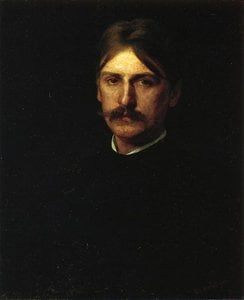
Thomas Eakins, 1844 – 1916

The 100 Most Famous Paintings by Thomas Eakins

The painting that made Thomas Eakins famous is A Gross Klinika (1875); it hangs in the Philadelphia Művészeti Múzeum, Philadelphia. Swimming (1885) and Max Schmitt egy vízije (1871) follow it in the hearts of collectors and museum visitors. Of the 346 works by Thomas Eakins in our catalogue, these 100 are the most admired, each presented with its date, its museum and what sets it apart.

Ranked by our popularity score, which combines the searches, visits and orders for each work. Updated október 2026. Every masterpiece on this page can be ordered as a museum-quality, hand-painted oil reproduction or a fine art print, at the size you choose.

Portrait of Thomas Eakins
Thomas Eakins · 1844 – 1916
Born · died
1844 – 1916, Philadelphia
Movement
Realism
Works in our catalogue
346
Most famous
A Gross Klinika (1875)
Most works at
Philadelphia Művészeti Múzeum

Thomas Eakins: the ten masterpieces

A Gross Klinika (1875) by Thomas Eakins
1

A Gross Klinika

1875 · Olajfestmény vászonon · Philadelphia Művészeti Múzeum, Philadelphia

A Gross Klinika – Egy amerikai realizmus csúcspontja Thomas Eakins’ “A Gross Klinika” egy olyan festmény, amely nem csupán egy művészeti alkotás, hanem egy történelmi dokumentum és a humánuszádra való kereszteződés szimbolikus ábrázolása is. 1875-ben elkészített olajon vászon című darab amerikai realizmus virágének bizonyítja erejét, és Eakins, a művész, aki a valóságot minden porcikájában megpróbálta leképezni, egy pillanatot rögzít: Dr. Samuel D. Gross, Philadelphia legénykori sebésze, egy fiatal beteget operál…

Swimming (1885) by Thomas Eakins
2

Swimming

1885 · Acrylic On Canvas · Amon Carter Museum of American Art, Fort Worth

Thomas Eakins' "Swimming," painted in 1884, isn’t merely a depiction of men enjoying a summer afternoon by the water; it’s a meticulously constructed study of human form, motion, and the subtle tensions simmering beneath the surface of American society. This oil on canvas, currently residing within the Amon Carter Museum of American Art in Fort Worth, Texas, is a pivotal work that encapsulates Eakins' revolutionary approach to art – one…

Max Schmitt egy vízije (1871) by Thomas Eakins
3

Max Schmitt egy vízije

1871 · Olajfestmény vászonon · Metropolitan Művészeti Múzeum, New York

Lenyűgöző téma és kompozíció Ez a kiváló festmény egy békés pillanatot örökít meg a Schuylkill folyón, ahol a fókusz Max Schmitten van, egy tekintélyes evezős, aki zíngva siklik át egyetlen egyes csónakjával. A kompozíció egyensúlyt teremt a sport dinamikus energiája és a természet tájának nyugodt szépsége között. A jelenet egy csendes, kontemplatív világba hívja a nézőt, ahol az emberi készség és a természeti harmónia együtt létezik, békés magányt és sportos…

Portrait of Samuel Murray (1889) by Thomas Eakins
4

Portrait of Samuel Murray

1889 · Oil On Canvas

To stand before Thomas Eakins’s Portrait of Samuel Murray is not merely to observe a likeness; it is to engage in an intimate confrontation with the spirit of late nineteenth-century America. This oil on canvas, dating from 1889, stands as a monumental testament to the power and conviction of Realism. Eakins, whose career was marked by an almost scientific dedication to truth, eschewed the romantic veneer that often cloaked portraiture.…

The Dancing Lesson (1878) by Thomas Eakins
6

The Dancing Lesson

1878 · Watercolor

To gaze upon Thomas Eakins' "The Dancing Lesson" is to step through a veil into a moment suspended in time—a breath held between notes of music and laughter. This captivating watercolor, executed in 1878, transcends the mere depiction of an event; it captures the very essence of human connection. The scene unfolds with an almost palpable warmth, inviting the viewer into a private gathering where generations interact through the universal…

John Biglin in a Single Scull (1873) by Thomas Eakins
7

John Biglin in a Single Scull

1873 · Watercolor · Yale University Art Gallery, New Haven

Thomas Eakins’ “John Biglin in a Single Scull,” painted in 1873, is more than just a depiction of an oarsman at work; it’s a meticulously crafted meditation on observation, human physicality, and the burgeoning spirit of realism within American art. This watercolor masterpiece, born from Eakins' deep engagement with the everyday lives of Philadelphia’s elite – doctors, sportsmen, and laborers – offers a rare glimpse into a moment of intense…

The gross clinic jefferson medical college of th (1875) by Thomas Eakins
8

The gross clinic jefferson medical college of th

1875 · Painting · Metropolitan Művészeti Múzeum, New York

To stand before this depiction of Jefferson Medical College is to step directly into the earnest, rigorous atmosphere of late nineteenth-century American intellectual life. The scene unfolds with an almost documentary precision, capturing not just a moment in time, but the very process of learning itself. We see a gathering—a cohort of men, perhaps students or young practitioners—assembled within what appears to be a lecture hall or clinic space. At…

The Pair Oared Shell (1872) by Thomas Eakins
9

The Pair Oared Shell

1872 · Oil On Canvas · Philadelphia Művészeti Múzeum, Philadelphia

To gaze upon Thomas Eakins's The Pair Oared Shell is to be invited into a moment suspended between exertion and profound tranquility. Painted in 1872, this work transcends a mere depiction of sport; it captures the very essence of shared human endeavor set against the backdrop of natural permanence. The scene unfolds on calm water, where two figures propel a long canoe, their synchronized effort forming a visual rhythm that…

Elizabeth Crowell with a Dog (1873) by Thomas Eakins
10

Elizabeth Crowell with a Dog

1873 · Oil On Canvas

To stand before Elizabeth Crowell with a Dog is to step directly into the nuanced, richly observed world of late nineteenth-century Philadelphia. Thomas Eakins, the master chronicler of American realism, has gifted us more than just a portrait; he offers an intimate tableau vivant. The scene unfolds with remarkable quietude: Elizabeth Crowell, clad in striking red, kneels gracefully beside her canine companion. Her posture speaks of deep connection, her hand…

More Thomas Eakins masterpieces, 11 to 100

Portrait of Walt Whitman (1887) by Thomas Eakins
#12

Portrait of Walt Whitman

1887 · Philadelphia Művészeti Múzeum

In the quiet, profound depths of Thomas Eakins’ Portrait of Walt Whitman, we encounter more than just a likeness; we witness a monumental collision of two American icons.…

Order a reproduction →
Swimming (1884) by Thomas Eakins
#13

Swimming

1884 · Amon Carter Museum of American Art

Thomas Eakins’ “Swimming,” painted in 1884, isn't merely a depiction of men enjoying a summer day; it’s a profound exploration of the human form, movement, and the burgeoning…

Order a reproduction →
Pushing for Rail (1874) by Thomas Eakins
#15

Pushing for Rail

1874 · Metropolitan Művészeti Múzeum

In the quiet, damp expanses of the New Jersey marshes near the Delaware River, a profound drama of human endurance unfolds within Thomas Eakins’s 1874 masterpiece, Pushing for…

Commission a hand-painted copy →
The Chess Players (1876) by Thomas Eakins
#16

The Chess Players

1876 · Metropolitan Művészeti Múzeum

In the hushed atmosphere of a Philadelphia parlor, time seems to decelerate within the frame of Thomas Eakins’s 1876 masterpiece, The Chess Players. This intimate oil on wood…

Commission a hand-painted copy →
Portrait of Mary Adeline Williams (1900) by Thomas Eakins
#17

Portrait of Mary Adeline Williams

1900 · Philadelphia Művészeti Múzeum

To stand before Thomas Eakins’s Portrait of Mary Adeline Williams is not merely to observe a likeness; it is to engage in an intimate dialogue with the past.…

Bring it home →
The Concert Singer (1890) by Thomas Eakins
#19

The Concert Singer

1890 · Philadelphia Művészeti Múzeum

Thomas Eakins: A Pioneer of Anatomical Realism Thomas Cowperthwait Eakins (1844–1916) stands as a monumental figure in American art—a painter of unflinching realism who dedicated his life to…

Commission a hand-painted copy →
Home Ranch (1892) by Thomas Eakins
#20

Home Ranch

1892 · Philadelphia Művészeti Múzeum

Thomas Eakins’s “Home Ranch,” painted in 1892 and now residing within the Philadelphia Museum of Art, isn't a grand historical tableau or a dramatic portrait; instead, it offers…

Order a reproduction →
Riter Fitzgerald (1895) by Thomas Eakins
#25

Riter Fitzgerald

1895 · Art Institute of Chicago

In this 1895 oil on canvas, an older gentleman is seated in a large, plush armchair. The chair is a deep red, featuring a soft, velvet-like texture and…

Order a reproduction →
The Courtship (1878) by Thomas Eakins
#26

The Courtship

1878 · Fine Arts Museums of San Francisco

Thomas Eakins' "The Courtship," painted in 1878, is more than just a portrait; it’s a meticulously observed study of human connection—a quiet tableau brimming with unspoken emotions and…

Bring it home →
Arthur B. Frost (1886) by Thomas Eakins
#29

Arthur B. Frost

1886 · Detroit Institute of Arts

Arthur B. Frost emerges from the shadows in this 1886 oil on canvas, a work executed after Thomas Eakins. The subject sits in a bust-length view, his body…

Bring it home →
The Timer (1879) by Thomas Eakins
#33

The Timer

1879 · New Britain Museum of American Art

A solitary man sits anchored in a dimly lit room, his profile cutting a sharp silhouette against the heavy gloom. He leans toward a table, his body caught…

Order a reproduction →
Retrospection (1880) by Thomas Eakins
#36

Retrospection

1880 · Yale University Art Gallery

Retrospection is an oil painting created by the artist Thomas Eakins. The work was executed in 1880. This piece is rendered in oil on a surface of canvas…

Commission a hand-painted copy →
Study of a Groom (1879) by Thomas Eakins
#37

Study of a Groom

1879 · Philadelphia Művészeti Múzeum

In this oil study, Thomas Eakins presents a quiet, introspective moment through the figure of a man. Titled Study of a Groom, the work emerged in the United…

Commission a hand-painted copy →
Professor William Woolsey Johnson (1896) by Thomas Eakins
#39

Professor William Woolsey Johnson

1896 · Fine Arts Museums of San Francisco

The portrait presents a bust-length study of Professor William Woolsey Johnson, rendered with a focus on the psychological weight of the subject. Positioned slightly off-center, the man gazes…

Bring it home →
Archbishop James Frederick Wood (1877) by Thomas Eakins
#40

Archbishop James Frederick Wood

1877 · Crystal Bridges Museum of American Art

The portrait presents Archbishop James Frederick Wood in a moment of quiet, seated introspection. Positioned slightly off-center, the figure occupies a space defined by deep shadows and a…

Order a reproduction →
The Red Shawl (1890) by Thomas Eakins
#41

The Red Shawl

1890 · Philadelphia Művészeti Múzeum

Step closer and observe the way the light settles upon the subject. In this 1890 oil on canvas, we find ourselves in the presence of a young person…

Commission a hand-painted copy →
Seated Figures (1886) by Thomas Eakins
#43

Seated Figures

1886 · Philadelphia Művészeti Múzeum

In this 1886 oil on cardboard study, two figures sit within a dark, indeterminate space. The composition is vertically oriented, focusing on the interaction of light and shadow…

Order a reproduction →
Portrait of Blanche Hurlburt (1885) by Thomas Eakins
#44

Portrait of Blanche Hurlburt

1885 · Philadelphia Művészeti Múzeum

In the Portrait of Blanche Hurlburt, Thomas Eakins presents a somber and intimate encounter with his subject. The woman is captured in a bust-length view, her profile turned…

Bring it home →
Portrait of Benjamin Eakins (1894) by Thomas Eakins
#46

Portrait of Benjamin Eakins

1894 · Philadelphia Művészeti Múzeum

The room falls away into a deep, indistinct darkness, leaving only the presence of an elderly man emerging from the gloom. He sits in a quiet, contemplative stillness,…

Order a reproduction →
James MacAlister (Sketch) (1895) by Thomas Eakins
#47

James MacAlister (Sketch)

1895 · Metropolitan Művészeti Múzeum

The portrait presents James MacAlister through a lens of somber realism. Captured in a three-quarter length view, the subject sits centrally against an indistinct, textured background that offers…

Commission a hand-painted copy →
Portrait of Elizabeth L. Burton (1905) by Thomas Eakins
#48

Portrait of Elizabeth L. Burton

1905 · Minneapolis Institute of Art

The Portrait of Elizabeth L. Burton is a significant oil on canvas work by the American artist Thomas Eakins. Created between 1905 and 1906, this portrait captures a…

Bring it home →
Old Lady Sewing (1879) by Thomas Eakins
#50

Old Lady Sewing

1879 · New Britain Museum of American Art

In 1879, Thomas Eakins turned his attention to a quiet, singular moment of domestic life. Old Lady Sewing presents us with an elderly woman absorbed in the rhythmic,…

Commission a hand-painted copy →
Miss Gertrude Murray (1895) by Thomas Eakins
#51

Miss Gertrude Murray

1895 · Dallas Múzeumának a művészetek háza

In this 1895 oil on canvas, a young woman is positioned in a bust-length view, oriented slightly off-center. She looks toward the right of the frame, her gaze…

Bring it home →
Portrait of Douglass Morgan Hall (1889) by Thomas Eakins
#56

Portrait of Douglass Morgan Hall

1889 · Philadelphia Művészeti Múzeum

In the quiet corridors of the Philadelphia Museum of Art, there exists a window into the profound psychological landscape of the late nineteenth century. Thomas Eakins’s “Portrait of…

Order a reproduction →
Study of a Nude Man (1869) by Thomas Eakins
#59

Study of a Nude Man

1869 · Philadelphia Művészeti Múzeum

The painting titled Study of a Nude Man (The Strong Man) is an oil on canvas work by the artist Thomas Eakins. Created in the United States, this…

Order a reproduction →
General E. Burd Grubb (1841-1914) (1898) by Thomas Eakins
#61

General E. Burd Grubb (1841-1914)

1898 · Yale University Art Gallery

In this 1898 portrait, we encounter a man whose presence seems to emerge from the shadows of his own history. The subject, General E. Burd Grubb, is rendered…

Bring it home →
Miss Eleanor S. F. Pue (1907) by Thomas Eakins
#64

Miss Eleanor S. F. Pue

1907 · Virginia Múzeum Természetrajzi és Művészeti Képtár

In this 1907 oil on canvas, the gaze of Miss Eleanor S. F. Pue meets the observer through the steady hand of Thomas Eakins. The portrait captures a…

Bring it home →
Mary Adeline Williams portréta (1899) by Thomas Eakins
#65

Mary Adeline Williams portréta

1899 · Art Institute of Chicago

Thomas Eakins és Mary Adeline Williams: Egy Mély Érzelmekkel Megmutatott Realizmus Ünnepélye A Thomas Eakins által alkotott „Mary Adeline Williams” című művészi reprodukció egy különleges figyelmet méltó alkotás,…

Bring it home →
Elizabeth at the Piano (1875) by Thomas Eakins
#70

Elizabeth at the Piano

1875 · Addison Gallery of American Art

Thomas Eakins’s “Elizabeth at the Piano” is more than a simple depiction of a woman playing an instrument; it's a meticulously crafted meditation on solitude, observation, and the…

Bring it home →
Views of Harry (1885) by Thomas Eakins
#74

Views of Harry

1885 · Philadelphia Művészeti Múzeum

This oil study, dated 1885, presents a dense arrangement of animal forms, likely cattle or oxen, within a low-light environment. The composition lacks a singular focal point, instead…

Order a reproduction →

Thomas Eakins's paintings by period

The subjects Thomas Eakins painted most

The four subjects that return most often among these masterpieces, with the finest example of each.

Where to see Thomas Eakins's paintings

The 8 museums that hold the most of the paintings on this page.

Museum City Works by Thomas Eakins Paintings from this list
Philadelphia Művészeti Múzeum, PhiladelphiaPhiladelphia Művészeti Múzeum Philadelphia 82 A Gross Klinika, Sketch for The Gross Clinic, The Pair Oared Shell
Metropolitan Művészeti Múzeum, New YorkMetropolitan Művészeti Múzeum New York 18 Max Schmitt egy vízije, The gross clinic jefferson medical college of th, Pushing for Rail
Yale University Art Gallery, New HavenYale University Art Gallery New Haven 11 John Biglin in a Single Scull, Archbishop James Frederick Wood (1813-1883), Dr. Agnew (Dr. D. Hayes Agnew) (1818-1892)
Pennsylvania Academy of Fine Arts, PhiladelphiaPennsylvania Academy of Fine Arts Philadelphia 16 Fifty Years Ago (Young Girl Meditating): Study, Spinning: Sketch, Charles Edmund Dana
National Gallery of Art, WashingtonNational Gallery of Art Washington 11 Annie C. Lochrey Husson (Mrs. Louis Husson), The Biglin Brothers Racing
Fine Arts Museums of San Francisco, San FranciscoFine Arts Museums of San Francisco San Francisco 4 The Courtship, Professor William Woolsey Johnson
Crystal Bridges Museum of American Art, BentonvilleCrystal Bridges Museum of American Art Bentonville 4 Archbishop James Frederick Wood, The Model
Art Institute of Chicago, ChicagoArt Institute of Chicago Chicago 3 Riter Fitzgerald, Mary Adeline Williams portréta

Thomas Eakins, decade by decade: the defining painting of each

  1. 1860s
    Study of a Nude Man (The Strong Man) (1869) by Thomas Eakins
    No. 49 of 100

    Study of a Nude Man (The Strong Man)

    Age 16 – 25 · Philadelphia Művészeti Múzeum

    A powerful, somber presence fills the space, defined by the heavy interplay of light and dark. The subject, a muscular male figure, is captured in profile, his upper…

  2. 1870s
    A Gross Klinika (1875) by Thomas Eakins
    No. 1 of 100

    A Gross Klinika

    Age 26 – 35 · Philadelphia Művészeti Múzeum

    A Gross Klinika – Egy amerikai realizmus csúcspontja Thomas Eakins’ “A Gross Klinika” egy olyan festmény, amely nem csupán egy művészeti alkotás, hanem egy történelmi dokumentum és a…

  3. 1880s
    Swimming (1885) by Thomas Eakins
    Rank 2 / 100

    Swimming

    Age 36 – 45 · Amon Carter Museum of American Art

    Thomas Eakins' "Swimming," painted in 1884, isn’t merely a depiction of men enjoying a summer afternoon by the water; it’s a meticulously constructed study of human form, motion,…

  4. 1890s
    Portrait of Frank Hamilton Cushing (1895) by Thomas Eakins
    No. 14 of 100

    Portrait of Frank Hamilton Cushing

    Age 46 – 55

    The Unflinching Gaze of American Realism To stand before Thomas Eakins' Portrait of Frank Hamilton Cushing is to encounter not merely a likeness, but a profound study in…

  5. 1900s

Thomas Eakins's masterpieces: questions and answers

Which painting is Thomas Eakins best known for?Show the answer

A Gross Klinika (1875), Philadelphia Művészeti Múzeum, Philadelphia. Next come Swimming (1885) and Max Schmitt egy vízije (1871).

How old was Thomas Eakins when painting A Gross Klinika?Show the answer

31 years old: A Gross Klinika dates from 1875 and Thomas Eakins was born in 1844.

What are Thomas Eakins's ten greatest paintings?Show the answer

A Gross Klinika, Swimming, Max Schmitt egy vízije, Portrait of Samuel Murray, Sketch for The Gross Clinic, The Dancing Lesson, John Biglin in a Single Scull, The gross clinic jefferson medical college of th, The Pair Oared Shell and Elizabeth Crowell with a Dog. The ranking above gives the year and the museum of each.

How many works did Thomas Eakins paint?Show the answer

Our catalogue lists 346 works by Thomas Eakins, dated from 1869 to 1908.

In which museums can I see Thomas Eakins's masterpieces?Show the answer

Most of them are in Philadelphia Művészeti Múzeum (Philadelphia), Metropolitan Művészeti Múzeum (New York) and Yale University Art Gallery (New Haven). The table above lists the museums one by one.

When did Thomas Eakins paint the masterpieces?Show the answer

In 1890s: 29 of the 100 works on this page date from then, among them Portrait of Frank Hamilton Cushing.

What are the first and last famous paintings of Thomas Eakins?Show the answer

The earliest on this page is Study of a Nude Man (The Strong Man) (1869), the latest The Model (1908).

What were Thomas Eakins's favourite subjects?Show the answer

Portrait (27), Man (26) and Woman (16), among the 100 works on this page.

Which technique did Thomas Eakins favour?Show the answer

Oil On Canvas: 48 of the 100 works on this page.

What art movement is Thomas Eakins part of?Show the answer

Realism and Contemporary realism, as the paintings on this page show.

Which masterpieces by Thomas Eakins hang at the Philadelphia Művészeti Múzeum?Show the answer

A Gross Klinika, Sketch for The Gross Clinic and The Pair Oared Shell are among the 38 works on this page held by the Philadelphia Művészeti Múzeum, Philadelphia.

Can I own a reproduction of a Thomas Eakins masterpiece?Show the answer

Yes. Every painting on this page can be ordered as a museum-quality, hand-painted oil reproduction or a fine art print, in the size you choose, from the painting's own page.

The life of Thomas Eakins

The Life of Thomas Eakins

Born in Philadelphia, Pennsylvania, on July 25, 1844, Thomas Eakins lived a life deeply rooted in the city of his birth. He was a man of many disciplines, working as a painter, photographer, sculptor, and fine arts educator. While his interests often led him abroad for study, the geography of his existence remained largely centered in Philadelphia. He moved through the city's intellectual and social circles, observing the people and the physical realities that defined the local landscape.

His professional life was marked by a commitment to the tangible. Whether he was capturing a likeness in oil or documenting a moment through a camera lens, his focus remained on the structural truth of his subjects. This dedication to the actual over the idealized often placed him at odds with the prevailing sensibilities of his time. He was a man of intense conviction, a trait that shaped both his artistic output and his standing within the academic community. He died in Philadelphia on June 25, 1916.

Early Life and Artistic Training

Born in Philadelphia, Thomas Eakins was shaped by a household defined by precision. His father, Benjamin Eakins, worked as a writing master and calligrapher, a profession that demanded a disciplined hand and a keen eye for detail. This early exposure to the mechanics of form and line provided a quiet foundation for a young man who would eventually seek to understand the human structure with scientific rigor. His education began in earnest at the Pennsylvania Academy of the Fine Arts, where he was enrolled from 1862 to 1866. It was here that his interest in the physical reality of the body began to take root, moving beyond simple sketching toward a more profound investigation of anatomy.

This anatomical curiosity led him to the lecture halls of Jefferson Medical College. Rather than remaining confined to the studio, Eakins sought out the clinical truth of the human frame, attending anatomy lectures to learn the underlying mechanics of muscle and bone. This intersection of art and science would become a defining characteristic of his approach. In 1866, he left Philadelphia for Paris to further his studies. His time in France was spent absorbing the technical mastery of the era, refining a method of observation that favored direct experience over romanticized ideals. This period of training solidified his commitment to a style rooted in the tangible, unvarnished truth of his subjects.

Technique and Artistic Style

Eakins carried the tradition of 19th-century American Realism to a high point of achievement. His approach was defined by a rigorous commitment to anatomical precision and a keen psychological insight. He did not merely seek to capture a likeness; he aimed to understand the underlying structures of the human form. This scientific curiosity led him to study the mechanics of locomotion and the complexities of the body, often drawing from his deep interest in anatomy. His subjects were frequently found in the midst of physical exertion, whether through the disciplined rhythm of rowing or the focused intensity of medical practice.

His interests were broad, often finding their way onto the canvas through depictions of music, sculpture, and outdoor sports. He was an innovator in his use of photography, employing the medium as a practical tool to aid his artistic purposes and achieve greater accuracy in his depictions of movement. This integration of new technology with traditional painting allowed him to observe the world with a clarity that was uncommon among his contemporaries. He focused on the tangible reality of his subjects, preferring the grit of actual experience over idealized or romanticized versions of life.

Key Works and Masterpieces

Eakins’s brush often sought the intersection of physical exertion and quiet contemplation. In 1871, he produced Max Schmitt in a Single Scull, a work that captures the rhythmic isolation of a rower. The painting reflects his fascination with movement and the solitary focus required by the sport. His interest in the human form extended into the realm of historical allegory, as seen in William Rush and His Model (1877). This piece utilized the female nude to explore a historical subject, even as it challenged the social conventions of his time.

The tension between scientific observation and human vulnerability is perhaps most visible in The Gross Clinic (1875). This work presents a stark, unflinching view of a surgical procedure, emphasizing the intense concentration of the medical professionals involved. It remains one of his most discussed paintings due to its directness. Later, in 1887, he turned his attention to the literary giant of his era with his Portrait of Walt Whitman. This study of the poet moves away from the clinical toward a more psychological rendering of a man’s character, capturing the weathered features of a life lived with intellectual rigor.

Teaching and Professional Life

Eakins’s influence extended far beyond the solitary confines of his studio, reaching into the classrooms where the next generation of American artists sought direction. In 1879, he assumed the position of professor of drawing and painting at the Pennsylvania Academy of Fine Arts. His presence there was transformative, turning the institution into a leading center for artistic study. He did not merely teach technique; he demanded a rigorous, almost clinical understanding of the human form. This commitment to anatomical truth often placed him at odds with the social and academic norms of the era.

His pedagogical reach was not limited to Philadelphia. He shared his methods at the Art Students League in Philadelphia and at the National Academy of Design in New York. However, his insistence on using fully nude male models to facilitate the study of musculature and movement proved deeply controversial. These unconventional methods eventually led to friction with his colleagues and his dismissal from the Drexel Institute in Philadelphia. Despite these professional setbacks and the social isolation that sometimes followed, his dedication to a science-based approach to art remained unyielding.

Legacy and Enduring Influence

The weight of Eakins's contribution to the American canon is measured by his uncompromising stance on the human form. He is widely acknowledged to be one of the most important American artists, a man whose commitment to the mechanics of life often placed him at odds with the era's sensibilities. His influence extended beyond the canvas and into the broader cultural consciousness; notably, his work was part of the painting event in the art competition at the 1932 Summer Olympics.

His presence in Philadelphia remains physically anchored in the city's history. The house he occupied in North Philadelphia, a structure that witnessed his lifelong devotion to his craft, was designated a National Historic Landmark in 1965. This recognition was followed in 1966 when the building was also listed on the National Register of Historic Places. These designations ensure that the space where he studied anatomy and developed his distinctive vision remains a permanent part of the American landscape.

Where to See the Works Today

The physical presence of Eakins's vision remains scattered across several major institutions, primarily concentrated in the American Northeast. In Philadelphia, the Philadelphia Museum of Art maintains a significant collection of his paintings, preserving the visual record of the city that shaped his perspective. His work also finds a home in New York City, where the Metropolitan Museum of Art holds several of his canvases, including studies of movement and character. The Brooklyn Museum also keeps his paintings within its permanent collection.

Beyond the urban centers of the East Coast, his influence is preserved in academic settings. The Yale University Art Gallery in Hartford holds works that reflect his commitment to anatomical accuracy and the study of the human form. These collections offer a way to encounter the precision of his brushwork and his interest in the mechanics of the body. To see his work in person is to encounter the directness of his observation.

All 346 works by Thomas Eakins →