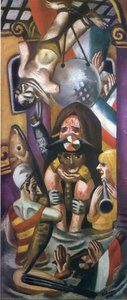
Max Beckmann, 1884 – 1950

Max Beckmann: A 100 Legnévesebb Festmény

A Az Éjszaka (1919) Max Beckmann leghíresebb festménye, amelyet a Düsseldorf-i Kunstsammlung Nordrhein-Westfalen tartja meg. A nagy szenvedés tájképe (1906) és Vas híd (Frankfurt nézete) (1922) a következő két mű, amelyeket a világ a legjobban ismer. A Max Beckmann 401 műve közül íme a 100 legnépszerűbb alkotás, amelyeket a gyűjtők és a múzeumlátogatók a leggyakrabban tekintik meg, évszámával, múzeumával és a mű történetével együtt.

A rangsorolásunkat a népszerűségi pontszám határozza meg, amely az egyes művek kereséseit, látogatottságát és megrendeléseit ötvözi. Frissítve: október 2026. Az ezen az oldalon található összes remekmű megrendelhető múzeumi minőségű, kézzel festett olajfestmény másolatként vagy fine art nyomtatásként, a választott méretben.

Max Beckmann portréja
Max Beckmann · 1884 – 1950
Született · meghalt
1884 – 1950, Lipcse
Mozgalom
Cubist expressionism
A katalógusban szereplő művek
401
Legnépszerűbb
Az Éjszaka (1919)
A legtöbb művel a
Bavári Állami Festırménygyűjtemények

Top 10: Max Beckmann leghíresebb festményei

Az Éjszaka (1919) szerzője Max Beckmann
1

Az Éjszaka

1919 · Olajfestmény vászonon · Kunstsammlung Nordrhein-Westfalen, Düsseldorf

Max Beckmann 1919-es remekműve, az *Éjszaka* több mint egy festmény; ez a háború utáni társadalmi trauma mélyen megrázó ábrázolása. A művészi kifejezésnek ezt a darabját nem csupán vizuális élményként kell megközelíteni, hanem az elidegenedés, a félelem és a modern élet széttagoltságának erőteljes állításaként is. Az *Neue Sachlichkeit* (Új Objektivitás) mozgalom sarokköve ez a festmény, amely túlmegy a puszta reprezentáción, belehatolva egy generáció nyers érzelmi tájképébe, amelyet a konfliktus súlyosan megsebzett.

A nagy szenvedés tájképe (1906) szerzője Max Beckmann
2

A nagy szenvedés tájképe

1906 · Olajfestmény vászonon · Bavári Állami Festırménygyűjtemények, Munchen

Max Beckmann 1906-ban festett “A Gonosz Nagyszabású Képe” (néhol “Nagy Halál Szenét”) egy olyan műalkotás, amely azonnal elképesztő hatást fejez ki. Ez a darab nem csupán egy kép, hanem egy mély, pszichológiai és spirituális feltárás, mely a 20. század elejének félelmeit és bizonytalanságait tükrözi. A festmény egy három férfi alakjának bemutatása egy árnyalt, zavaró térben, ahol a testek és a szellemek közötti határ elmosódik, és a nézőt magába vonja a…

Vas híd (Frankfurt nézete) (1922) szerzője Max Beckmann
3

Vas híd (Frankfurt nézete)

1922 · Olajfestmény vászonon · Kunstsammlung Nordrhein-Westfalen, Düsseldorf

Max Beckmann 1922-es alkotása, “A vashíd (Frankfurt látképe)” egy dinamikus, expresszionista városkép, amely a német művész egyedülálló vizuális stílusát mutatja be. A festmény egy forrongó ipari tájképet ábrázol, melynek központi eleme egy impozáns, csarnoki hídívelő építmény, ami a kompozíciót átszövi. Ez a darab Beckmann képességének bizonyítéka a realisztikus és expresszionista vonások keverelemében, egy élénk és magával ragadó vizuális élményt teremtve. A műalkotás a két világháború közötti időszakban született, és tükrözi…

Columbine (1950) szerzője Max Beckmann
4

Columbine

1950 · Olajfestmény vászonon · Saint Louis Art Museum, Saint Louis

Max Beckmann „Columbine” című alkotása a német ekspressionizmus lenyűgöző példája, amely az artista későbbi éveiben, 1950-ben készült. Ez a monumentális méretű olajvastag vászon nem csupán egy ülő nőalakot ábrázol maszk mögött, hanem egy olyan világot kelt, ahol markáns építészeti elemek és vibráló színek ölelnek körül. A festmény tökéletesen példázza Beckmann sajátos stílusát, amelyet a torzított alakok, a gazdag szimbolika és a mély érzelmi intenzitás határoz meg.

A színészek (1942) szerzője Max Beckmann
5

A színészek

1942 · Olajfestmény vászonon

Az emberi létezés és a társadalom felfedezése Max Beckmann erőteljes triptykuma az emberi létezés összetett szövetét és a társadalmi szerepköröket egy élénk, érzelmileg töltött kompozíción keresztül örökíti meg. Minden egyes panel egy dinamikus jelenetet mutat be, amelyet torz alakok, szimbolikus tárgyak és kifejező gesztusok töltenek meg, arra invitálva a nézőt, hogy gondolkodjon a bezártság, az identitás és a társas interakció témáiról. Beckmann emberalakok ábrázolása – egyesek ülve, mások állva vagy…

Selfportrait in tuxedo, Busch-Reisinger M (1927) szerzője Max Beckmann
6

Selfportrait in tuxedo, Busch-Reisinger M

1927 · Oil On Canvas

The gaze of Max Beckmann meets the viewer directly in Selfportrait in tuxedo, Busch-Reisinger M. This oil-on-canvas work, executed in 1927, captures the artist in a moment of poised, formal presence. He stands before us, a figure of quiet strength, wearing the elegant attire of a tuxedo that marks a specific era of social transition. The painting exists as a significant presence within the German Expressionism movement, embodying the tension…

Temptation (1937) szerzője Max Beckmann
7

Temptation

1937 · Oil On Canvas

Max Beckmann, a renowned German Expressionist painter, created his masterpiece Temptation in 1937. This oil on canvas painting is housed at the Bayerische Staatsgemäldesammlungen (Munich, Germany), and it exemplifies Beckmann's unique style and thematic exploration of human nature. The Artistic Context Beckmann was a key figure in the Expressionist movement, which emphasized subjective emotional experience. His work often drew upon historical and mythological themes to convey contemporary moral and spiritual…

The argonauts (1950) szerzője Max Beckmann
9

The argonauts

1950 · Oil On Canvas

The artwork is a triptych titled The Argonauts, created between 1949 and 1950. The composition features a middle panel containing several figures: the poet Orpheus is positioned at the center, with Jason located at his right and the sea god Glaucus at his left. The painting depicts a variety of people in different positions, including individuals who are standing, sitting, or lying down. The scene includes at least 12 people,…

A Max Beckmann rangsor további része, 11 és 100 között

Apachentanz (1938) szerzője Max Beckmann
#12

Apachentanz

1938 · Kunsthalle Bremen

The air in the room feels heavy, thick with the scent of greasepaint and the tension of a performance that teeters on the edge of violence. At the…

Rendelj egy reprodukciót →
Siesta szerzője Max Beckmann
#15

Siesta

In 1923, Max Beckmann captures a quiet, domestic scene in his work titled Siesta. The scene unfolds within an interior setting, pulling the viewer into a private moment…

Rendelj egy reprodukciót →
Christ in Limbo (1947) szerzője Max Beckmann
#17

Christ in Limbo

1947 · National Gallery of Art

The air within the frame feels heavy, thick with a sense of spiritual suspension. Three figures press against one another in a tight, stage-like arrangement that denies any…

Kérjen kézzel festett másolatot →
Still Life with Cigar Box (1926) szerzője Max Beckmann
#18

Still Life with Cigar Box

1926 · Bavári Állami Festırménygyűjtemények

A heavy, vertical arrangement of shadows and light defines this 1926 composition. A large, pale ceramic pitcher dominates the upper right, its surface catching a dim light that…

Vidd haza! →
The Argonauts: Music (1949) szerzője Max Beckmann
#20

The Argonauts: Music

1949 · National Gallery of Art

A Gathering of Shadows and Sound The air within the frame feels heavy, thick with a claustrophobic tension that presses the figures together into a shallow, crowded space.…

Vidd haza! →
Self-Portrait in Gray Robe (1941) szerzője Max Beckmann
#21

Self-Portrait in Gray Robe

1941 · Bavári Állami Festırménygyűjtemények

The artist stares back from the canvas, his presence heavy and unyielding. In this 1941 self-representation, the subject is caught in a moment of profound introspection, his head…

Rendelj egy reprodukciót →
Cabins (1948) szerzője Max Beckmann
#24

Cabins

1948 · Kunstsammlung Nordrhein-Westfalen

In Cabins, we encounter a composition that feels less like a window into a scene and more like a psychological landscape. Painted in 1948, this work by Max…

Vidd haza! →
The Duchess of Malvedi (1926) szerzője Max Beckmann
#27

The Duchess of Malvedi

1926 · Bavári Állami Festırménygyűjtemények

In 1926, Max Beckmann produced The Duchess of Malvedi, a vertical close-up portrait that demands an immediate, unsettling presence. The composition focuses tightly on a single female figure,…

Vidd haza! →
Lady in gray cap (1944) szerzője Max Beckmann
#29

Lady in gray cap

1944 · Kunsthalle Bremen

A woman sits in a quiet, heavy stillness, her gaze drifting away from the viewer toward an unseen horizon. She wears a dark, patterned headscarf that frames a…

Rendelj egy reprodukciót →
Portrait of Edie Rickey (1949) szerzője Max Beckmann
#34

Portrait of Edie Rickey

1949 · Saint Louis Art Museum

In this 1949 portrait, we encounter Edie Rickey through a lens of profound, quiet intensity. The composition is a tight, vertical close-up, pulling the viewer into an immediate,…

Rendelj egy reprodukciót →
Double image. People on the street (1914) szerzője Max Beckmann
#35

Double image. People on the street

1914 · Berlinische Galerie

The air feels heavy and thick in this urban scene, where three figures press against the very edge of the viewer's space. There is a sense of claustrophobia…

Vidd haza! →
Hotel de l’Ambre (1949) szerzője Max Beckmann
#36

Hotel de l’Ambre

1949 · Bavári Állami Festırménygyűjtemények

A dense, claustrophobic composition defines this 1949 oil on canvas, where architectural fragments collide in a shallow, flattened space. Dark vertical elements frame a central, chaotic void, suggesting…

Rendelj egy reprodukciót →
Small cafe, revolving door (1944) szerzője Max Beckmann
#37

Small cafe, revolving door

1944 · Kunstmuseum Den Haag

Small cafe, revolving door is an oil on canvas painting by Max Beckmann. Created in 1944, the work emerged from the artist's period of residence in Amsterdam, Netherlands.…

Vidd haza! →
Vampire (1948) szerzője Max Beckmann
#40

Vampire

1948 · Museum Folkwang

is a painting by Max Beckmann, executed in 1948. The work emerged during the final years of the artist's life, following a career defined by a confrontation with…

Kérjen kézzel festett másolatot →
The removal of the sphinxes (1945) szerzője Max Beckmann
#41

The removal of the sphinxes

1945 · Staatliche Kunsthalle Karlsruhe

The scene unfolds within the heavy atmosphere of 1945, a moment frozen in time through the hands of the German artist Max Beckmann. In this work, titled The…

Vidd haza! →
Sculpture Studio / Studio Corner (1950) szerzője Max Beckmann
#52

Sculpture Studio / Studio Corner

1950 · Bavári Állami Festırménygyűjtemények

In "Sculpture Studio / Studio Corner" by Max Beckmann, the viewer enters a cramped, layered environment where the boundaries between tools and life begin to blur. The scene…

Vidd haza! →
Red Clown / Man with Crown (1941) szerzője Max Beckmann
#53

Red Clown / Man with Crown

1941 · Bavári Állami Festırménygyűjtemények

A close-up, profile view of a stylized human face dominates this expressionist oil painting. The subject, a man wearing a golden crown or headpiece, is rendered with bold,…

Vidd haza! →
Carnival Paris (1930) szerzője Max Beckmann
#57

Carnival Paris

1930 · Bavári Állami Festırménygyűjtemények

The painting presents a dense arrangement of overlapping figures within a compressed space. The composition is characterized by fragmented forms and a sense of theatrical movement. Thick, black,…

Kérjen kézzel festett másolatot →
The Trapeze (1923) szerzője Max Beckmann
#58

The Trapeze

1923 · Toledói Múzeum

The Trapeze is an oil on canvas painting executed by Max Beckmann in 1923. The artist, a German painter, draftsman, printmaker, sculptor, and writer, was born on February…

Kérjen kézzel festett másolatot →
Baccarat (1947) szerzője Max Beckmann
#59

Baccarat

1947 · Nelson-Atkins Múzeum

The painting Baccarat is a work by Max Beckmann. Created in 1947 in Amsterdam, this oil on canvas captures a moment of high-stakes tension. The figures are gathered…

Vidd haza! →
Self-Portrait in Black (1944) szerzője Max Beckmann
#61

Self-Portrait in Black

1944 · Bavári Állami Festırménygyűjtemények

The work titled Self-Portrait in Black is a painting by the artist Max Beckmann. Created in 1944, it captures the artist during a period of profound transition. Beckmann,…

Rendelj egy reprodukciót →
Woman with Mirror and Orchids (1947) szerzője Max Beckmann
#62

Woman with Mirror and Orchids

1947 · Museum of Fine Arts, Houston

The oil painting titled Woman with Mirror and Orchids was created by the artist Max Beckmann. This work dates to about 1947. The composition focuses on a seated…

Vidd haza! →
The acrobats (1939) szerzője Max Beckmann
#65

The acrobats

1939 · Saint Louis Art Museum

In the profound and often unsettling world of Max Beckmann, The Acrobats emerges as a breathtaking spectacle of movement and existential tension. Painted in 1939, a year shadowed…

Kérjen kézzel festett másolatot →
Self-portrait with champagne glass (1919) szerzője Max Beckmann
#70

Self-portrait with champagne glass

1919 · Städel Múzeum

This arresting self-portrait by Max Beckmann, painted in 1919, offers a profound glimpse into the artist’s evolving consciousness during a turbulent period of European history. More than just…

Vidd haza! →
Portrait of an Argentinean (1929) szerzője Max Beckmann
#81

Portrait of an Argentinean

1929 · Bavári Állami Festırménygyűjtemények

A seated male figure dominates this vertical composition, positioned slightly off-center in formal evening attire. He wears a black tuxedo jacket over a white waistcoat and a black…

Rendelj egy reprodukciót →

Max Beckmann festményei időszakok szerint

A leggyakoribb témakörök, amelyeket Max Beckmann festett

A négy leggyakoribb téma ezek között a mesterdarabok közül, mindegyik legkivágtebb példájával.

Hol láthatja Max Beckmann festményeit

A 8 olyan múzeum, amely a legtöbb ezen az oldalon szereplő festményet őrzi.

Múzeumok Város Max Beckmann művei Ebből a listából származó festmények
Bavári Állami Festırménygyűjtemények, MunchenBavári Állami Festırménygyűjtemények Munchen 39 A nagy szenvedés tájképe, Woman with Mandolin in Yellow and Red, Temptation
Städel Múzeum, FrankfurtStädel Múzeum Frankfurt 18 Portrait of Carl Couple, The Circus Carriage, Sinagoga
Saint Louis Art Museum, Saint LouisSaint Louis Art Museum Saint Louis 39 Columbine, Portrait of Edie Rickey, Fisherwomen
National Gallery of Art, WashingtonNational Gallery of Art Washington 8 Bathing Scene (The Green Cloak), Christ in Limbo, The Argonauts: Music
Thyssen-Bornemisza Múzeum, MadridThyssen-Bornemisza Múzeum Madrid 4 Leave-Taking, Still life with yellow roses, Self-Portrait with Raised Hand
Kunstsammlung Nordrhein-Westfalen, DüsseldorfKunstsammlung Nordrhein-Westfalen Düsseldorf 3 Az Éjszaka, Vas híd (Frankfurt nézete), Cabins
MoMA - Museum of Modern Art, New YorkMoMA - Museum of Modern Art New York 5 Family Picture, Departure: The Castle
Kunsthalle Bremen, BremaKunsthalle Bremen Brema 4 Apachentanz, Lady in gray cap

Max Beckmann évtizedeken át: egy-egy remekmű minden évtizedből

  1. 1890s
  2. 1900s
    A nagy szenvedés tájképe (1906) szerzője Max Beckmann
    #2 100 közül

    A nagy szenvedés tájképe

    Kor: 16 – 25 év · Bavári Állami Festırménygyűjtemények

    Max Beckmann 1906-ban festett “A Gonosz Nagyszabású Képe” (néhol “Nagy Halál Szenét”) egy olyan műalkotás, amely azonnal elképesztő hatást fejez ki. Ez a darab nem csupán egy kép,…

  3. 1910s
    Az Éjszaka (1919) szerzője Max Beckmann
    1. / 100

    Az Éjszaka

    Kor: 26 – 35 év · Kunstsammlung Nordrhein-Westfalen

    Max Beckmann 1919-es remekműve, az *Éjszaka* több mint egy festmény; ez a háború utáni társadalmi trauma mélyen megrázó ábrázolása. A művészi kifejezésnek ezt a darabját nem csupán vizuális…

  4. 1920s
    Vas híd (Frankfurt nézete) (1922) szerzője Max Beckmann
    #3 100 közül

    Vas híd (Frankfurt nézete)

    Kor: 36 – 45 év · Kunstsammlung Nordrhein-Westfalen

    Max Beckmann 1922-es alkotása, “A vashíd (Frankfurt látképe)” egy dinamikus, expresszionista városkép, amely a német művész egyedülálló vizuális stílusát mutatja be. A festmény egy forrongó ipari tájképet ábrázol,…

  5. 1930s
    Temptation (1937) szerzője Max Beckmann
    #7 100 közül

    Temptation

    Kor: 46 – 55 év

    Max Beckmann, a renowned German Expressionist painter, created his masterpiece Temptation in 1937. This oil on canvas painting is housed at the Bayerische Staatsgemäldesammlungen (Munich, Germany), and it…

  6. 1940s
    A színészek (1942) szerzője Max Beckmann
    5. / 100

    A színészek

    Kor: 56 – 65 év

    Az emberi létezés és a társadalom felfedezése Max Beckmann erőteljes triptykuma az emberi létezés összetett szövetét és a társadalmi szerepköröket egy élénk, érzelmileg töltött kompozíción keresztül örökíti meg.…

  7. 1950s
    Columbine (1950) szerzője Max Beckmann
    #4 100 közül

    Columbine

    Kor: 66 év · Saint Louis Art Museum

    Max Beckmann „Columbine” című alkotása a német ekspressionizmus lenyűgöző példája, amely az artista későbbi éveiben, 1950-ben készült. Ez a monumentális méretű olajvastag vászon nem csupán egy ülő nőalakot…

Max Beckmann festményei: gyakranIsmételt kérdések

Mi a leghíresebb Max Beckmann festmény?Mutasd meg a választ

Az Éjszaka (1919), Kunstsammlung Nordrhein-Westfalen, Düsseldorf. Ezután következik A nagy szenvedés tájképe (1906) és Vas híd (Frankfurt nézete) (1922).

Hány éves volt Max Beckmann, amikor megfestette a Az Éjszaka című művét?Mutasd meg a választ

35 éves: Az Éjszaka 1919-ből származik, Max Beckmann pedig 1884 évfolyamon született.

Melyek a 10 leghíresebb Max Beckmann festmény?Mutasd meg a választ

Az Éjszaka, A nagy szenvedés tájképe, Vas híd (Frankfurt nézete), Columbine, A színészek, Selfportrait in tuxedo, Busch-Reisinger M, Temptation, Woman with Mandolin in Yellow and Red, The argonauts és Temptation. A fenti rangsor a művek évszámát és a múzeumát jelzi.

Hány festménye van Max Beckmann művésznek?Mutasd meg a választ

Katalógusunkban 401 mű található Max Beckmann alkotótól, 1899 és 1950 közötti időszakból.

Hol láthatom Max Beckmann leghíresebb festményeit?Mutasd meg a választ

A legtöbbjüket Bavári Állami Festırménygyűjtemények (Munchen), Städel Múzeum (Frankfurt) és Saint Louis Art Museum (Saint Louis) találhatja meg. A fenti táblázatban a múzeumokat egymás után soroljuk fel.

Melyik időszakban festette Max Beckmann leghíresebb műveit?Mutasd meg a választ

1930s idején: a jelen laphonon található 100 műből 22 származik onnan, köztük Temptation.

Mi a leghattyúbb Max Beckmann festmény, és melyik a legutóbb készült?Mutasd meg a választ

A legkorábbi alkotás ezen az oldalon Self-portrait (1899), a legutóbb pedig Columbine (1950).

Milyen témaköröket ábrázolt Max Beckmann?Mutasd meg a választ

Woman (17), Man (15) és People (14), a jelen oldalon található 100 mű közül.

Mire és mivel festett Max Beckmann?Mutasd meg a választ

Oil On Canvas: 42 a 100 ezen az oldalon található műalkotásból.

Mely művészeti irányba tartozik Max Beckmann művész alkotmánya?Mutasd meg a választ

Cubist expressionism, ahogy azt ezen az oldalon látható festmények is mutatják.

Milyen Max Beckmann festményei találhatók a Bavári Állami Festırménygyűjtemények gyűjteményében?Mutasd meg a választ

A A nagy szenvedés tájképe, Woman with Mandolin in Yellow and Red és Temptation a 17 mű közül foglal helyet ezen az oldalon, amelyeket a Bavári Állami Festırménygyűjtemények, Munchen tartományában őrzik.

Hol vásárolhatok egy Max Beckmann reprodukciót?Mutasd meg a választ

Igen. Az oldalon található minden festmény a festmény saját oldalán, a választott méretben rendelhető meg, hogy muzeumi minőségű, kézzel festett olajfestmény-másolatként vagy kiváló minőségű művészeti nyomtatásként.

Max Beckmann: életrajz

The Life and Art of Max Beckmann

Max Beckmann was a man of many disciplines, working as a painter, draftsman, printmaker, sculptor, and writer. He entered the world on February 12, 1884, in Leipzig, Saxony. He grew up in an upper-middle-class family as the youngest of three children. His early years were shaped by the quiet stability of his home until 1894, when his father, Carl Beckmann, a grain merchant, passed away. His mother, Antoine Beckmann, remained a central figure in his life as he began to find his way through the complexities of modern existence.

His work often felt like a confrontation with the reality of the human condition. He did not merely paint scenes; he captured the tension of a changing era through a variety of mediums. His output was vast, ranging from large-scale canvases to intimate prints. He was a man who sought to articulate the weight of history through his hands, often using the tools of his trade to process the shifting landscapes of the twentieth century.

Early Life and Artistic Training

Born into a middle-class family in Leipzig, Germany, Max Beckmann showed an early inclination toward drawing. His initial sketches revealed a precocious talent that hinted at the depth of his later work. During these formative years, he sought out the rigor of the old traditions, training in a conservative academic style that emphasized technical precision. This grounding in formal technique provided him with a solid foundation, even as his own spirit began to push against the boundaries of conventional methods.

As he matured, Beckmann found himself drawn to the Old Masters. He spent much of his time studying their compositions and mastery of form, a fascination that would eventually help him develop a strikingly original style. He was not content with mere imitation; instead, he used the lessons of the past to build a personal visual language. This period of study was marked by a tension between his academic training and a growing desire to express something more profound and less structured.

By 1912, he was already tackling ambitious subjects that required a command of large-scale composition. One such work was his painting of The Sinking of the Titanic, a piece that demonstrated his ability to handle complex, dramatic narratives. At this stage, his work was characterized by academically correct depictions, focusing on the weight and presence of figures within a defined space. He was a history painter at heart, using the grand scale of the past to explore the human condition through a lens of structured, deliberate form.

Experiences During World War I

The outbreak of World War I brought a sudden, violent end to Beckmann's academic training. He did not remain a bystander to the conflict; instead, he volunteered to serve in the medical corps. Working as a medical orderly, he was thrust into the direct reality of human suffering. The clinical, structured world of his early training was replaced by the chaotic and harrowing conditions of the front lines.

The strain of this service eventually became too much to bear. While stationed on the Belgian front, the weight of the war's devastation led to a nervous breakdown. He was discharged from the military in 1915, returning to a life that had been fundamentally altered by what he had witnessed. The horrors he saw during his time in the medical corps ignited a radical shift in his vision. The academic precision of his youth gave way to a new way of seeing, one that reflected a fractured and troubled humanity.

Artistic Style and Technique

Beckmann’s visual language was built from a tension between tradition and a restless, modern impulse. He looked back to the Old Masters, finding a foundation in the works of Rembrandt and Rubens, while also drawing from the structured forms of Cézanne and the emotive brushwork of Van Gogh. His compositions often felt crowded and compressed, utilizing shallow space and dark, heavy outlines to push his subjects toward the viewer. This technique created a sense of claustrophobia, as if the figures were trapped within the frame. He frequently paired this distorted figuration with a brutal realism, using his canvases to offer sharp social criticism of the world around him.

The physical application of paint was central to his expressive power. He favored a masterful impasto technique, applying the medium in thick, gestural brushstrokes that gave his surfaces a palpable, heavy weight. This texture added a sense of urgency to his depictions of human struggle. His interests were not limited to the Western tradition; he also found inspiration in the unsettling, symbolic narratives of Northern European artists like Bosch, Bruegel, and Matthias Grünewald. By blending these influences, he developed a way of painting that felt both ancient and deeply rooted in the anxieties of the twentieth century.

The Weimar Republic and New Objectivity

During the 1920s, Beckmann found himself moving through a Germany that was struggling to find its footing. He became associated with the New Objectivity movement, a style that moved away from the inward-looking emotions of earlier years toward a more direct, often biting, look at reality. His work from this period captured the doomed nature of the Weimar Republic with a sense of acidic cynicism. He did not shy away from the chaos of the era, instead using his brush to document the tension of a society in transition.

Even when his subjects appeared light or festive, such as circus performers or social gatherings, an undercurrent of moodiness or unease often remained beneath the surface. There was a persistent sense of discomfort in his compositions. This tension was particularly evident in his graphic work. He produced several black-and-white print portfolios during these years, including the work titled Hell, which utilized the raw power of printmaking to explore the darker aspects of the human condition.

Exile in Amsterdam and the Nazi Regime

The political climate in Germany grew increasingly hostile toward Beckmann’s vision. In 1933, the rise of the Nazi regime brought direct consequences to his professional life when he was dismissed from his teaching position at the Stadel Art School in Frankfurt. His work was targeted by the authorities and included in the Degenerate Art exhibition, a move that signaled the impossibility of remaining in his homeland. Facing this mounting pressure and the threat of the regime, he chose to leave Germany behind.

Beckmann spent ten years in self-imposed exile in Amsterdam. This period was marked by the profound uncertainty of living through the Second World War. While in Amsterdam, his paintings often turned toward mythic and parabolic images, moving away from the specific realities of the world he had left behind. His art during these years reflected a sense of being unmoored from a particular time or place, focusing instead on the internal struggles of the human condition.

Life and Work in America

After years of living in exile in Amsterdam, Max Beckmann finally immigrated to America in 1947. His arrival marked a new chapter of stability, though his focus remained deeply tied to the act of creation and the sharing of his craft. He spent his first two years in the United States living in St. Louis, Missouri, where he became an active part of the local artistic community. During this time, he shared his knowledge through teaching positions at Washington University in St. Louis and the Brooklyn Museum.

The final years of his life were spent in New York, where he moved in 1949. This period was brief, lasting only until his death in 1950. Even in these concluding months, his work continued to reflect the personal and psychological depth that had characterized his entire career. His presence in the American art scene was marked by a refusal to simplify his complex visual language, even as he settled into a new home far from his German roots.

Notable and Key Artworks

Beckmann’s canvases often felt like crowded, claustrophobic rooms where the tension of the era was physically palpable. In 1919, he produced The Night, a work that captures the fragmentation of modern life through distorted figures and a sense of profound alienation. This piece reflects the societal trauma left in the wake of the Great War, using a heavy, psychological approach to depict the chaos of the post-war period. His ability to translate internal anxiety into a visual language became a defining feature of his output.

As the industrial landscape of Germany shifted, so did his focus. His 1922 painting, The Iron Bridge (View of Frankfurt), uses thick, gestural brushstrokes to depict a city in transition. The composition is anchored by the heavy, geometric silhouette of the suspension bridge, cutting through a palette of saturated earth tones and industrial grays. It captures the pulsating energy of an urban environment caught between the old world and a rapidly modernizing future.

Throughout his life, Beckmann returned to his own image, using his own face to explore the human condition. His 1938 work, Self-Portrait with Horn, shows him navigating a world of increasing uncertainty. Even in his final years, his work remained deeply personal. His Self-Portrait in Blue Jacket, painted in 1950, remains a significant part of his late period, reflecting the man he had become after his time in exile and his move to America.

Legacy and Historical Impact

Max Beckmann remains a central figure in the history of 20th-century painting. While he often resisted the labels placed upon him, his work is widely considered a cornerstone of the German Expressionism movement. He possessed a singular ability to translate the fractured psyche of a continent into a visual language that felt both deeply personal and universally understood. His paintings do not merely depict scenes; they carry an extraordinary psychological depth that forces a confrontation with the human condition.

His influence extended far beyond the borders of Germany. Even as he navigated the difficult years of exile in Amsterdam and his eventual move to the United States, his voice remained distinct. He managed to bridge the gap between traditional academic training and the radical shifts of modernism. By refusing to settle into a single movement, he carved out a space that was entirely his own, characterized by a tension between the physical world and the internal, often troubled, landscape of the mind.

Where to See His Works Today

Finding the physical traces of Beckmann's life requires traveling through the cities that shaped his exile and his later years. In Germany, the Kunstsammlung Nordrhein-Westfalen in Duesseldorf maintains a significant presence of his work, holding pieces like The Night from 1919. His presence in Europe is also felt in Zurich, where the Kunsthaus Zürich preserves his imagery. These collections offer a way to see how his vision shifted as he moved through the complexities of the early twentieth century.

For those following his path to the United States, his later life is documented in American institutions. The Metropolitan Museum of Art in New York holds works from his final years, including his 1950 Self-Portrait in Blue Jacket. The Museum of Modern Art (MoMA) also maintains his works within its permanent collection. These pieces reflect the final chapter of a man who spent his last years navigating the streets of New York.

Minden 401 műmű Max Beckmann alkotása →