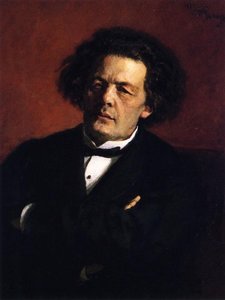
Ilja Jefimovics Repin, 1844 – 1930

A 100 legnévesebb festménye: Ilja Jefimovics Repin

Ilja Jefimovics Repin nevesebbá tett műve a Iváson az Rettegeteg és fia, Ivan, 1885. november 16-án (1885); amely a Tretyakov-galéria múzeumában található, Moszkva városában. A Zaporozhiai lovasok válasza Szultán Mahmúd IV-nek (1878) és Barge-hajózók a Volgán (1873) követik őket a gyűjtők és a múzeumi látogatók elősörvetében. A Ilja Jefimovics Repin katalógusában található 672 mű közül ezek a 100 a legcsodálatosabbak, melyeket dátummal, múzeummal és a műre jellemző különlegességekkel mutatunk be.

A rangsorolásunkat a népszerűségi pontszám határozza meg, amely az egyes művek kereséseit, látogatottságát és megrendeléseit ötvözi. Frissítve: október 2026. Az ezen az oldalon található összes remekmű megrendelhető múzeumi minőségű, kézzel festett olajfestmény másolatként vagy fine art nyomtatásként, a választott méretben.

Ilja Jefimovics Repin portréja
Ilja Jefimovics Repin · 1844 – 1930
Született · meghalt
1844 – 1930, Csuhujiv
Mozgalom
Realism
A katalógusban szereplő művek
672
Legnépszerűbb
Iváson az Rettegeteg és fia, Ivan, 1885. november 16-án (1885)
A legtöbb művel a
Tretyakov-galéria

Ilja Jefimovics Repin: a tíz remekmű

Iváson az Rettegeteg és fia, Ivan, 1885. november 16-án (1885) szerzője Ilja Jefimovics Repin
1

Iváson az Rettegeteg és fia, Ivan, 1885. november 16-án

1885 · Olajfestmény vászonon · Tretyakov-galéria, Moszkva

A vászonon olvasztott olajfestmény, melynek címe „Iváson az Rettegeteg és fia, Ivan, 1885. november 16-án”, a nemzetközi tehetség, a debreceni születésű, de világhírű orosz realista művész, Ilya Repin alkotása. Ezt a lenyűgöző mű masterpiece-et 1883 és 1885 között készítette el a mester. A kompozíció egy tragikus, meghatározó történelmi pillanatra összpontosít, amely az orosz cázar, IV. Ivan (az Rettegeteg) és fia, Ivan Ivanovics csariovics között zajlik. A jelenet egy szívszorító drámai…

A Zaporozhiai lovasok válasza Szultán Mahmúd IV-nek (1878) szerzője Ilja Jefimovics Repin
2

A Zaporozhiai lovasok válasza Szultán Mahmúd IV-nek

1878 · Olajfestmény vászonon · A Helyszíniségi Orosz Múzeum, Szentpétervár

Ilya Yefimovich Repin, Oroszország egyik legkiemelkedőbb festője, 1844-ben született a kisukrajnai Chuguev városban. Élete korai időszakában, a vidéki életben töltött éveiben alakult ki az őszinteség és a realista megközelítés, melyet évtizedek óta meghatároz. A Zaporozhiai Hadsereg Válasz Szultán Mahmut IV-nek (1878) egy monumentális alkotás, amely nem csupán egy történelmi pillanat leegyszerűsített ábrázolása, hanem a ukrán hősök szívét is megérintő, a szabadság és a hősies önállóság szimbóluma. Ez a festmény egy…

Barge-hajózók a Volgán (1873) szerzője Ilja Jefimovics Repin
3

Barge-hajózók a Volgán

1873 · Olajfestmény vászonon · A Helyszíniségi Orosz Múzeum, Szentpétervár

A tizenkilencedik századi oroszképző realizmus hatalmas tájában kevés vászon képes a néző figyelmét olyan nyers, megalkuvást nem tetsző erővel lenakászolni, mint Ilja Jefimovics Repin Barge-hajózók a Volgán című műve. Az 1870 és 1873 között készült monumentális alkotás sokkal több, mint a fizikai munka egyszerű ábrázolása; ez az emberi szellem mély pszichológiai tanulmánya a szisztematikus nehézségek súlya alatt. Ahogy a jelenetet figyegessük, a Volga folyó nehéz, lullságos légköre szinte érezhetően rátolódik…

Váratlan visszatérés (1884) szerzője Ilja Jefimovics Repin
4

Váratlan visszatérés

1884 · Olajfestmény vászonon · Tretyakov-galéria, Moszkva

A orosz realizmus hatalmas szövetében kevés alkotás ragadja meg a magánélet intimitása és a társadalmi zivatarok közötti mély feszültséget olyan érezhető módon, mint Ilja Jefimovics Repin Váratlan visszatérés című műve. Az 1884-ben festett remekmű sokkal több, mint egy egyszerű családi jelenet; ez egy az időben megfagyott pillanat pszichológiai tanulmánya, amelyben egy család szentélyének határai hirtelen átszelték a történelem súlya. A jelenet egy forradalmi száműtetést ábrázolja, egy férfit, akinek apró jelenléte…

Sadko (1876) szerzője Ilja Jefimovics Repin
5

Sadko

1876 · Oil On Canvas · A Helyszíniségi Orosz Múzeum, Szentpétervár

Ilya Repin’s “Sadko,” completed in 1876, is not merely a depiction of a fantastical tale; it’s an immersion into a world where myth and reality intertwine. This monumental canvas, measuring 323 x 230 cm, captures the essence of Russian folklore – the legend of the Volga boatman Sadko, who traded his riches for three beautiful daughters with the Sea King. The scene unfolds as a vibrant, almost overwhelming, tableau of…

Krestny Khod (Religious Procession) in Kursk Gubernia (1883) szerzője Ilja Jefimovics Repin
6

Krestny Khod (Religious Procession) in Kursk Gubernia

1883 · Oil On Canvas · Tretyakov-galéria, Moszkva

A Social Commentary Through Art "CITE>Ilya Yefimovich Repin:CITE>" is renowned for his captivating and thought-provoking paintings, and "CITE>Krestny Khod (Religious Procession) in Kursk Gubernia:CITE>" stands out as a testament to his skillful storytelling through art. This oil on canvas masterpiece, measuring 175 x 280 cm, was created in 1883 and is now housed at the Tretyakov Gallery in Moscow. The Painting's Significance When first exhibited, "Krestny Khod (Religious Procession) in…

Portrait of Chuguev resident S.L. Lyubitskaya (1877) szerzője Ilja Jefimovics Repin
8

Portrait of Chuguev resident S.L. Lyubitskaya

1877 · Oil On Canvas

To stand before Ilya Yefimovich Repin's Portrait of Chuguev resident S.L. Lyubitskaya is to encounter a moment suspended in time, a quiet dialogue between the subject and the viewer. Painted in 1877, this oil on canvas transcends a mere likeness; it is a profound study in human introspection. Repin, the master chronicler of Russian life, captures here not just the features of S.L. Lyubitskaya, but the very essence of her…

The Vice-President of the Academy of Arts, I.I. Tolstoy (1899) szerzője Ilja Jefimovics Repin
10

The Vice-President of the Academy of Arts, I.I. Tolstoy

1899 · Oil On Canvas · A Helyszíniségi Orosz Múzeum, Szentpétervár

To gaze upon Ilya Yefimovich Repin's depiction of The Vice-President of the Academy of Arts, I.I. Tolstoy, is to step into a moment suspended in time—a sanctuary of quiet thought amidst the grandeur of late 19th-century Russian intellectual life. This portrait transcends a mere likeness; it captures the very essence of contemplation. The subject, seated with an air of distinguished gravity, holds a book as if it were both a…

További Ilja Jefimovics Repin remekművek, 11től 100ig

Önismeret (Self-Portrait) (1887) szerzője Ilja Jefimovics Repin
#14

Önismeret (Self-Portrait)

1887 · Tretyakov-galéria

The Tretyakov Gallery in Moscow holds within its walls countless treasures of Russian art, but few portraits resonate with the same profound intimacy as Ilya Yefimovich Repin's “Self-Portrait”…

Vidd haza! →
Portrait of Emperor Nicholas II (1895) szerzője Ilja Jefimovics Repin
#16

Portrait of Emperor Nicholas II

1895 · Hermitaeus-múzeum

Step closer to observe the weight of this figure. In this 1895 portrait, we encounter Emperor Nicholas II not as a distant myth, but with a heavy, palpable…

Vidd haza! →
Sadko in the Underwater Kingdom (1875) szerzője Ilja Jefimovics Repin
#20

Sadko in the Underwater Kingdom

1875 · Tretyakov-galéria

To gaze upon Ilya Yefimovich Repin’s Sadko in the Underwater Kingdom is to willingly surrender oneself to a realm suspended between dream and deep-sea mystery. This captivating oil…

Vidd haza! →
Nikolai Remizov portréta (1917) szerzője Ilja Jefimovics Repin
#23

Nikolai Remizov portréta

1917

Portrait Of Nikolai Remizov – A Masterpiece of Russian Realism Ilya Yefimovich Repin’s “Portrait of Nikolai Remizov,” painted in 1917, stands as a testament to the enduring power…

Vidd haza! →
Portrait of Bella Gorskaya (1910) szerzője Ilja Jefimovics Repin
#24

Portrait of Bella Gorskaya

1910 · The State Museum of Fine Arts of Tatarstan Republic

To stand before Portrait of Bella Gorskaya is to step directly into the vibrant, nuanced world of turn-of-the-century Russia. Ilya Yefimovich Repin, a titan whose brushstrokes defined the…

Kérjen kézzel festett másolatot →
Portrait of K.B. Boleslavova (1913) szerzője Ilja Jefimovics Repin
#30

Portrait of K.B. Boleslavova

1913

To stand before Portrait of K.B. Boleslavova is to be drawn into a moment suspended in time—a quiet confluence of intellect and contemplation. Ilya Yefimovich Repin, the master…

Vidd haza! →
Boris Godunov with Ivan the Terrible (1890) szerzője Ilja Jefimovics Repin
#31

Boris Godunov with Ivan the Terrible

1890 · Art Gallery of Tver

To stand before Ilya Repin's depiction of Boris Godunov with Ivan the Terrible is to step directly into the tumultuous heart of Tsarist Russia. This painting is not…

Vidd haza! →
Golgotha szerzője Ilja Jefimovics Repin
#37

Golgotha

Ilya Yefimovich Repin’s “Golgotha” stands as a monumental testament to the power of realism and empathy within the realm of religious art. Painted between 1921 and 1922, this…

Kérjen kézzel festett másolatot →
Interior (etude). (1883) szerzője Ilja Jefimovics Repin
#39

Interior (etude).

1883 · Tretyakov-galéria

Ilya Yefimovich Repin, a titan of Russian realism, bequeathed to us not merely paintings but profound reflections on human experience. His masterpiece, “Interior (etude),” completed in 1883 and…

Kérjen kézzel festett másolatot →
On a Turf Bench. (1876) szerzője Ilja Jefimovics Repin
#41

On a Turf Bench.

1876

Ilya Yefimovich Repin stands as a monumental figure in Russian art, his legacy inextricably linked with the nation's burgeoning realist movement. Born in 1844 in Chuguev, Ukraine –…

Rendelj egy reprodukciót →
Unexpected Visitors (1888) szerzője Ilja Jefimovics Repin
#42

Unexpected Visitors

1888

“Unexpected Visitors” (Не ждали), painted by Ilya Yefimovich Repin in 1888, is more than just a depiction of a family gathering; it's a profound commentary on Russian society…

Rendelj egy reprodukciót →
Haulers on the Volga. (1870) szerzője Ilja Jefimovics Repin
#43

Haulers on the Volga.

1870

is an oil on canvas painting by Ilya Repin. Executed in 1870, the work measures 131 x 281 cm. The scale of the canvas emphasizes the physical presence…

Vidd haza! →
Poet-futurist szerzője Ilja Jefimovics Repin
#45

Poet-futurist

Ilya Repin’s Poet-Futurist: A Portrait of Vladimir Vladimirovich Mayakovsky – Decoding Symbolism and Artistic Innovation The artwork presented here is Ilya Repin's “Poet-futurist (portrait of Vladimir Vladimirovich Mayakovsky),”…

Vidd haza! →
Portrait of Yuria Repina, the Artist's son. (1882) szerzője Ilja Jefimovics Repin
#47

Portrait of Yuria Repina, the Artist's son.

1882 · Tretyakov-galéria

“Portrait of Yuria Repina, the Artist’s son” by Ilya Yefimovich Repin stands as a cornerstone of 19th-century Russian art—a poignant depiction that transcends mere visual representation to embody…

Vidd haza! →
Sergey Vitte portréta (1903) szerzője Ilja Jefimovics Repin
#51

Sergey Vitte portréta

1903

A Szomorú Szerződés Érzeke: Repin Megjegyzése Sérhei Vittéről Ilya Yefimovich Repin, az országhatáború után világsühmű névvé vált, és egy olyan művészi szellem megtestesítője lett, amely mélyen átível minden…

Kérjen kézzel festett másolatot →
Judas (1885) szerzője Ilja Jefimovics Repin
#53

Judas

1885

The painting Judas by Ilya Repin captures a moment of heavy, silent reckoning. Created in 1885, the work focuses on the biblical figure Judas Iscariot. He is the…

Vidd haza! →
Zaporozhets szerzője Ilja Jefimovics Repin
#60

Zaporozhets

Vitebszki Modern Művészeti Múzeum

Ilya Yefimovich Repin’s “Zaporozhets,” painted in 1880-1891, isn’t merely a depiction of a man; it’s a carefully constructed tableau brimming with historical resonance and profound emotional depth. The…

Kérjen kézzel festett másolatot →
The Procurator (1912) szerzője Ilja Jefimovics Repin
#62

The Procurator

1912 · Finnish National Gallery

The Procurator is a vertical bust-length portrait of an elderly man, presented from an eye-level perspective that establishes an intimate connection with the viewer. The subject is depicted…

Kérjen kézzel festett másolatot →
A Shy Peasant (1877) szerzője Ilja Jefimovics Repin
#63

A Shy Peasant

1877

In his 1877 oil on canvas, A Shy Peasant, Ilya Yefimovich Repin presents a profound study of human emotion and quietude. The painting captures a man with a…

Vidd haza! →
Religious Procession (1877) szerzője Ilja Jefimovics Repin
#65

Religious Procession

1877 · A Helyszíniségi Orosz Múzeum

The oil on canvas painting titled Religious Procession was executed by the artist Ilya Repin. This large-scale work was completed between 1880 and 1883. The composition focuses on…

Rendelj egy reprodukciót →
A woman in a cap szerzője Ilja Jefimovics Repin
#69

A woman in a cap

Vitebszki Modern Művészeti Múzeum

Ilya Repin's “A Woman in a Cap,” painted circa 1876-1878, isn’t merely a portrait; it’s a carefully constructed window into the soul of late 19th-century Russia. This arresting…

Kérjen kézzel festett másolatot →
Diogenes and the boy (1867) szerzője Ilja Jefimovics Repin
#78

Diogenes and the boy

1867

To stand before this vintage oil painting is to step directly into the charged atmosphere of 19th-century religious fervor. The scene, titled Diogenes and the boy, immediately arrests…

Rendelj egy reprodukciót →

Ilja Jefimovics Repin festményei időszakok szerint

A leggyakoribb témakörök, amelyeket Ilja Jefimovics Repin festett

A négy leggyakoribb téma ezek között a mesterdarabok közül, mindegyik legkivágtebb példájával.

Hol láthatja Ilja Jefimovics Repin festményeit

A 8 olyan múzeum, amely a legtöbb ezen az oldalon szereplő festményet őrzi.

Múzeumok Város Ilja Jefimovics Repin művei Ebből a listából származó festmények
Tretyakov-galéria, MoszkvaTretyakov-galéria Moszkva 59 Iváson az Rettegeteg és fia, Ivan, 1885. november 16-án, Váratlan visszatérés, Krestny Khod (Religious Procession) in Kursk Gubernia
A Helyszíniségi Orosz Múzeum, SzentpétervárA Helyszíniségi Orosz Múzeum Szentpétervár 28 A Zaporozhiai lovasok válasza Szultán Mahmúd IV-nek, Barge-hajózók a Volgán, Sadko
Finnish National Gallery, HelsinkiFinnish National Gallery Helsinki 29 Portrait of Professor Ivanov, The Procurator, The Scytheman
Vitebszki Modern Művészeti Múzeum, VitebszkVitebszki Modern Művészeti Múzeum Vitebszk 2 Zaporozhets, A woman in a cap
The State Museum of Fine Arts of Tatarstan Republic, KazanThe State Museum of Fine Arts of Tatarstan Republic Kazan 2 Portrait of Bella Gorskaya
Nizhniy Tagil State Museum of Fine Arts, Nizhny TagilNizhniy Tagil State Museum of Fine Arts Nizhny Tagil 2 Portrait of actor and dramatist Grigory Grigorievich Ghe
Varsói Nemzeti Múzeum, VarsóVarsói Nemzeti Múzeum Varsó 2 Study of a peasant in the grass.
Hermitaeus-múzeum, SzentpétervárHermitaeus-múzeum Szentpétervár 1 Portrait of Emperor Nicholas II

Ilja Jefimovics Repin, évtizedenként: az évtized meghatározó festményei

  1. 1850s
  2. 1860s
    Portrait of Tatyana Repina, the Artist's Mother. (1867) szerzője Ilja Jefimovics Repin
    #49 100 közül

    Portrait of Tatyana Repina, the Artist's Mother.

    Kor: 16 – 25 év · Prágai Nemzeti Galéria

    Ilya Yefimovich Repin, one of Russia’s most celebrated and profoundly humanistic painters, possessed an extraordinary ability to distill the essence of his subjects onto canvas. Few portraits capture…

  3. 1870s
    A Zaporozhiai lovasok válasza Szultán Mahmúd IV-nek (1878) szerzője Ilja Jefimovics Repin
    2. hely 100 közül

    A Zaporozhiai lovasok válasza Szultán Mahmúd IV-nek

    Kor: 26 – 35 év · A Helyszíniségi Orosz Múzeum

    Ilya Yefimovich Repin, Oroszország egyik legkiemelkedőbb festője, 1844-ben született a kisukrajnai Chuguev városban. Élete korai időszakában, a vidéki életben töltött éveiben alakult ki az őszinteség és a realista…

  4. 1880s
    Iváson az Rettegeteg és fia, Ivan, 1885. november 16-án (1885) szerzője Ilja Jefimovics Repin
    1. / 100

    Iváson az Rettegeteg és fia, Ivan, 1885. november 16-án

    Kor: 36 – 45 év · Tretyakov-galéria

    A vászonon olvasztott olajfestmény, melynek címe „Iváson az Rettegeteg és fia, Ivan, 1885. november 16-án”, a nemzetközi tehetség, a debreceni születésű, de világhírű orosz realista művész, Ilya Repin…

  5. 1890s
    The Vice-President of the Academy of Arts, I.I. Tolstoy (1899) szerzője Ilja Jefimovics Repin
    #10 100 közül

    The Vice-President of the Academy of Arts, I.I. Tolstoy

    Kor: 46 – 55 év · A Helyszíniségi Orosz Múzeum

    To gaze upon Ilya Yefimovich Repin's depiction of The Vice-President of the Academy of Arts, I.I. Tolstoy, is to step into a moment suspended in time—a sanctuary of…

  6. 1900s
    Portrait of writer Yevgeny Nikolayevich Chirikov (1906) szerzője Ilja Jefimovics Repin
    25. hely 100 közül

    Portrait of writer Yevgeny Nikolayevich Chirikov

    Kor: 56 – 65 év

    To stand before Ilya Yefimovich Repin’s Portrait of writer Yevgeny Nikolayevich Chirikov is to step directly into the vibrant, thoughtful atmosphere of turn-of-the-century Russian intellectualism. Painted in 1906,…

  7. 1910s
    Nikolai Remizov portréta (1917) szerzője Ilja Jefimovics Repin
    23. hely 100 közül

    Nikolai Remizov portréta

    Kor: 66 – 75 év

    Portrait Of Nikolai Remizov – A Masterpiece of Russian Realism Ilya Yefimovich Repin’s “Portrait of Nikolai Remizov,” painted in 1917, stands as a testament to the enduring power…

  8. 1920s

Ilja Jefimovics Repin remekművei: kérdések és válaszok

Melyik festményről ismert leginkább Ilja Jefimovics Repin?Mutasd meg a választ

Iváson az Rettegeteg és fia, Ivan, 1885. november 16-án (1885), Tretyakov-galéria, Moszkva. Ezután következik A Zaporozhiai lovasok válasza Szultán Mahmúd IV-nek (1878) és Barge-hajózók a Volgán (1873).

Hány éves volt Ilja Jefimovics Repin, amikor megalkotta a Iváson az Rettegeteg és fia, Ivan, 1885. november 16-án című művét?Mutasd meg a választ

41 éves: Iváson az Rettegeteg és fia, Ivan, 1885. november 16-án 1885-ből származik, Ilja Jefimovics Repin pedig 1844 évfolyamon született.

Melyek Ilja Jefimovics Repin tíz legnagyszerűbb festménye?Mutasd meg a választ

Iváson az Rettegeteg és fia, Ivan, 1885. november 16-án, A Zaporozhiai lovasok válasza Szultán Mahmúd IV-nek, Barge-hajózók a Volgán, Váratlan visszatérés, Sadko, Krestny Khod (Religious Procession) in Kursk Gubernia, Ceremonial Meeting of the State Council, Portrait of Chuguev resident S.L. Lyubitskaya, Portrait of the Poet Voinov és The Vice-President of the Academy of Arts, I.I. Tolstoy. A fenti rangsor a művek évszámát és a múzeumát jelzi.

Hány művet festett Ilja Jefimovics Repin?Mutasd meg a választ

Katalógusunkban 672 mű található Ilja Jefimovics Repin alkotótól, 1859 és 1926 közötti időszakból.

Melyik múzeumokban tekinthetjük meg Ilja Jefimovics Repin remekműveit?Mutasd meg a választ

A legtöbbjüket Tretyakov-galéria (Moszkva), A Helyszíniségi Orosz Múzeum (Szentpétervár) és Finnish National Gallery (Helsinki) találhatja meg. A fenti táblázatban a múzeumokat egymás után soroljuk fel.

Mikor festette Ilja Jefimovics Repin ezeket a remekműveket?Mutasd meg a választ

1870s idején: a jelen laphonon található 100 műből 34 származik onnan, köztük A Zaporozhiai lovasok válasza Szultán Mahmúd IV-nek.

Mikszétek a Ilja Jefimovics Repin első és legutolsó híres festményei?Mutasd meg a választ

A legkorábbi alkotás ezen az oldalon Portrait of A. Bocharova, artist's aunts (1859), a legutóbb pedig Portrait of the Poet Voinov (1926).

Melyek voltak Ilja Jefimovics Repin kedvenc témái?Mutasd meg a választ

Portrait (36), Russian art (30) és Portraits (10), a jelen oldalon található 100 mű közül.

Melyik technikát részesítte előnyben Ilja Jefimovics Repin?Mutasd meg a választ

Oil On Canvas: 46 a 100 ezen az oldalon található műalkotásból.

Mely művészeti irányzathez tartozik Ilja Jefimovics Repin?Mutasd meg a választ

Realism, ahogy azt ezen az oldalon látható festmények is mutatják.

Mely Ilja Jefimovics Repin remekművei láthatóak a Tretyakov-galéria falain?Mutasd meg a választ

A Iváson az Rettegeteg és fia, Ivan, 1885. november 16-án, Váratlan visszatérés és Krestny Khod (Religious Procession) in Kursk Gubernia a 28 mű közül foglal helyet ezen az oldalon, amelyeket a Tretyakov-galéria, Moszkva tartományában őrzik.

Én is vásárolhatok egy Ilja Jefimovics Repin remekművének reprodukcióját?Mutasd meg a választ

Igen. Az oldalon található minden festmény a festmény saját oldalán, a választott méretben rendelhető meg, hogy muzeumi minőségű, kézzel festett olajfestmény-másolatként vagy kiváló minőségű művészeti nyomtatásként.

Ilja Jefimovics Repin életútja

Early Life, Family and Training

Ilya Yefimovich Repin entered the world on August 5, 1844, in Chuguev, located within the Kharkov Governorate of the Russian Empire. His upbringing was shaped by the practicalities of a modest household; his father, Yefim Vasilyevich Repin, was a military settler who later worked as an itinerant merchant. This background provided a connection to the movement of people and the realities of provincial life that would later inform his perspective. His early years were defined by the quiet discipline of a small town, far from the formal academies that would eventually define his professional life.

The seeds of his technical skill were sown through a traditional apprenticeship. At the age of sixteen, he began the meticulous work of painting icons, learning the craft under the guidance of local icon painters. This period of training required a precise hand and an understanding of religious composition. It was a rigorous introduction to the visual language of his surroundings, teaching him to observe the nuances of form and light before he ever stepped foot in a major metropolitan center.

In 1863, driven by an ambition to refine his talent, he traveled to Saint Petersburg. He did not enter the Imperial Academy of Arts through the standard channels at first, but instead audited courses, absorbing the atmosphere and instruction of the institution. This period of self-directed study allowed him to bridge the gap between his provincial training and the formal academic standards of the capital. He was a man of persistence, navigating the transition from a student of religious imagery to a serious practitioner of secular art.

The Rise of a Realist Master

The transition from a student to a central figure in Russian art was marked by rapid academic success. After navigating the challenges of his early training, he secured his first prizes at the Imperial Academy of Arts in 1869 and 1871. These accolades signaled a shift toward a more direct engagement with the world around him. His growing reputation led to a significant commission from Grand Duke Vladimir Alexandrovich for The Barge Haulers on the Volga, a work that would define his early career and establish his commitment to depicting the realities of labor.

Between 1873 and 1876, his perspective expanded through two years spent in Paris and Normandy. This period allowed him to observe the techniques of painting in the open air, which he would later integrate into his own approach to light and form. He did not merely replicate the styles he encountered; instead, he refined a method of capturing the human condition with a specific, unvarnished clarity. This period of travel provided the technical breadth necessary to move beyond simple representation into a more profound psychological realism.

By 1894, his influence had become institutionalized when he was appointed a professor of historical painting at the St. Petersburg Academy. He had moved from the periphery of the art world to its very center, teaching the next generation how to navigate the tension between academic tradition and the demand for social truth. His career had come full circle, from a student auditing classes to a master shaping the direction of national art.

Key Works and Masterpieces

Repin’s ascent was marked by a profound ability to translate the struggles of the common man into monumental visual narratives. In 1873, he produced Barge Haulers on the Volga, a work that captured the brutal physical toil of laborers dragging boats along the river. This painting moved beyond simple observation, offering a searing indictment of social injustice through the exhaustion and resolve of its subjects. It established him as a painter deeply attuned to the human condition and the socio-political tensions of his era.

His interest in the complexities of the Russian soul led him to explore both religious and historical themes with intense psychological depth. Between 1880 and 1883, he painted Religious Procession in Kursk Province, a nuanced study of faith and social hierarchy. This period also saw the development of Reply of the Zaporozhian Cossacks, a work created between 1880 and 1891 that captured a defiant spirit of resistance. His brushwork often balanced the joy of folk motifs with the darker, more heavy aspects of history.

The capacity for drama reached a peak in 1885 with Ivan the Terrible and His Son Ivan. This depiction of a moment of horrific violence and remorse remains one of his most striking explorations of power and guilt. Through these varied subjects, Repin moved from the grit of the riverbanks to the heavy shadows of the Kremlin, always maintaining a focus on the internal struggles of his figures.

Technique and Artistic Style

Repin established himself as the foremost exponent of the Russian Realist style, a movement that sought to strip away academic idealization in favor of the unvarnished truth of contemporary life. His artistic language was defined by a profound sense of plasticity, a quality that allowed him to render the human form and its surroundings with a tangible, three-dimensional presence. This technical command enabled him to move beyond mere likeness, capturing the physical weight of a laborer or the subtle tension in a historical scene. He was a master of genre painting, finding profound meaning in the everyday activities of the common people and the complex social hierarchies of his era.

His approach was not static, however. During his time in France and Italy, he encountered the burgeoning Impressionist movement, and the influence of French plein-air techniques became evident in his later work. He began to integrate these observations into his rigorous realist foundation, utilizing light and brushwork to suggest atmosphere and movement rather than relying solely on rigid, polished finishes. This synthesis allowed him to depict the psychological depth of his subjects through a more fluid, observational lens. He used the human face as a landscape of emotion, often focusing on the internal struggles of his sitters.

Later Years and Death

The final chapter of Repin’s life was marked by a quiet withdrawal from the turbulent currents of history. Following the February Revolution of 1917, he found himself increasingly disillusioned by the violence and terror unleashed by the Bolsheviks. This profound sense of unease prompted a retreat from the center of Russian life toward the more tranquil surroundings of his estate, Penates. Located in Kuokkala, Finland, this sanctuary provided a refuge from the political upheaval that had reshaped his homeland.

In this secluded setting, he continued to paint, finding a sense of peace away from the social transformations occurring in the cities. His focus shifted toward more personal and introspective subjects, often drawing from his immediate surroundings and the people closest to him. He remained active in his craft until his final days, maintaining a connection to the art that had defined his existence. He died on 29 September 1930 in Kuokkala. He is buried at The Penates.

Legacy and Enduring Influence

The influence of Ilya Yefimovich Repin extended far beyond the borders of the Russian Empire, reaching into the very foundations of modern painting. By defining the parameters of Russian realism, he established a visual language that would later inform the development of Socialist Realism. His ability to merge technical academic precision with a sharp social conscience allowed his work to function as a mirror to a changing society. This commitment to portraying the human condition with honesty ensured that his impact would be felt by generations of artists who followed in his footsteps.

His reputation was recognized on the international stage, far from the provincial towns of his youth. In 1900, he served as a jury member of the Paris World Fair, a position that reflected his standing among the global artistic elite. This recognition was further solidified when he was awarded the Legion of Honour, an honor that underscored his importance to the European art world. He moved between the rigorous traditions of the Academy and the evolving techniques of plein-air painting, leaving behind a body of work that bridged the gap between the old world and the new.

Where to See the Works Today

The physical presence of Repin's oeuvre is scattered across several major institutions, reflecting the breadth of his influence. The Tretyakov Gallery in Moscow remains the most significant repository, housing 26 of his works. Within this collection, one can find his portrait of the composer Modest Musorgsky, dated 1881, alongside the portrait of Pavel Tretyakov from 1883. These pieces offer a direct encounter with the psychological depth he brought to his subjects.

Beyond Moscow, his canvases have traveled to various corners of Europe and the former Soviet territories. The Vitebsk Museum of Modern Art holds two of his works, while the Pushkin State Museum in Moscow preserves a single piece. In Prague, the National Gallery maintains one of his paintings, ensuring his visual language remains accessible to international audiences. These specific locations provide a fragmented but significant map of his artistic output.

Minden 672 műmű Ilja Jefimovics Repin alkotása →