Early Life and Education
- Born: 1871 in Siatista, Western Macedonia, Greece
- Family moved to Istanbul (Constantinople) in 1874
- Scholarship to the Zappeion School for Girls (1883-1888)
- Briefly worked as a teacher after graduation
- Decided to pursue painting and moved to Munich in 1895
Training and Artistic Development in Munich
- Studied with Georgios Jakobides and Nikolaos Gyzis
- Unable to attend the Munich Academy of Fine Arts due to being a woman, she took private courses.
- Studied alongside notable artists like Nikolaos Vokos, Paul Nauen, Anton Ažbe, and Walter Thor.
- Returned to Istanbul in 1898 before returning to Munich until 1900.
- Early work initially followed the conservative rules of academic art.
War Correspondence and Artistic Focus
- Traveled extensively throughout Europe.
- Married journalist Nicholas Karavia in 1907, settling in Alexandria, Egypt for thirty years.
- Founded and ran an art school in Alexandria.
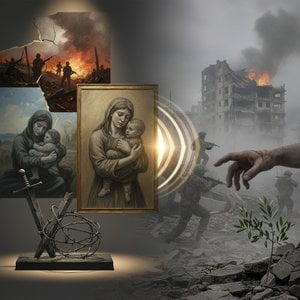
- During the Balkan Wars (1912-1913), worked as a correspondent for an Alexandrian newspaper, documenting the war through sketches.
- Her drawings captured the lives of soldiers, refugees, and casualties with an impressionistic style.
- Published "Impressions of the 1912–1913 War in Macedonia and Epirus" (1936) featuring these sketches.
- Continued documenting conflicts including the Asia Minor Campaign (1921) and the Greco-Italian War (1940-41).
Style, Themes, and Recognition
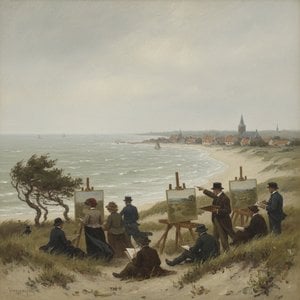
- Artistic Style: Initially conservative academic style, later adopted Impressionist and plein air techniques.
- Themes: Portraits, landscapes, still lifes, genre scenes, book illustrations. Her portraits were noted for their psychological insight.
- Exhibitions: Exhibited extensively from 1898 onwards, including at the Exposition Universelle in Paris (1900), Istanbul, Athens, Cairo, Rome, and the Venice Biennale (1934).
- Recognition: Awarded the silver medal of the Athens Academy in 1945 and the Cross of the Order of Beneficence in 1954.
Later Life and Legacy
- Returned to Greece in 1940 and lived there until her death.
- Died in Athens in 1960.
- Collections: A significant collection of her war sketches is held by the War Museum of Athens, with approximately 70 works donated to the Municipal Art Gallery of Ioannina in 1957.
- Historical Significance: Thalia Flora-Karavia's work provides a unique visual record of wartime experiences from a female perspective, blending artistic skill with journalistic observation. Her contribution to documenting historical events through art is significant.