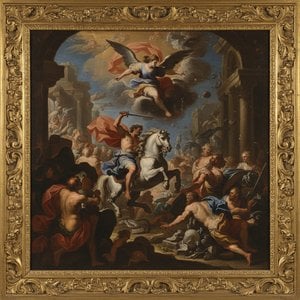
Johann Michael Rottmayr (1654 - 1730): Austrian Baroque Master
Johann Michael Rottmayr, born in Lauf an der Pegnitz, Bavaria around 1654 (sources vary between 1654 and 1656), stands as a pivotal figure in the transition from the High Baroque to the Rococo styles in Central Europe. He wasn’t merely a painter; he was a conduit, skillfully channeling the vibrant energy of Italian Renaissance masters through the lens of burgeoning Austrian artistic sensibilities. Rottmayr's journey began within a family already touched by artistry, providing fertile ground for his innate talents to blossom. His formal training commenced under Johann Carl Loth in Venice – a formative experience that would indelibly shape his aesthetic vision. Loth’s tutelage wasn’t simply about technique; it was an immersion into the world of Titian, Veronese, and Tintoretto, instilling within Rottmayr a deep appreciation for coloristic richness, dramatic composition, and the masterful use of light and shadow. This Venetian influence would remain a cornerstone of his style throughout his career. He wasn’t alone in absorbing Italian influences; Hans Adam Weissenkircher, a contemporary from Lauf, also played a crucial role in bringing these artistic currents northwards, fostering a shared aesthetic dialogue that enriched the region's art scene.Early Life and Artistic Training
Rottmayr’s early life was marked by familial artistic inclinations. While precise details about his parents remain scarce, it is known that he possessed an innate talent for painting from a young age. His formal education began in Venice around 1675 under the guidance of Johann Carl Loth, a Venetian artist who had emigrated to Bavaria and established himself as a respected teacher. This encounter proved transformative; Loth instilled within Rottmayr not only technical proficiency but also a profound understanding of the artistic principles championed by masters such as Titian, Veronese, and Tintoretto – artists whose mastery of color, perspective, and theatrical lighting profoundly impacted Rottmayr’s artistic sensibilities. Loth's influence ensured that Rottmayr would never lose sight of the grandeur and dynamism inherent in the Venetian Baroque tradition.Return to Salzburg and Patronage
Returning to Austria around 1688, Rottmayr swiftly gained recognition and secured a prestigious position as the general painter to Johann Ernst Graf Thun, Prince-Bishop of Salzburg – a role that afforded him considerable stability and access to influential circles. This patronage fueled his artistic endeavors, resulting in commissions encompassing both secular and religious projects. Notably, he collaborated closely with Johann Bernhard Fischer von Erlach, a leading architect of Salzburg’s era, embarking on ambitious architectural undertakings where Rottmayr seamlessly integrated painting into the overall design—a hallmark of Baroque aesthetics. Their partnership culminated in the magnificent frescoes adorning Schloss Frain an der Thaya (now Vranov nad Dyjí), demonstrating Rottmayr's exceptional skill in creating illusionistic ceiling paintings that captivated viewers with their breathtaking scale and immersive atmosphere.Melk Abbey Dome: A Triumph of Illusion
Rottmayr’s magnum opus undoubtedly resides within the central dome of Melk Abbey, completed between 1703 and 1706. This monumental fresco depicts a sublime vision of heaven—a swirling vortex of luminous figures bathed in radiant light, conveying an overwhelming sense of spiritual transcendence. Rottmayr employed groundbreaking techniques of perspective and illusionistic foreshortening to achieve this effect, blurring the boundaries between earthly space and divine realm. The sheer ambition of the project cemented Rottmayr’s reputation as one of Austria's foremost Baroque artists and ensured that his masterpiece would endure for centuries to come.Vienna Years and Artistic Evolution
Around 1699, Rottmayr relocated to Vienna, where he continued to produce significant works—primarily commissioned by imperial patrons—and further refined his artistic style. Influenced by Rubens and Van Dyck, Rottmayr’s palette became more nuanced, and his compositions gained greater harmony, signaling a subtle shift toward the burgeoning Rococo aesthetic. He remained active until his death in Vienna on October 25th, 1730, leaving behind an impressive legacy of paintings that continue to inspire admiration for their beauty and technical virtuosity. His contribution to Austrian art history is undeniable—a bridge between tradition and innovation—solidifying his place among the most celebrated artists of his time.Gyakran Ismételt Kérdések
Milyen hangulatokat közvetítenek Rottmayer János M. művei?
Rottmayer János M. Hangulat alapú gyűjtemény oldala olyan felület, amely a művész alkotásait hangulat alapján csoportosítja.
Mennyire népszerűek Rottmayer János M. művei?
Létre van hozva egy Statisztika oldal Rottmayer János M. számára, amely statisztikákat mutat be a művész alkotmányairól a ez a weboldal felületén.
Hol és melyik országban született Rottmayer János M.?
Rottmayer János M. Lauf an der Pegnitz városban, Németország országban született.