A Pioneer of Greek Modernism
Nikolaos Lytras (1883-1927) stands as a pivotal figure in the history of Greek art, representing a courageous embrace of modernist ideals amidst the conservative currents of his time. Born in Athens, he emerged from a lineage steeped in artistic tradition—his father, Nikiforos Lytras, was himself a respected painter and educator. This profound connection undoubtedly shaped his formative years, instilling within him an appreciation for both meticulous craftsmanship and restless intellectual exploration. His early training at the Athens School of Fine Arts between 1902 and 1906, under the tutelage of his father and Georgios Jakobides, provided a rigorous foundation in established academic principles.
However, the boundaries of tradition could not contain Lytras' burgeoning vision. Seeking to transcend the limitations of purely academic instruction, he traveled to the Academy of Fine Arts in Munich, where he studied from 1906 to 1912. It was here, under the guidance of Ludwig von Löfftz, that his style began to undergo a radical metamorphosis. Immersing himself in the burgeoning Expressionist movement, Lytras felt the profound influence of Der Blaue Reiter—the legendary German collective. This exposure fostered a deep-seated interest in conveying raw emotion and psychological depth through color and form, moving away from mere representation toward a more visceral, spiritual expression.
The Intersection of War and Art
Lytras' life was not merely defined by the quietude of the studio, but also by the tumultuous shifts of history. His involvement with the Balkan Wars marked a significant turning point in his creative journey. Serving as an officer, he diligently documented the fortifications of Turkish territories, producing sketches that reveal both his keen observational prowess and a solemn commitment to documenting historical reality. This period of conflict added a layer of gravity and lived experience to his perspective, perhaps tempering his modernist experimentation with a profound sense of human consequence.
Upon returning home decorated for bravery, Lytras sought to rebuild the artistic landscape of his homeland. He joined forces with Gregorios Zevgolis to establish a collaborative studio in Athens, a venture that served as a testament to the importance of artistic camaraderie and shared ambition. This period of reconstruction was essential in fostering a new generation of Greek artists who were no longer tethered solely to the past but were looking toward the vibrant, fragmented beauty of the modern world.
Mastery of Color and Form
The true essence of Lytras' genius is perhaps most vividly captured in his later masterpieces, which blend the boundaries of realism, impressionism, and expressionism. His work often features a captivating use of light and color to evoke specific atmospheres. One cannot discuss his legacy without mentioning "The Straw Hat" (1925), considered one of the most daring works of early Greek Modernism. In this painting, Lytras utilizes strong, vivid colors—juxtaposing cold blue-gray tones with warm orange and yellow hues—to capture a sun-drenched moment in an island landscape. The use of thick paint and gestural brushwork emphasizes the material nature of the medium itself.
His repertoire was remarkably diverse, ranging from:
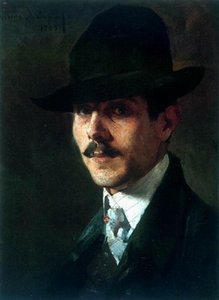
- Expressive Portraits: Such as his Portrait of painter Oumvertos Argyros, which showcases his ability to capture character through modernist lens.
- Serene Still Lifes and Landscapes: Works that often utilized muted tones and a sense of timeless elegance to explore the beauty of the everyday.
- Narrative Illustrations: Demonstrating his versatility, such as his work for Penelope Delta’s novel "A Tale With No Name."