A Life Sculpted in Realism: The World of Malvina Hoffman
Malvina Cornell Hoffman, born in New York City in 1885, emerged as a pivotal figure in American sculpture during a period defined by both artistic innovation and societal change. Her journey began within a household steeped in creativity—her father, Richard Hoffman, was a celebrated concert pianist and composer, while her mother, Fidelia Marshall Lamson Hoffman, possessed a musical talent of her own. This nurturing environment fostered an early appreciation for the arts, though Malvina’s path would ultimately lead her to three-dimensional form rather than melodic expression. Her education at prestigious private schools like Veltin, Chapin, and Brearley provided a solid foundation, but it was her enrollment at the Woman's School of Applied Design and the Art Students League that ignited her passion for artistic creation. Early mentorship from luminaries such as John White Alexander in painting, and later George Grey Barnard, Herbert Adams, and Gutzon Borglum in sculpture, proved instrumental in shaping her developing style. A formative experience came with assisting sculptor Alexander Phimister Proctor in 1907, providing invaluable hands-on knowledge of the sculpting process.
Parisian Influences and the Dance
The year 1908 marked a turning point as Hoffman embarked on her first sojourn to Paris, a city that would profoundly influence her artistic trajectory. She initially studied with Janet Scudder before securing the coveted opportunity to work under the tutelage of Auguste Rodin from 1910 to 1914. This period proved transformative; Rodin’s emphasis on realism, his ability to capture raw emotion and psychological depth in his figures, resonated deeply with Hoffman. She absorbed his techniques, particularly his approach to bronze casting, a skill she would master herself. It was during this time that her artistic focus began to crystallize around the human form, specifically the grace and dynamism of dancers. The ballet world captivated her imagination, and she found in its performers ideal subjects for her sculptures. Figures like Vaslav Nijinsky and Anna Pavlova became frequent models, their movements and expressions inspiring some of her most celebrated early works, including “Russian Dancers” (1911). Hoffman didn’t merely replicate physical likeness; she sought to convey the essence of dance—the fleeting moments of weightlessness, the power and control, the sheer artistry of movement.
The Hall of Races and a Legacy in Bronze
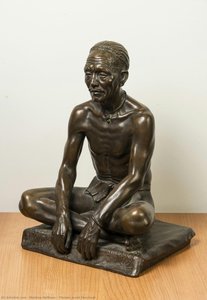
While her portraits of dancers established Hoffman's reputation, it was the monumental commission for the Field Museum of Natural History in Chicago that cemented her place in art history. From 1929 to 1933, she undertook the ambitious “Hall of the Races of Mankind,” a series comprising 104 sculptures depicting individuals from diverse cultures and ethnicities around the globe. This project was not without its complexities; initially intended as plaster molds, Hoffman successfully advocated for their execution in bronze, believing it would lend greater dignity and permanence to the representations. The Hall, unveiled at the Century of Progress International Exposition in 1933, was a landmark achievement, though it also sparked debate regarding anthropological representation and cultural sensitivity—issues that continue to be relevant today. Beyond this grand undertaking, Hoffman continued to create compelling portraits, including “Paderewski The Man” and “Tibetan Jewel Merchant,” showcasing her skill in capturing both physical resemblance and inner character. Her dedication to the technical aspects of sculpture led her to publish *Sculpture Inside and Out* (1939), a comprehensive guide to bronze casting that remains a valuable resource for artists today.
A Pioneer’s Enduring Impact
Malvina Hoffman's contributions extended beyond her sculptural achievements. She was an active member of the artistic community, maintaining a salon at her Sniffen Court studio where artists and intellectuals gathered to exchange ideas. Her commitment to social causes was evident in her wartime efforts, including organizing the French War Charity (appui aux artistes) and the American-Yugoslav Relief Fund for Children. Elected as an Associate member of the National Academy of Design in 1925 and a full Academician in 1931, she received numerous accolades throughout her career. Her sculptures are now held in prominent museum collections, including the Metropolitan Museum of Art and the Detroit Institute of Arts, ensuring that her work continues to inspire and captivate audiences. Though the original “Hall of the Races of Mankind” was later dismantled, it remains a significant chapter in her story—a testament to her ambition, skill, and willingness to tackle complex cultural themes. Malvina Hoffman died in New York City in 1966, leaving behind a legacy as a pioneering female sculptor who achieved international recognition for her artistic vision and technical mastery. Her memoir, *Yesterday Is Tomorrow: A Personal History*, offers a poignant glimpse into the life of an artist dedicated to capturing the beauty and complexity of the human experience.