A Life Rooted in Observation: The World of Julia Whitney Barnes
Julia Whitney Barnes, born in the small town of Newbury, Vermont in 1976, is an artist whose work feels intrinsically connected to place and the delicate rhythms of nature. Her journey began not within the walls of a studio, but quite literally on the floor of her childhood home—a detail she often cites as formative, hinting at a lifelong comfort with unconventional spaces and a grounded approach to creation. After two decades in Brooklyn, Barnes relocated to Poughkeepsie, New York, a move that proved pivotal in solidifying her artistic voice and deepening her engagement with the natural world surrounding her. This shift wasn’t merely geographical; it represented a return to roots, a blossoming of personal connection reflected powerfully in her art.
Barnes received formal training at Parsons School of Design, earning her BFA, followed by an MFA from Hunter College. However, her education extends far beyond institutional walls. It's evident in the meticulous study of botanical forms, the experimentation with historical photographic processes, and a persistent curiosity that drives her exploration of diverse media—from cyanotypes and watercolor to oil paintings, stained glass, murals, and site-specific installations. This breadth isn’t about stylistic inconsistency; rather, it speaks to a fundamental desire to find the most effective language for conveying her unique vision.
The Cyanotype as Portal: A Dialogue with History and Nature
Central to Barnes's practice is the cyanotype—a photographic printing process dating back to 1842, invented by Sir John Herschel. This technique, initially used for botanical documentation by figures like Anna Atkins (often hailed as the first female photographer), holds a particular resonance for Barnes. She doesn’t simply *use* the cyanotype; she engages in a dialogue with its history, acknowledging and building upon the legacy of those who came before her. The process itself—laying objects directly onto chemically treated paper and exposing them to sunlight—is inherently collaborative, a partnership between artist and environment.
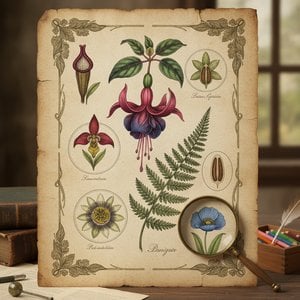
Barnes's cyanotypes are far from straightforward reproductions. She meticulously arranges local flora – weeds alongside rare species, wildflowers with cultivated blooms – creating compositions where individual identities blur and merge. This deliberate ambiguity isn’t accidental; it reflects her belief in the equal importance of all growing things. The resulting prints, often layered with watercolor, gouache, and ink, possess a dreamlike quality—familiar yet subtly otherworldly. They evoke a sense of memory, of fleeting moments captured and transformed into something enduring.
Expanding Beyond the Frame: Murals and Site-Specific Installations
While the cyanotype provides a foundational element in Barnes’s work, her artistic ambition extends far beyond the confines of the traditional picture plane. She has become increasingly known for large-scale murals and site-specific installations, transforming public spaces into immersive environments. These projects—commissioned by organizations like the New York City Department of Transportation and Arts Brookfield—demonstrate a commitment to accessibility and community engagement.
Her installations aren’t simply decorative additions; they are carefully considered responses to their surroundings, often incorporating elements of local history, ecology, or social context. She creates objects that feel both beautiful and mysterious, familiar yet slightly outside of time. This approach is particularly evident in her work with the Wilderstein Sculpture Biennial, where she created an installation responding to the landscape and architectural features of the historic estate.
A Collective Spirit: Art as Activism
Barnes’s artistic practice isn't solely defined by individual creation; she is also a dedicated member of Tart, an intersectional feminist and anti-racist art collective based in New York City. This involvement underscores her belief in the power of collaboration and the importance of using art as a platform for social change. Her work with Tart reflects a commitment to challenging established norms and amplifying marginalized voices.
Furthermore, Barnes’s dedication extends to education; she has worked as an artist-in-residence at institutions like the Museum of Brooklyn and the Hudson River Museum, fostering creativity in others and sharing her knowledge with aspiring artists. This multifaceted approach—artist, educator, activist—defines her role within the contemporary art landscape.
Legacy and Future Directions
Julia Whitney Barnes’s work occupies a unique space within contemporary art. It is simultaneously rooted in historical techniques and deeply engaged with present-day concerns. Her cyanotypes are not merely beautiful objects; they are meditations on nature, memory, and the interconnectedness of all living things. Her large-scale installations demonstrate a commitment to public engagement and a desire to create meaningful experiences for diverse audiences. As she continues to explore new media and push the boundaries of her practice, Barnes remains a vital voice in the ongoing conversation about art, ecology, and social justice—an artist whose work is sure to resonate with viewers for years to come.