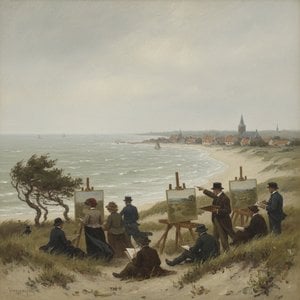
Julius Mordecai Pincas (Jules Pascin): A Life Painted in Shadows and Light
Born into a world of wealth and tradition, Julius Mordecai Pincas – later known as Jules Pascin – emerged from the bustling port city of Vidin in Bulgaria, a place steeped in history and shadowed by the Danube. His early life, marked by family expectations and artistic inclinations initially dismissed by his father, laid the foundation for an extraordinary career that would ultimately lead him to become one of the most captivating figures within the School of Paris.
His childhood was spent amidst the opulence of a Sephardic Jewish trading family. Moving to Bucharest in 1892, young Julius discovered his passion for art, sketching in unexpected corners – even at a local brothel, an experience that would later inform his unique perspective on human nature and beauty. This early exposure, coupled with the disapproval of his father regarding his artistic pursuits, fueled a determination to forge his own path. He received formal training in Vienna and Munich, absorbing influences from Impressionism, Cézanne’s structured landscapes, and the bold experimentation of Fauvism. These formative years instilled within him a keen eye for detail, an appreciation for color, and a willingness to challenge conventional artistic boundaries.
Parisian Dreams and the Birth of a Pseudonym
In 1905, Pascin embarked on a pivotal journey to Paris – a city that had long been a magnet for artists seeking inspiration and freedom. Immediately immersed in the vibrant atmosphere of Montparnasse, he joined a circle of kindred spirits, including figures like Paul Klee and Wassily Kandinsky. It was here, adopting the pseudonym “Pascin” – an anagram of his surname – that he began to truly establish himself as an artist. This deliberate shift wasn’t merely a stylistic choice; it was a strategic maneuver designed to shield his family from potential embarrassment stemming from his more provocative early drawings.
His initial Parisian works reflected the influence of the Fauvist movement, characterized by intense colors and expressive brushstrokes. He also studied at the Académie Matisse, further refining his technique and exploring new approaches to composition. However, Pascin’s artistic journey wasn't simply about mimicking established styles; he was actively seeking a unique voice – one that would capture the essence of modern life with both sensitivity and boldness.
The Soul of Paris: Women, Shadows, and Psychological Depth
Pascin’s art is inextricably linked to his fascination with women. He depicted them in a myriad of ways—often nude or partially dressed, captured in moments of quiet contemplation, casual intimacy, or poignant vulnerability. These weren't idealized representations; rather, they were imbued with a profound psychological depth, hinting at the complexities and contradictions inherent within the human experience. His paintings are not merely portraits but windows into the souls of his subjects.
His palette was remarkably vibrant, utilizing bold colors to create dramatic effects and evoke powerful emotions. He skillfully employed light and shadow to sculpt forms, adding a sense of atmosphere and mystery to his compositions. Beyond mere representation, Pascin sought to convey an underlying narrative—a story whispered through the subtle gestures, expressions, and relationships depicted in his works. He was particularly drawn to capturing the fleeting moments of everyday life – a dancer’s graceful movement, a waiter’s weary gaze, or a woman lost in thought.
Major Works and Lasting Legacy
Among Pascin's most celebrated paintings are *Nude with a Green Hat* (1925), a striking study of female beauty; *Little Girl on an Armchair* (1925), which captures innocence and vulnerability; and *Loose Women* (1911), a provocative depiction of modern life. His portrait of Hermine David, a muse and lover, remains a significant work housed in the Musée National d'Art Moderne, Centre Pompidou in Paris.
Despite his artistic success, Pascin’s life was marked by personal struggles. He battled with depression and alcoholism throughout much of his career, ultimately succumbing to suicide in 1930 at the young age of 45. Yet, despite this tragic end, his legacy continues to endure. Jules Pascin remains a pivotal figure within the School of Paris, an artist whose bold style, psychological depth, and captivating portrayals of human experience continue to resonate with audiences today. His works are exhibited in museums around the world, ensuring that his unique vision will be remembered for generations to come.
Gyakran Ismételt Kérdések
Hol találhatók Jules Pascin művei kulcsszavakra csoportosítva?
Jules Pascin műveinek keresése egy adott témában a művész Kulcsszavak alapján oldalán lehetséges, amely a alkotásokat kulcsszavak alapján csoportosítja.
Jules Pascin műveit műkor movements szerint böngészhetem?
Jules Pascin művész alkotásainak különböző irányzatait a művész Összes irányzat oldalán tekintheti meg, ahol a műalkotások stílusirányzat szerinti csoportosításban láthatóak.
Mely Jules Pascin művei a legnézettebbek?
Jules Pascin műveire vonatkozó statisztikusok a művész Statisztika oldalán érhetőek el.