A Bridge Between Worlds: The Life and Art of Joseph Stella
Joseph Stella (1877–1946), an Italian-American Futurist & Precisionist painter, stands as a testament to artistic reinvention and the transformative power of embracing new ideas. Born Giuseppe Michele Stella in Muro Lucano, Italy, his early life was marked by a dedication to medicine—a path swiftly abandoned in favor of a passion for visual art that would reshape his entire career trajectory.Early Influences and Artistic Formation
Stella’s artistic journey began at the Art Students League of New York in 1896, where he honed his skills under William Merritt Chase, absorbing the stylistic precepts of Impressionism. However, it was during his travels in Europe—particularly Paris—that Stella encountered the seismic shifts occurring within the European avant-garde. The salon of Gertrude Stein became a crucible for intellectual exchange and artistic experimentation, introducing him to luminaries like Umberto Boccioni and Gino Severini who championed Futurism’s fervent celebration of speed, machinery, and urban dynamism. This encounter proved pivotal; Stella was captivated by the Futurist manifesto's bold assertion that technology would supersede traditional religion—a conviction that profoundly shaped his artistic vision.The Embrace of Futurism and Its Impact
Immediately recognizing the potential for expressive innovation, Stella wholeheartedly adopted Futurism’s principles. He began incorporating dynamic lines, fragmented forms, and vibrant color palettes into his paintings, mirroring the energy of industrial landscapes and urban centers. His seminal work, Battle of Lights, Coney Island (1913-14), exemplifies this stylistic fusion—a dazzling depiction of the amusement park that transcends mere representation to convey the visceral sensation of experiencing it firsthand. This painting wasn’t merely a visual record; it was an attempt to capture the pulse of modernity itself. He continued exploring these themes in subsequent paintings like Der Rosenkavalier (1914) and Spring (The Procession – A Chromatic Sensation) (1914-16), pushing towards increasingly vigorous color abstractions.Precisionism: Geometric Clarity and American Sensibility
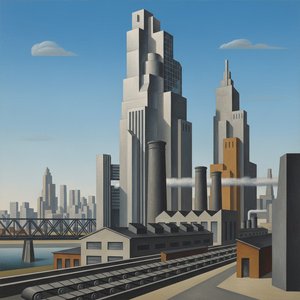
Alongside Futurism, Stella’s artistic exploration encompassed Precisionism—a movement characterized by meticulous geometric forms and a deliberate rejection of Impressionistic brushstrokes. This stylistic duality reflects Stella's astute understanding of both European avant-garde ideals and the distinctive aesthetic sensibilities of America. His iconic depiction of the Brooklyn Bridge embodies this fusion perfectly: clean lines converge to create a monumental structure that simultaneously conveys structural integrity and visual grandeur. The bridge became for him a symbol of American ingenuity and progress—a testament to the transformative power of modern engineering.Legacy and Recognition
Stella’s participation in the Armory Show of 1913 cemented his position as a pioneer of early 20th-century American modernism, garnering critical acclaim and propelling him into the spotlight. Katherine Dreier's Societe Anonyme, New York’s first museum dedicated to advanced contemporary art, championed Stella’s work—solidifying his legacy within the burgeoning avant-garde movement. Joseph Stella died in 1946, leaving behind a rich artistic output that continues to inspire artists and scholars alike. His paintings stand as enduring emblems of innovation, dynamism, and the unwavering pursuit of artistic excellence—a bridge between European modernist fervor and American visual culture.Gyakran Ismételt Kérdések
Mely Joseph Stella művei a legnézettebbek?
Joseph Stella műveire vonatkozó statisztikusok a művész Statisztika oldalán érhetőek el.
Milyen hangulatokat közvetítenek Joseph Stella művei?
A művész Hangulat alapú gyűjtemény oldala Joseph Stella alkotásait hangulat alapján csoportosítva mutatja be.
Milyen más neveken ismert Joseph Stella?
Joseph Stella más néven is ismert: Giuseppe Michele Stella.