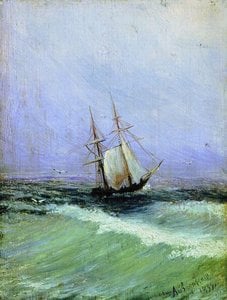
A Life Embraced by the Waves
Ivan Konstantinovich Aivazovsky, born Hovhannes Aivazian in 1817, was more than a painter of seascapes; he was a conduit to the ocean’s soul. His very existence seemed inextricably linked to the Black Sea—a vast, unpredictable expanse that would forever dominate his artistic vision and fuel an extraordinary career spanning nearly six decades. Born in the Crimean port city of Feodosia, Aivazovsky didn't merely observe the sea; he felt it – its raw energy, sublime beauty, and inherent danger becoming the very essence of his art. From a young age, this connection was nurtured, initially by local architect Jacob Koch who recognized the boy’s talent, then blossoming within the rigorous academic environment of the Imperial Academy of Arts in Saint Petersburg. Yet, formal training alone couldn't account for the depth of Aivazovsky’s understanding; it was the constant presence of salt-laced air and the cries of gulls that truly shaped his artistic sensibility. His Armenian heritage also played a significant role, as he was baptized at the St. Sargis Armenian Church in Feodosia and maintained strong cultural ties throughout his life, occasionally incorporating Armenian themes into his expansive body of work.The Early Years and Artistic Foundations
Aivazovsky’s early years were steeped in the atmosphere of Feodosia, a vibrant port city with deep historical roots. His family's origins traced back to Western Armenia, and this heritage instilled within him a profound connection to the land and sea—a connection that would profoundly influence his artistic vision. The Crimean landscape, with its rugged coastline, dramatic cliffs, and ever-changing moods of the Black Sea, served as his initial inspiration. He began sketching and painting locally, honing his skills under the guidance of Jacob Koch, a local architect who recognized Aivazovsky’s exceptional talent. This early exposure to the natural world laid the foundation for his later mastery of capturing its beauty and power. His enrollment at the Imperial Academy of Arts in Saint Petersburg provided him with formal training in classical techniques, but it was his continued immersion in the maritime environment—visiting ships, observing naval maneuvers, and absorbing the stories of sailors—that truly shaped his artistic development. The rigorous academic setting complemented his practical experience, providing him with a solid grounding in composition, color theory, and perspective.A Journey Through Europe and the Rise to Prominence
In the early 1840s, Aivazovsky embarked on a transformative journey through Europe, seeking new artistic influences and broadening his horizons. Italy proved particularly formative, immersing him in the vibrant landscapes of the Mediterranean and exposing him to the techniques of artists like J.M.W. Turner, whose dynamic brushwork and atmospheric effects deeply resonated with Aivazovsky’s own evolving style. He spent time studying the works of the Old Masters, absorbing their compositional principles and color palettes. Upon his return to Russia, a pivotal moment arrived: his appointment as the main painter of the Russian Navy. This wasn't merely a prestigious title; it was access—access to ships, sailors, naval battles, and firsthand observation that profoundly influenced his work. He became intimately acquainted with maritime life, lending an authenticity to his depictions that resonated deeply with both military officials and art enthusiasts alike. The patronage of the Imperial Court provided him with financial security and recognition, allowing him to dedicate himself fully to his artistic pursuits.Mastering the Marine Canvas: Style and Technique
Aivazovsky’s paintings are instantly recognizable for their romantic sensibility and technical brilliance. He possessed an extraordinary ability to capture not just the visual spectacle of the sea—its shimmering light, turbulent waves, and dramatic skies—but also its very essence—its moods, its power, and its mystery. His technique was characterized by a remarkable sensitivity to color, using thin layers of paint to create luminous textures and atmospheric effects. He often worked en plein air, directly from nature, capturing fleeting light effects with astonishing accuracy. His compositions were dynamic and dramatic, frequently employing diagonal lines and contrasting colors to convey a sense of movement and energy. Aivazovsky’s most celebrated works—such as *The Ninth Wave* (1850), *Capture of the Schamylata* (1848) and *Battle of Kinburn* (1843)—are testaments to his mastery of depicting naval battles, capturing the chaos and drama of these events with remarkable realism. He wasn’t afraid to depict destruction—the splintered wreckage of ships, the desperate struggles of sailors—but even within these scenes, there was always an underlying sense of beauty and awe.Legacy and Enduring Influence
Ivan Konstantinovich Aivazovsky stands as one of the greatest masters of marine art in Russian history—a legacy cemented by his technical skill, emotional depth, and prolific output. His paintings are celebrated not only for their aesthetic beauty but also for their ability to evoke powerful emotions and capture the essence of the sea. He significantly contributed to the development of Russian landscape painting, influencing generations of artists with his innovative techniques and dramatic compositions. Aivazovsky’s work continues to resonate with audiences worldwide, exhibited in museums and galleries across the globe. His paintings are a testament to the enduring power of nature and the human spirit—a reminder of our vulnerability in the face of the elements and our capacity for resilience and hope. He wasn't simply a painter of seascapes; he was a poet of the ocean, translating its moods, mysteries, and majesty onto canvas with unparalleled skill and passion.Gyakran Ismételt Kérdések
Megtekinthetem Ivan Aivazovsky műveit technikánként csoportosítva?
A Összes médium oldalon Ivan Aivazovsky művei technikák szerint vannak csoportosítva.
Hol és 어느 해 született Ivan Aivazovsky?
Ivan Aivazovsky Feodoszija városban született, 1817 évben.
Hol és melyik országban született Ivan Aivazovsky?
Ivan Aivazovsky Feodoszija városban, Oroszország országban született.
Hány Ivan Aivazovsky alkotása tekinthető meg a katalógusban?
A 1096 műalkotás darab alkotást Ivan Aivazovsky részéről a Összes műalkotás oldalon tekintheti meg.
Honnan származik Ivan Aivazovsky?
Ivan Aivazovsky Oroszország-ban született.
Milyen színeket használt leggyakrabban Ivan Aivazovsky?
Ivan Aivazovsky Paletta Genom egy olyan oldal, amely bemutatja a művész életművének színes profilját.
Létezik-e egy időrendi áttekintés Ivan Aivazovsky műveiről?
Ivan Aivazovsky műveletei időrendi sorrendben tekinthetők meg a művész Műalkotások időrendje oldalán.