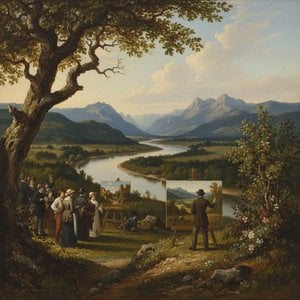
George Grosvenor Thomas: A Painter of Light and Scottish Landscapes
Born in Sydney, Australia, in 1856, George Grosvenor Thomas’s artistic journey took a dramatic turn when he emigrated to the United Kingdom in 1885. Driven by a desire for greater opportunities within the art world, he settled in Glasgow, a city already burgeoning with artistic innovation and profoundly influenced by the Barbizon School of painting. This pivotal move marked the beginning of a career dedicated to capturing the beauty of the British countryside – particularly its landscapes and still lifes – through a distinctly Impressionistic lens.
Thomas’s early years in Glasgow were shaped by his association with the Glasgow Boys, a group of young artists who challenged the established artistic conventions of the time. While not formally part of their core circle, he was deeply influenced by their spirit of experimentation and their embrace of contemporary techniques. This exposure to new ideas, combined with his own innate talent, propelled him towards a unique style characterized by loose brushwork, vibrant colors, and an emphasis on capturing fleeting moments of light and atmosphere. He quickly mastered both oil painting and watercolor, demonstrating versatility in his chosen mediums.
A Painter’s Palette: Influences and Technique
Thomas’s artistic development was profoundly shaped by a diverse range of influences. The Barbizon School, with its focus on plein air painting and the depiction of rural life, provided a foundational understanding of landscape representation. He also drew inspiration from the works of Jean-Baptiste-Camille Corot and Charles-François Daubigny, both masters of capturing atmospheric effects and employing broken color techniques to create a sense of luminosity. His brushwork was often characterized by short, expressive strokes applied with rapid succession, allowing him to quickly convey the essence of a scene – the dappled sunlight filtering through trees, the shimmering surface of water, or the subtle shifts in color caused by changing light conditions.
He meticulously observed nature, studying how light interacted with different surfaces and materials. This dedication to realism is evident in his detailed renderings of foliage, rocks, and water, but always tempered by an Impressionistic sensibility. His use of complementary colors – blues and oranges, greens and reds – created a vibrant and dynamic effect, while his skillful handling of atmospheric perspective conveyed the depth and scale of the landscapes he depicted.
Subjects and Exhibitions: A Broad Range of Artistic Expression
While primarily known for his landscape paintings, Thomas’s oeuvre encompassed a surprisingly diverse range of subjects. He frequently painted rural scenes – farms, fields, and woodlands – but also explored urban settings, capturing the bustle of city life and the quiet intimacy of domestic interiors. He was equally adept at creating still lifes, arranging flowers and fruit in carefully considered compositions that celebrated their beauty and transience. His work appeared regularly in prestigious exhibitions across Britain and on the continent, including those held by the Royal Academy, Royal Scottish Academy, and Royal Scottish Society of Painters in Watercolour.
His travels to Munich and Dresden resulted in gold medals recognizing his artistic merit, solidifying his reputation as a skilled and accomplished painter. He maintained connections with the Glasgow Boys throughout his career, continuing to exchange ideas and influence each other’s work.
Legacy and Recognition
George Grosvenor Thomas died in London in 1923, leaving behind a substantial body of work that continues to be admired for its beauty, sensitivity, and technical skill. His paintings offer a captivating glimpse into the landscapes and lives of Victorian Britain, capturing both the grandeur of nature and the quiet dignity of everyday life. Today, his works are held in prominent collections around the world, including the Glasgow, Budapest, and Weimar Art Galleries, ensuring that his artistic legacy endures.
Kérdések és válaszok
Hány Grosvenor Thomas alkotása tekinthető meg a katalógusban?
A Összes műalkotás oldalon Grosvenor Thomas 15 műalkotás alkotását tekintheti meg.
Hol találhatók Grosvenor Thomas alkotásai színpaletta szerint csoportosítva?
Grosvenor Thomas műveinek keresése egy adott színpalettában a művész Színpaletták alapján oldalán lehetséges.
Mely történelmi korszakban alkotott Grosvenor Thomas?
Grosvenor Thomas a 19th Century korszakban alkotott. Ez az időszak a művész tevékenységét a történelembe helyezi.