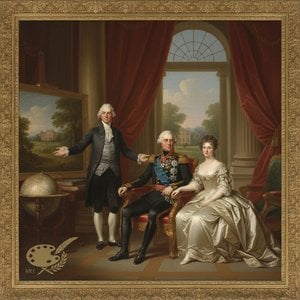
Early Life and Training (1774-1801)
George Chinnery, a name synonymous with the vibrant landscapes and captivating portraits of 19th-century India and China, was born in London on January 5, 1774. His early life was steeped in a unique artistic lineage; his father, a skilled craftsman, had pioneered the Gurney system of shorthand – a revolutionary method for rapid note-taking that would profoundly influence Chinnery’s own approach to art. This meticulous attention to detail and desire to capture fleeting moments became hallmarks of his oeuvre. Following in his father's footsteps, Chinnery received formal training at the Royal Academy Schools in London, where he honed the foundational techniques of classical painting – mastering perspective, anatomy, and color theory. However, it was not merely a pursuit of academic rigor that drove him; a keen desire to experience the world beyond the confines of England fueled his ambition.
Move to India and Rise as a Calcutta Artist (1802-1825)
In 1802, Chinnery embarked on a transformative journey eastward, sailing to Madras (now Chennai), India. This marked a pivotal moment in his career, establishing him as one of the leading Western artists within the British community. Madras quickly became his base of operations, and he swiftly gained recognition for his ability to capture the essence of Indian life – from bustling marketplaces to serene temple complexes. He was particularly sought after for his portraits, skillfully portraying prominent figures like Colonel James Achilles Kirkpatrick and his family, offering a fascinating glimpse into colonial society and familial relationships. The Calcutta Residency, where Chinnery spent much of this period, proved to be an exceptionally fertile ground for artistic development; he became the preeminent painter within the British community in Kolkata (Calcutta), documenting the city’s rich cultural tapestry with remarkable sensitivity.
Macau and the Influence of Lam Qua (1825-1846)
As mounting debts threatened his financial stability, Chinnery made a strategic move to Macau in 1825. This relocation proved remarkably fruitful, as he quickly established himself as a highly sought-after portraitist among European merchants and Chinese residents alike. His style during this period was closely imitated by the Cantonese artist Lam Qua – a testament to Chinnery’s considerable influence on the local artistic scene. The techniques of Lam Qua were essentially copies of Chinnery's, highlighting the latter's skill and popularity. Interestingly, Chinnery’s time in Macau coincided with his visit to Hong Kong in 1846, where he meticulously documented the newly established colony through a series of detailed studies – capturing its rapid growth and unique atmosphere.
Artistic Style and Techniques
Chinnery's artistic style is characterized by a captivating blend of Orientalist influences and meticulous realism. While undeniably influenced by European traditions, his work possesses an undeniable empathy and observational acuity that transcends simple exoticization. He was particularly adept at capturing the nuances of Asian subjects – their clothing, expressions, and surroundings – with remarkable detail and sensitivity. Chinnery primarily worked in oil paint and watercolor, often employing a combination of both mediums to achieve desired effects. Perhaps most notably, he utilized a modified version of the Gurney shorthand system to quickly jot down notes on his sketches, providing invaluable contextual information about his subjects and observations – a technique that reveals his dedication to capturing not just appearances but also the essence of what he witnessed.
Legacy and Historical Significance
George Chinnery’s legacy extends far beyond his individual artistic achievements. He stands as a unique chronicler of 19th-century India and China, documenting a period of profound transformation and cultural exchange. His paintings offer invaluable historical insights into British colonial life, the interactions between Europeans and Asians, and the daily lives of ordinary people. He was the only Western painter residing in southern China during this era, making him an unparalleled witness to a rapidly changing world. Furthermore, his influence can be seen in the work of local artists like Lam Qua, demonstrating his profound impact on the artistic landscape of the region. His depictions of everyday life – from bustling marketplaces to serene temple complexes – provide a rare and intimate glimpse into the past. Notably, his story has been brought to wider attention through James Clavell’s novel Tai-pan, where he is portrayed as Aristotle Quance, a fascinating figure in the narrative. Today, substantial collections of his drawings are held in museums across Europe and America, ensuring that his remarkable artistic legacy continues to be appreciated and studied.
Kérdések és válaszok
Hol és 어느 해 született George Chinnery?
George Chinnery London városban született, 1774 évben.
Hol tekinthetném meg George Chinnery műveit időrendi sorrendben?
George Chinnery műveletei időrendi sorrendben tekinthetők meg a művész Műalkotások időrendje oldalán.
Hogyan fejlődött George Chinnery művészete az idő múlásával?
George Chinnery pályafutása időszakosan nyílik meg a művész Krónika oldalán: egy horizontális időrendi vonal a műalkotásokról, amelyek a karrier szakaszaira oszlanak.