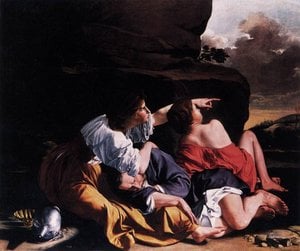
A Tuscan Dawn: The Life and Art of Orazio Gentileschi
Born in 1563 amidst the rolling hills of Tuscany, Orazio Gentileschi embarked on a journey that would see him become a pivotal figure in the transition from Mannerism to Baroque painting. Initially known as Orazio Lomi, he gravitated towards Rome, then the epicenter of artistic innovation, where he honed his skills within the workshops of Cola dell’Amata and absorbed the architectural sensibilities of Francesco da Sangallo. These early influences instilled in him a meticulous attention to form and composition, characteristics that would remain hallmarks of his style even as it dramatically evolved. Gentileschi’s initial work often involved contributing figures to larger decorative schemes conceived by other artists – a formative experience that taught him collaboration and adaptability, yet also hinted at a burgeoning ambition for independent expression. He began his career assisting established masters, learning the intricacies of perspective, color theory, and the skillful rendering of drapery—skills he would later master himself.Embracing the Shadow: Caravaggio's Influence and Artistic Development
The turn of the 17th century marked a turning point in Gentileschi’s artistic trajectory. The revolutionary naturalism of Caravaggio burst onto the Roman art scene, challenging established conventions with its dramatic use of light and shadow – *tenebrism* – and unflinching realism. Gentileschi was profoundly affected by this seismic shift, adopting elements of Caravaggio's style into his own work. However, he wasn’t merely an imitator; rather, he filtered Caravaggio’s innovations through his existing artistic sensibilities. While retaining the dramatic intensity, Gentileschi softened the harshness of Caravaggio’s *tenebrism*, introducing a lighter palette and a more refined approach to detail. This resulted in paintings that possessed both emotional power and elegant grace – a unique synthesis that distinguished him from his contemporaries. He didn't simply copy Caravaggio; he internalized the principles, adapting them to his own temperament and developing a style that was simultaneously powerful and subtly nuanced. Biblical scenes and mythological narratives became frequent subjects, allowing Gentileschi to explore themes of faith, heroism, and human vulnerability with compelling visual storytelling.A Courtly Wanderer: From Paris to London
Gentileschi’s artistic reputation extended beyond Italy's borders. His talent attracted the patronage of powerful figures, leading him on a peripatetic journey through Europe. He spent time at the court of Marie de' Medici in Paris, where his refined style resonated with the Queen’s taste for elegance and sophistication. This period saw a further evolution in his work, characterized by increasingly elaborate compositions and a heightened sense of decorum. He developed a particular skill in creating portraits that captured not only physical likeness but also the personality and social standing of his subjects. However, it was his invitation to England in 1626 that would define the final chapter of his career. Appointed court painter to Charles I, Gentileschi became one of the first major exponents of Caravaggism in Britain, significantly influencing the development of English Baroque painting. He undertook ambitious projects, including a series of ceiling paintings for Greenwich Palace (now Marlborough House), showcasing his mastery of large-scale decorative schemes and solidifying his position as a leading artist of his time. His work in England demonstrated a willingness to adapt his style to suit the tastes of a new audience while retaining his core artistic principles.The Language of Light and Shadow: Artistic Techniques
Gentileschi’s distinctive style was rooted in a sophisticated understanding of technique. He meticulously studied anatomy, rendering figures with remarkable accuracy and realism. His use of *tenebrism*, inherited from Caravaggio, created dramatic contrasts between light and shadow, intensifying the emotional impact of his scenes. He employed a rich, vibrant palette—often incorporating warm reds, yellows, and blues—to create a sense of dynamism and vitality. Furthermore, Gentileschi was known for his skillful handling of drapery, capturing its folds and textures with astonishing precision. His compositions were carefully balanced, often employing pyramidal structures to convey stability and harmony. He wasn’t just painting; he was orchestrating visual drama, using light, color, and form to tell compelling stories.Legacy and Lasting Impact
Orazio Gentileschi’s contributions to the world of art are multifaceted. He bridged the gap between Mannerism and Baroque, absorbing the innovations of Caravaggio while forging his own distinctive style. His use of vibrant colors, dramatic compositions, and refined technique influenced a generation of artists across Europe. He was instrumental in introducing Caravaggism to England, leaving an indelible mark on the artistic landscape there. But perhaps his most enduring legacy lies in his daughter, Artemisia Gentileschi. Trained in her father’s studio, she emerged as one of the most celebrated female painters of the Baroque era, carrying forward the family's artistic tradition and achieving renown in her own right. Today, Gentileschi’s works are held in prestigious museums and galleries worldwide – from the Uffizi Gallery in Florence to the Accademia Gallery in Venice – testaments to his enduring brilliance and lasting impact on the history of art. His paintings continue to captivate viewers with their emotional depth, technical virtuosity, and timeless beauty.- Major Works: “Danae”, "The Annunciation", "The Virgin Mary"
- Key Influences: Mannerism, Caravaggio
- Artistic Style: Baroque, Dramatic compositions, Bright colors.
Gyakran Ismételt Kérdések
Hogyan fejlődött Gentileschi Orazio művészete az idő múlásával?
Gentileschi Orazio Krónika oldala egy görgetésre alapozott idővonal, amely a művész alkotásait kronologikus sorrendben, a pályafelvétetei szerinti fejezetekbe csoportosítva mutatja be.
Hány Gentileschi Orazio alkotása tekinthető meg a katalógusban?
A 59 műalkotás darab alkotást Gentileschi Orazio részéről a Összes műalkotás oldalon tekintheti meg.
Hol és melyik országban született Gentileschi Orazio?
Gentileschi Orazio Toscana városban, Olaszország országban született.
Hol találhatók Gentileschi Orazio művei technika szerint csoportosítva?
A Összes médium oldalon Gentileschi Orazio művei technikák szerint vannak csoportosítva.
Hogyan találhatok Gentileschi Orazio műveit egy adott témában?
Gentileschi Orazio művei kulcsszavakra bontva is felfedezhetők a művész Kulcsszavak alapján oldalán. Minden kulcsszó a hozzá tartozó alkotásokat gyűjti össze.
Mely történelmi korszakban alkotott Gentileschi Orazio?
Gentileschi Orazio a Reneszánsz korszakban alkotott. Ez az időszak a művész tevékenységét a történelembe helyezi.
Hol és 어느 해 született Gentileschi Orazio?
Gentileschi Orazio Toscana városban született, 1563 évben.
What aliases or alternate names does Gentileschi Orazio have?
Gentileschi Orazio appears under the alternate names Orazio Lomi, Orazio Gentileschi.