


Augustus Earle (1793–1838)
augustus earle was a london-born travel artist. unlike earlier artists who worked outside europe and were employed on voyages of exploration or worked abroad for wealthy, often aristocratic patrons, earle was able to operate quite independently – able to combine his lust for travel with an ability to earn a living through art. the body of work he produced during his travels comprises a significant documentary record of the effects of european contact and colonisation during the early nineteenth century.James Earle, Augustus’s father, was an american-born artist who instilled in him a passion for visual representation from a young age. Georgiana Caroline Smyth, his mother, descended from John Carteret Pilkington, a prominent aristocrat and former partner of Joseph Smith, contributed to earle's intellectual curiosity.
Earle’s artistic training commenced at the Royal Academy where he exhibited classical, genre and historical paintings between 1806 and 1814. This early exposure solidified his commitment to mastering traditional techniques and capturing the grandeur of bygone eras.
The pivotal moment in earle's artistic journey arrived in 1815 when William Henry Smyth, his step-brother—a naval officer commanding HMS Scylla—secured permission for earle’s participation in a Mediterranean expedition. This voyage afforded him unparalleled access to diverse cultures and landscapes, resulting in a prolific output of sketches and watercolors.
Sicily, Malta, Gibraltar and North Africa became canvases for earle's meticulous observations, documenting the intricacies of daily life and architectural marvels under colonial rule. Upon returning to England in 1817, he embarked on an ambitious circumnavigation that spanned across America, Brazil, Tristan da Cunha, New South Wales, New Zealand, the Pacific Ocean, Asia, India, Mauritius and St Helena.
His initial foray into American art culminated in exhibitions at New York and Philadelphia where he showcased his talent alongside fellow artists. However, little is known about earle’s artistic endeavors during this period.
Continuing his voyage in February 1820, earle arrived in Rio de Janeiro, Brazil, delving into the complexities of colonial society and capturing vibrant scenes of Carnival.
Chile and Lima followed swiftly, providing opportunities to explore Andean vistas and engage with Peruvian culture. Notably, earle’s fascination with indigenous populations led him to meticulously record their customs and traditions.
In February 1824, he commenced a journey to Calcutta—a destination driven by the allure of encountering the Māori people—aboard HMS Duke of Gloucester. The voyage was fraught with challenges due to severe storms forcing an unplanned halt on Tristan da Cunha.
During his eight-month residency on Tristan da Cunha, earle undertook educational responsibilities and documented the island’s unique environment, producing sixteen remarkable watercolors that stand as testament to his artistic dedication.
His subsequent expedition to Hobart, Tasmania—facilitated by Admiral Cockburn—allowed him to capture the rugged beauty of Van Diemen's Land and its inhabitants. Despite a brief stay, earle’s Tasmanian sketches remain among his most celebrated works.
Finally, in May 1829, earle arrived in Sydney, Australia, establishing himself as a respected artist and documenting the burgeoning colonial landscape.
He established a gallery, offering instruction to aspiring painters and fostering artistic dialogue within the community. His depictions of Aboriginal subjects—particularly “Crying over the bones of a dead chief”—demonstrate his sensitivity to indigenous culture and his commitment to portraying it with accuracy and nuance.
His lithograph print "Portrait of Bungaree" alongside Fort Macquarie, Sydney Harbour, exemplifies earle’s ability to synthesize artistic vision with topographical precision. Augustus Earle's legacy endures as a pioneering figure in travel art—a chronicler of the Victorian era who captured both its grandeur and its contradictions.
- Notable Works: “A man-of-war’s boat cutting out a French barque”, “View From The Sydney Hotel”
- Influences: Benjamin West
- Institutions: Royal Academy
Kérdések és válaszok
Milyen más nevét vagy álneveit használ még Earle, Máté?
Earle, Máté a következő más néven is ismert: Augustus Earle, James Earle, Earle.
Létezik-e összes olyan témáról, amelyet Earle, Máté festett, összefoglaló?
Earle, Máté Témakörök katalógusa oldala olyan felület, amely a művész alkotásait témák szerint rendszerezi.
Hol tekinthetném meg Earle, Máté összes művét?
Earle, Máté minden alkotása megtekinthető a ez a weboldal oldalán, az alkotó Összes műalkotás oldalán keresztül.
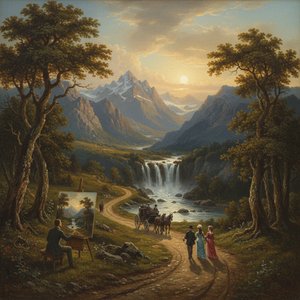


![Port Jackson, New South Wales [picture] / [augustus Earle] — Earle, Máté](/media/artworks/images-thumb/fb/08/fb08b9cec7c051c607c62da47c6f4247.jpg)

