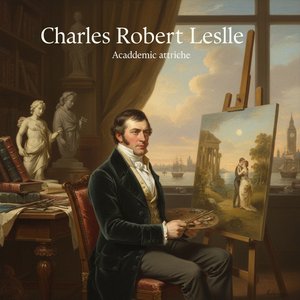
Early Life and Training
Charles Robert Leslie, a name synonymous with charming depictions of everyday London life in the 19th century, was born into an American family residing in London. His birth occurred on October 19, 1794, within the bustling heart of the city – a fact that profoundly shaped his artistic perspective and ultimately influenced his distinctive style. His parents, Robert Charles and Lydia Leslie, were both artists themselves, fostering an environment rich with creative expression from a remarkably young age. This familial legacy instilled in him a deep appreciation for visual arts, setting the stage for his own burgeoning talent. At just five years old, the family relocated to Philadelphia, Pennsylvania, where Charles received his initial education. However, his heart remained firmly rooted in London, and upon reaching adolescence, he returned to England, eager to pursue his artistic ambitions with renewed determination. His early training involved an apprenticeship with a bookseller – a practical experience that honed his observational skills and attention to detail, qualities crucial for any aspiring artist. Yet, it was clear from the outset that Leslie’s true passion lay not in the realm of literature but within the vibrant world of painting and theatre.Artistic Career and Influences
Leslie's arrival in London in 1811 marked a pivotal moment in his career. He quickly sought out mentorship from established artists, recognizing the importance of guidance and collaboration during this formative period. He found support from notable figures such as Benjamin West, a celebrated portraitist and former Royal Academician, and Washington Allston, an American artist known for his dramatic landscapes. These connections provided him with invaluable insights into artistic techniques, compositional strategies, and the broader art world. Initially, Leslie’s work leaned towards grand historical paintings – a common pursuit among young artists seeking to establish themselves within the prestigious Royal Academy. However, he soon discovered that his true calling lay in genre painting—capturing scenes of ordinary life, social interactions, and the nuances of everyday London society. This shift reflected a growing desire to portray the world around him with honesty and empathy, moving away from idealized historical narratives towards more relatable subjects. The influence of artists like Benjamin West, known for his dynamic compositions and dramatic lighting, and Washington Allston, famed for his atmospheric landscapes, undoubtedly shaped Leslie’s early style, providing a foundation upon which he would later build his own unique artistic voice.Notable Works and Style
Leslie's oeuvre is characterized by a remarkable ability to capture the spirit of London in all its complexity. His paintings are not merely representations of scenes; they are imbued with a sense of immediacy and authenticity, reflecting the energy, vibrancy, and social dynamics of Victorian England. Among his most celebrated works is “The Murder of Rutland by Lord Clifford,” an early painting that demonstrates his emulation of historical painting techniques while showcasing his developing skill in composition and dramatic storytelling. However, it was his genre scenes—such as "Londoners Gypsying"—that truly cemented his reputation. These paintings offer a glimpse into the lives of ordinary Londoners, capturing their fashions, customs, and social interactions with remarkable detail and wit. His portrait of Sir Walter Scott further solidified his position as a skilled portraitist, demonstrating his ability to capture the personality and character of celebrated sitters. The meticulous attention to costume, setting, and expression in these works reveals Leslie’s keen observational skills and his talent for conveying subtle nuances of human emotion.Museum Involvement and Legacy
Leslie's contributions to the art world extended beyond his own paintings. He was elected as an Associate of the Royal Academy in 1821, a significant recognition of his artistic merit. Full membership followed in 1826, solidifying his place among the leading artists of his time. His work is now preserved within the archives of the Centre d’art britannique de yale, ensuring that future generations can appreciate his unique artistic vision. Leslie's legacy endures as a master of Victorian genre painting. His paintings offer a valuable window into the social and cultural landscape of 19th-century London, capturing the spirit of an era with remarkable detail and charm. His influence can be seen in the works of later artists who followed in his footsteps, demonstrating the lasting impact of his artistic innovations. Furthermore, his friendship with John Constable, another prominent British artist, provides a fascinating glimpse into the social and intellectual circles of the time. Leslie’s life and work serve as a testament to the power of observation, empathy, and artistic vision—qualities that continue to resonate with audiences today.Kérdések és válaszok
Létezik-e egy időrendi áttekintés Charles Robert Leslie műveiről?
Charles Robert Leslie műveletei időrendi sorrendben tekinthetők meg a művész Műalkotások időrendje oldalán.
Honnan származik Charles Robert Leslie?
Charles Robert Leslie Egyesült Királyság-ban született.
Hogyan fejlődött Charles Robert Leslie művészete az idő múlásával?
Charles Robert Leslie Krónika oldala egy görgetésre alapozott idővonal, amely a művész alkotásait kronologikus sorrendben, a pályafelvétetei szerinti fejezetekbe csoportosítva mutatja be.