Early Life and Artistic Foundations
Berenice Abbott, born Berenice Alice Abbott on July 17, 1898, in Springfield, Ohio, began her life amidst a quiet, yet formative, backdrop of personal change. Her early years were marked by the separation of her parents, an experience that instilled within her a resilience and independence—qualities that would prove invaluable throughout her artistic journey. She spent her childhood in Ohio, absorbing the landscapes and rhythms of rural life before embarking on a path that led her to the vibrant, transformative energy of New York City. Initially attending The Ohio State University for a brief period in 1918, she quickly realized that the structured academic environment wasn’t aligned with her restless spirit and burgeoning creative impulses. This early departure from formal education was not a failure but rather a deliberate step towards forging her own unique artistic path. She moved to New York City, seeking opportunities within the city's thriving art scene, initially intending to pursue journalism at Columbia University – a plan that ultimately proved secondary to her growing passion for sculpture and painting. It was in this dynamic urban landscape that she began to connect with influential figures—artists, writers, and photographers—who would profoundly shape her artistic vision and introduce her to the avant-garde circles of the era. The connections she made with Marcel Duchamp and Man Ray were particularly significant, opening doors to a world of experimentation and challenging conventional notions of art. These encounters fostered a spirit of innovation that became deeply ingrained in her approach to visual expression.
Parisian Awakening and Photographic Development
A pivotal moment in Berenice Abbott’s artistic evolution arrived in 1921 when she traveled to Paris, a city renowned for its artistic ferment and intellectual vibrancy. This move proved transformative, propelling her into the heart of European art and photography. She immersed herself in the study of sculpture under the guidance of Emile Bourdelle, honing her technical skills and deepening her understanding of form and composition. However, it was her encounter with Man Ray that truly ignited her passion for photography. Working as his studio assistant, she gained invaluable experience in darkroom techniques, mastering the intricacies of photographic processes—a skill set that would become central to her distinctive style. During this period, Abbott’s unique aesthetic began to emerge: a keen eye for detail, an appreciation for composition, and a commitment to capturing the essence of her subjects. Her talent quickly garnered recognition, culminating in an exhibition at Le Sacre du Printemps gallery in 1926, where she showcased portraits of prominent artists and literary figures—including James Joyce and Eugène Atget—a testament to her growing reputation within Parisian artistic circles. Further studies in Berlin refined her technical abilities and broadened her artistic horizons before she returned to Paris in 1927, establishing a second studio on the rue Servandoni, solidifying her position as a respected figure in the European art world.
The Rediscovery of Eugène Atget
A defining moment in Berenice Abbott’s career occurred in 1927 when she encountered the work of Eugène Atget—a largely unrecognized French photographer who had documented the streets and people of Paris with remarkable sensitivity and insight. Atget's photographs, characterized by their intimate glimpses into everyday life, captured a bygone era of Parisian charm and social dynamics. Abbott was deeply moved by his meticulous technique and intuitive understanding of human behavior, recognizing in his work a kindred spirit—a dedication to capturing the authentic essence of urban experience. Following Atget’s death in 1927, Abbott embarked on a remarkable undertaking: she purchased his entire photographic archive, preserving a vital collection of images that had been largely overlooked by the art world. This act of preservation not only honored Atget's legacy but also profoundly influenced Abbott’s own artistic practice, shaping her approach to documentary photography and inspiring her to document the changing face of New York City.
Documenting a Changing City: New York Transformed
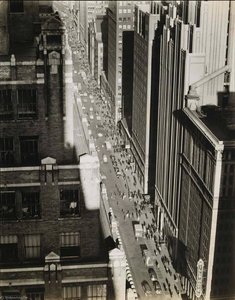
Upon returning to New York City in 1929, Berenice Abbott was struck by the rapid transformation of the urban landscape—a phenomenon she recognized as both exciting and poignant. Inspired by Atget’s example and driven by a desire to capture this dynamic shift, she initiated a monumental project: a comprehensive photographic survey of New York City. Supported by funding from the Works Progress Administration (WPA), Abbott meticulously documented the city's architecture, street scenes, and social life—creating a visual record of its evolution during a period of immense change. Her photographs weren’t merely representations of buildings and people; they were insightful observations about urban life, progress, and the passage of time. She employed a distinctive approach, utilizing both bird's-eye and worm's-eye perspectives to capture the city from multiple vantage points—a technique that allowed her to reveal its complex layers and create a sense of depth and scale. The resulting collection, “Changing New York,” became a landmark achievement in documentary photography, establishing Abbott as a leading figure in the field and providing invaluable insights into the history of one of the world’s most dynamic cities.
Legacy and Enduring Influence
Berenice Abbott's legacy extends far beyond her stunning photographs—a testament to her pioneering spirit and artistic vision. She is celebrated for her groundbreaking work in documentary photography, demonstrating an unparalleled ability to capture the essence of urban life through her lens. Her portraits offer intimate glimpses into the lives of influential cultural figures, while her New York City photographs serve as a valuable historical record of the city’s evolution—a visual chronicle of its transformation over several decades. Crucially, Abbott played a vital role in preserving and promoting the work of Eugène Atget, bringing his artistry to wider recognition and ensuring his place in photographic history. Beyond her artistic practice, she contributed significantly to the field through her writings and illustrations on photographic techniques, furthering its development as an art form. Her photographs are now held in prestigious collections worldwide—a lasting tribute to their enduring power and significance. Berenice Abbott’s influence continues to inspire photographers today, reminding us of the profound ability of the camera to document, interpret, and celebrate the world around us.