Early Life and Education
Alex Katz, a name synonymous with cool detachment and vibrant color, was born on July 24th, 1927, in the bustling borough of Brooklyn, New York – specifically in Sheepshead Bay. His early years were shaped by a move to St. Albans, Queens, a shift that instilled within him a keen observation of everyday life and its subtle nuances. From a young age, Katz displayed an undeniable passion for art, a spark ignited by the world around him. This nascent interest led him to pursue formal studies at the Cooper Union in 1946-1949, where he immersed himself in the theories and techniques of Modern art under the guidance of Morris Kantor. However, it was his time at the Skowhegan School of Painting and Sculpture in Maine that truly proved transformative. This experience, spanning from 1949 to 1950, fundamentally altered his approach to painting, emphasizing direct observation and capturing subjects *from life* – a principle he would carry with him throughout his illustrious career. The emphasis on plein air painting at Skowhegan provided Katz with a profound understanding of light, color, and composition, laying the groundwork for his distinctive style.Artistic Style and Influences
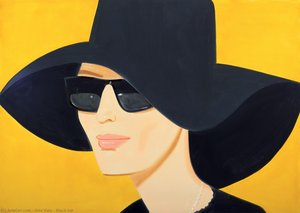
Katz’s artistic signature is instantly recognizable: a captivating blend of simplicity, bold colors, and an almost unnerving emotional distance. His work often falls into two distinct categories – portraiture and landscape – yet these genres rarely exist in isolation; they frequently intertwine to create complex and layered compositions. His style isn't simply minimalist; it’s carefully constructed, a deliberate choice of elements designed to evoke a specific mood or feeling. It is believed that Katz was profoundly influenced by the Japanese woodblock artist Kitagawa Utamaro, whose meticulous attention to detail and ability to capture human emotion resonated deeply with the young painter. Interestingly, comparisons have also been drawn between Katz’s work and that of contemporary artists like Andy Warhol and Keith Haring – a testament to his innovative approach and willingness to challenge conventional artistic boundaries. A key element of Katz's technique is his experimentation with "cutouts" – meticulously painting on panels of wood or aluminum before carefully removing sections, creating an almost architectural quality within the artwork. Furthermore, he developed a signature method of directly applying paint to shaped aluminum sheets, resulting in freestanding portraits that exist as tangible objects within the space around them. Perhaps most notably, Katz is recognized for his use of monochrome backgrounds – a bold departure from traditional portraiture and a deliberate move towards Pop Art aesthetics, separating him from many of his gestural figure painter contemporaries.Notable Works and Development
Katz’s artistic journey began modestly in the late 1950s with small collages featuring figures set within landscapes. These early works served as a crucial stepping stone, allowing him to refine his compositional skills and explore the relationship between human form and its environment. As the decade progressed, portraiture became increasingly central to his work, with paintings of friends and his wife, Ada, forming a recurring theme – a testament to their enduring connection and mutual influence. A pivotal moment in Katz’s career arrived in the 1960s when he began experimenting with dramatically cropped faces, drawing inspiration from film and advertising techniques. This stylistic shift resulted in iconic images like "Alex Katz: Thursday Night" and “Ada in Black Sweater,” instantly recognizable for their stark simplicity and arresting composition. Simultaneously, Katz embarked on a prolific career in printmaking, producing numerous editions of lithographs, etchings, silkscreens, woodcuts, and linoleum cuts – expanding his artistic vocabulary and reaching new audiences. In the late 1980s and 1990s, Katz turned his attention to landscapes, creating “environmental” paintings that sought to immerse the viewer in a sense of place. These works moved away from traditional landscape painting, emphasizing looser edges and painterly brushstrokes, conveying an almost tactile quality. More recently, Katz has explored new avenues, including night pictures – a departure from his sunlit landscapes – and floral paintings bursting with blossoms, demonstrating a continued willingness to push the boundaries of his artistic practice.Achievements and Historical Significance
Alex Katz’s impact on contemporary art is undeniable. He stands as one of the most important painters of our time, recognized globally for his distinctive style and unwavering commitment to his vision. His work has been exhibited in over 200 solo shows and nearly 500 group exhibitions worldwide, solidifying his position as a leading figure in the art world. Katz’s influence extends beyond individual artworks; he is credited with pioneering techniques that continue to inspire artists today. He was awarded an honorary doctorate from Colby College in 1984, recognizing his contributions to the arts and his dedication to artistic excellence. Throughout his career, Katz has maintained a close relationship with institutions such as the Whitney Museum of American Art, Tate Gallery, Guggenheim Museum Bilbao, and numerous museums across Europe and Asia. His work is held in prestigious private collections, further cementing his legacy as an artist of enduring significance. Beyond his individual achievements, Katz’s artistic journey reflects a broader cultural shift – a move away from traditional representational art towards a more direct and immediate engagement with the world around us. He remains a vital voice in contemporary art, continually challenging conventions and pushing the boundaries of what is possible.Kérdések és válaszok
Hol tekinthetném meg Alex Katz műveit időrendi sorrendben?
A művész Műalkotások időrendje oldala Alex Katz műveit év évre, időrendi sorrendben mutatja be.
Mely történelmi korszakban alkotott Alex Katz?
Alex Katz a Modern kor korszakban alkotott. Ez az időszak a művész tevékenységét a történelembe helyezi.
Megvizsgálhatom Alex Katz színhasználatát az összes művében?
Alex Katz műveiben megjelenő színhasználat a ez a weboldal oldalon a művész Paletta Genom oldalán tanulmányozható.