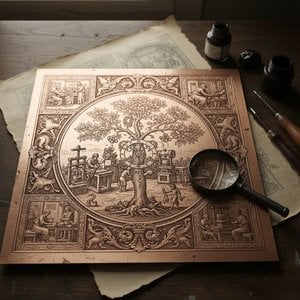
The Master of Line: The Life and Legacy of Adam Sandor Ehrenreich
In the vibrant cultural tapestry of nineteenth-century Central Europe, few artists captured the weight of history with such meticulous precision as Adam Sandor Ehrenreich. A Hungarian engraver and etcher born in the burgeoning city of Pest—now Budapest—in 1784, Ehrenreich emerged as a virtuoso of the burin and needle. His life’s work was not merely about reproduction, but about the translation of soul onto paper. Through his mastery of fine lines and subtle tonal gradations, he bridged the gap between the grander traditions of the Renaissance and the burgeoning emotional intensity of the Romantic era, leaving an indelible mark on the Hungarian artistic landscape.
The formative years of Ehrenreich were steeped in the rich, evolving artistic currents of his homeland. While much of his early personal biography remains shrouded in the mists of time, his technical prowess suggests a rigorous and disciplined education. He was deeply influenced by the masters of anatomical accuracy and expressive rendering, drawing inspiration from the monumental legacies of Leonardo da Vinci and the delicate portraiture of Natale Schiavoni. This foundation allowed him to approach the copper plate not just as a craftsman, but as an interpreter of human character and historical grandeur.
Technical Brilliance and the Art of the Engraving
Ehrenreich’s artistic identity was defined by his extraordinary command over the technical nuances of printmaking. He possessed a rare ability to utilize etching and engraving techniques to simulate textures that seemed almost tactile to the viewer. Whether he was capturing the soft sheen of silk or the rugged contours of a weathered face, his work was characterized by a profound commitment to draughtsmanship and tonal depth. His use of fine hatching and cross-hatching created a rhythmic interplay of light and shadow, a technique that breathed life into static images and imbued them with a sense of dramatic tension.
His most celebrated achievements often involved the translation of existing masterpieces into the medium of print, a process that required immense skill to preserve the original painterly nuances. Notable highlights of his oeuvre include:
- The Portrait of Antonio Salieri: An exquisite 1810 engraving created after a painting by Natale Schiavoni, which captures the dignified essence of the legendary composer through a delicate interplay of light and shadow.
- The Rearing Horse and Mounted Warrior: A monumental undertaking where Ehrenreich painstakingly engraved a depiction of a bronze sculpture attributed to Leonardo da Vinci, demonstrating his ability to transform sculptural mass into intricate graphic detail.
Historical Significance and Enduring Influence
Beyond the technical brilliance of his individual plates, Ehrenreich played a vital role in fostering a tradition of historical portraiture within Hungary. His work served as a cultural conduit, bringing the likenesses of great historical figures and the grandeur of classical themes to a wider audience. In an era before the ubiquity of photography, his engravings functioned as essential windows into the past, preserving the dignity of the musical elite and the heroism of antiquity for the collectors and intellectuals of his time.
The legacy of Adam Sandor Ehrenreich resides in the permanence of his lines. He did not merely record history; he rendered it palpable. By capturing the nuanced expressions and emotional resonance of his subjects, he ensured that the spirit of the late eighteenth and early nineteenth centuries would endure. Today, his works remain a testament to the power of printmaking as an art form capable of profound intellectual depth and timeless aesthetic beauty.