The Genesis of Disruption: From Impressionism to Early Cubist Experiments
Cubism is an early-20th-century avant-garde art movement which began in Paris. It revolutionized painting and the visual arts, and sparked artistic innovations in music, ballet, literature, and architecture. Cubist subjects are analyzed, broken up, a...
The early decades of the 20th century witnessed a seismic shift in artistic perception, a dismantling of established conventions that irrevocably altered the course of visual representation. To understand the radical nature of Cubism and its interwoven relationship with Expressionism, one must first acknowledge the preceding era – Impressionism. While groundbreaking in its own right, capturing fleeting moments of light and atmosphere, Impressionism ultimately remained tethered to the observable world. Artists like Monet and Renoir sought to depict *how* we see, but their subject matter largely adhered to recognizable forms. A growing dissatisfaction with this fidelity to external reality fueled a desire for something more profound – an exploration not merely of perception, but of conception itself. This yearning found initial expression in the works of Paul Cézanne, whose methodical deconstruction of form into geometric shapes laid the groundwork for Cubism’s analytical approach. Cézanne wasn't simply painting what he saw; he was analyzing the underlying structure of objects, reducing them to their essential components – cylinders, spheres, and cones. This intellectual pursuit, coupled with an increasing fascination with non-Western art forms—particularly African masks and Iberian sculpture—provided a crucial impetus for the revolutionary experiments that would soon unfold in Parisian studios.
Analytical vs. Synthetic Cubism: A Comparative Exploration of Form and Perspective
Fragmentation or fragmented may refer to: == Computers == Fragmentation (computing), a phenomenon of computer storage File system fragmentation, the tendency of a file system to lay out the contents of files non-continuously IP fragmentation, a pro...
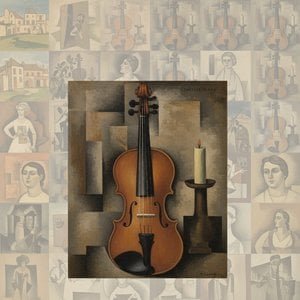
The initial phase of Cubism, often referred to as Analytical Cubism (roughly 1908-1912), was characterized by a rigorous fragmentation of objects and figures. Artists like Pablo Picasso and Georges Braque embarked on a systematic dissection of their subjects, breaking them down into multiple facets and reassembling them on the canvas in a deliberately fractured manner. This wasn’t about creating an illusionistic representation; it was about presenting a subject from *all* possible viewpoints simultaneously. Color palettes were typically muted—grays, browns, and ochres—to avoid distracting from the formal complexities of the composition. The emphasis lay squarely on intellectual analysis and the exploration of spatial relationships. However, this intensely cerebral approach gradually gave way to Synthetic Cubism (around 1912-1914). Synthetic Cubism marked a shift towards simplification and collage. Instead of breaking down objects, artists began constructing them from pre-existing materials—newspaper clippings, wallpaper fragments, musical scores—integrating these elements directly into the canvas. This introduced a new level of ambiguity and challenged traditional notions of representation. The use of brighter colors and bolder patterns further distinguished Synthetic Cubism, signaling a move away from pure analysis towards a more playful and decorative aesthetic.
Expressionism's Subjective Lens: Emotional Resonance in a Fragmented World
Expressionism is a modernist movement, initially in poetry and painting, originating in Northern Europe around the beginning of the 20th century. Its typical trait is to present the world solely from a subjective perspective, distorting it radically ...
While Cubism focused on the intellectual deconstruction of form, Expressionism delved into the realm of subjective experience. Originating primarily in Northern Europe around the turn of the century, Expressionist artists sought to convey emotional states—anxiety, alienation, despair—through distorted forms and jarring color combinations. Unlike the objective analysis of Cubism, Expressionism prioritized inner turmoil over external reality. Artists like Edvard Munch, with his iconic “The Scream,” exemplified this focus on psychological intensity. However, the boundaries between Cubism and Expressionism were often porous. Many artists experimented with both styles, recognizing their complementary potential. The fragmentation inherent in Cubist compositions could be powerfully employed to convey a sense of inner disintegration or emotional chaos. Furthermore, the bold colors and distorted forms characteristic of Expressionism found resonance within certain strands of Synthetic Cubism. Consider the works of Béla Kádár, whose vibrant paintings blend elements of both movements, creating evocative scenes that capture the psychological complexities of modern life.
Key Figures & Their Innovations: Picasso, Braque, and the Pioneers of the Movement
No discussion of Cubism would be complete without acknowledging the pivotal contributions of Pablo Picasso and Georges Braque. Picasso’s “Les Demoiselles d'Avignon” (1907) is widely considered a foundational work of the movement, its radical depiction of female figures—angular, fragmented, and inspired by African masks—shocking audiences and challenging conventional notions of beauty. Braque, meanwhile, brought a more methodical approach to Cubist experimentation, focusing on still life compositions and exploring the interplay between form and space. Their collaborative efforts during the Analytical Cubist phase were particularly significant; they worked in such close proximity that their early works are often difficult to distinguish. Beyond Picasso and Braque, other artists played crucial roles in shaping the movement’s trajectory. Juan Gris introduced a more structured approach to Synthetic Cubism, employing geometric precision and vibrant color palettes. Fernand Léger explored the intersection of Cubism with industrial imagery, creating dynamic compositions that reflected the energy of modern life. These pioneers weren't simply breaking rules; they were fundamentally redefining the language of painting.
Philosophical Undercurrents: Nietzsche, Freud, and the Rejection of Traditional Representation
The artistic innovations of Cubism and Expressionism were not born in a vacuum. They were deeply intertwined with broader philosophical currents that challenged traditional modes of thought. The writings of Friedrich Nietzsche, particularly his critique of objective truth and his emphasis on individual perspective, resonated powerfully with artists seeking to break free from established conventions. Similarly, the psychoanalytic theories of Sigmund Freud—with their exploration of the unconscious mind and the power of irrational forces—provided a framework for understanding the emotional intensity of Expressionist art. The rejection of traditional representation can be seen as a direct response to these philosophical ideas. Artists questioned the very notion of objective reality, recognizing that perception is inherently subjective and shaped by individual experience. This led to an exploration of inner states, fragmented realities, and the complexities of human consciousness. Even artists like El Greco, centuries before the formal emergence of Expressionism, foreshadowed this shift with his elongated figures and emotionally charged religious scenes—a testament to the enduring power of subjective vision.
The Enduring Legacy: Cubist Expressionism's Influence on 20th-Century Art and Beyond
The impact of Cubist Expressionism reverberated throughout the 20th century, influencing countless artists and movements. From Futurism’s embrace of dynamism to Surrealism’s exploration of the subconscious, the legacy of fragmentation, abstraction, and subjective expression is undeniable. Lyonel Feininger, for example, masterfully bridged Expressionism and Cubism in his architectural visions, creating a unique style that captured the spiritual essence of modern life. The movement also paved the way for Abstract Expressionism after World War II, with artists like Jackson Pollock and Mark Rothko pushing the boundaries of non-representational painting even further. Today, the principles of Cubist Expressionism continue to inspire contemporary artists across various media. Its emphasis on intellectual inquiry, emotional resonance, and formal innovation remains as relevant as ever. At WahooArt.com, we are dedicated to making these masterpieces accessible, offering high-quality reproductions that allow you to experience the power and beauty of Cubist Expressionism firsthand. Explore our collection today and discover the enduring legacy of this transformative artistic movement—from custom paintings based on your favorite works to detailed art appraisals, we provide a gateway into the world of fine art.