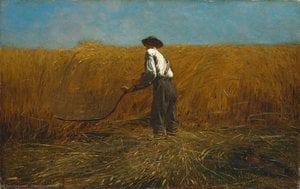
Hilltop Barn: A Study in Rural Tranquility
Winslow Homer’s “Hilltop Barn,” completed in 1874, stands as a quintessential example of American Realism—a movement that sought to depict the everyday lives and landscapes of ordinary people with unflinching honesty. More than just a picturesque depiction of rural Vermont farmland, this watercolor captures a profound sense of stillness and contemplation, reflecting Homer’s deep connection to the natural world and his masterful ability to convey emotion through subtle visual cues.
Composition and Setting: Capturing the Essence of Place
The painting presents a deceptively simple scene: two horses patiently pulling a carriage down a dirt road leading up to a weathered barn. Scattered amongst the animals are three figures—presumably members of a family—and a dog, adding human presence to the expansive landscape. Homer’s careful positioning of these elements creates a harmonious balance between man and nature, emphasizing the quiet dignity of rural life.
Watercolor Technique: Light, Color, and Texture
Homer's signature technique—watercolor—is crucial to the painting’s atmosphere. He employs delicate brushstrokes that blend seamlessly together, layering washes of muted greens, browns, and blues to build up a rich textural surface. The artist skillfully captures the diffused light filtering through the trees, creating an ethereal glow that illuminates the barn and its surroundings. This technique isn't merely about representation; it’s about conveying feeling—a sense of serenity and timeless beauty.
Historical Context: Homer and the Transcendentalist Tradition
"Hilltop Barn" aligns itself with the broader artistic currents of its time, particularly the Transcendentalist movement. Influenced by thinkers like Ralph Waldo Emerson and Henry David Thoreau, American artists sought to express spiritual truths through observation of nature. Homer’s work embodies this ethos—a belief in the inherent goodness of humanity and the transformative power of experience—mirroring the sentiments expressed in Thoreau's Walden.
Symbolism: The Barn as Emblematic Representation
The barn itself serves as a powerful symbol within the painting. It represents not just agricultural productivity but also resilience, permanence, and connection to tradition. Homer’s depiction of it—worn yet sturdy—suggests an enduring spirit—a quiet dignity that speaks to the fundamental values of rural America. The horse's patient demeanor reinforces this theme, embodying perseverance and acceptance of the natural order.
Emotional Impact: A Moment Frozen in Time
"Hilltop Barn" transcends mere visual description; it evokes a palpable emotional response. Its tranquil composition invites contemplation—a feeling of peace and contentment derived from observing the beauty of the countryside. Homer’s masterful use of watercolor captures not only the physical appearance of Vermont but also its intangible essence—the quiet dignity of rural life, untouched by the anxieties of modern existence.



 Előnézet
 Váltás nyomtatványra
 Megosztás
 Megosztás
 Részletek
 Útmutató

 Letöltés
 Hasonló darabok
 X-ray felvétel
 Diavetítés
 Statisztika

 Tovább olvasom






































 Az üvegkeretes opció csak 110 cm alatti méretben érhető el