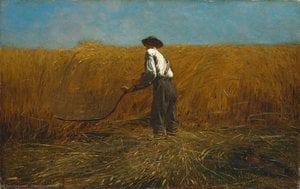
A művész életrajza
A Brush with the American Spirit: The Life and Art of Winslow Homer
Winslow Homer, born in Boston in 1836, wasn’t sculpted by the traditional European art academies that shaped so many of his contemporaries. Instead, he emerged from a distinctly American experience, one rooted in practicality and observation. His journey began not with grand historical canvases, but as a commercial illustrator at the tender age of twelve for Harper's Weekly. This early apprenticeship was formative, honing an exceptional ability to capture scenes with clarity and detail – skills that would become hallmarks of his mature work. He wasn’t learning perspective in Paris; he was learning to *see* America, its people, and its unfolding story. The bustling streets of Boston, the quiet dignity of rural New England life, these were his first subjects, rendered with a precision born of necessity for the demands of print media. This foundation allowed him to transition into painting, initially in watercolor, before fully embracing the expressive potential of oil paints.
Early Life and Artistic Beginnings
Homer’s childhood was marked by a close relationship between his parents—Charles Savage Homer, a merchant with restless ambitions, and Henrietta Maria Benson Homer, a gifted amateur watercolorist who instilled in him a lifelong appreciation for artistic observation. His father's entrepreneurial spirit propelled him to seek fortune abroad, leaving young Winslow largely under his mother’s tutelage. From Cambridge, Massachusetts, where he attended school, Homer developed an early fascination with drawing and sketching—skills that would prove invaluable throughout his career. He began honing his craft by copying the works of established artists, gaining experience in mastering technique and capturing visual impressions. This formative period instilled in him a disciplined approach to artmaking that would characterize his later work. His mother’s encouragement fostered his artistic talent and nurtured his innate sensitivity to beauty—traits that would become integral to Homer's distinctive style.
The Civil War Years: Witnessing History Through Art
The American Civil War profoundly impacted Homer’s artistic vision, transforming him from a painter of idyllic landscapes into a chronicler of the brutal realities of conflict. As a war correspondent for Harper’s Weekly, he documented the daily lives of soldiers and civilians—not grand battles or strategic maneuvers—but rather the quiet moments of grief, resilience, and human suffering amidst chaos. This experience instilled in him an unwavering commitment to portraying truthfulness and empathy—values that would permeate his paintings throughout his life. Homer eschewed romanticized depictions of heroism, focusing instead on capturing the psychological impact of war on ordinary people. His sketches for Harper’s Weekly are considered singular examples of wartime reporting, demonstrating his remarkable ability to convey emotion through visual imagery. The Civil War served as a catalyst for Homer's artistic evolution, prompting him to explore themes of trauma and vulnerability—themes that would become central to his oeuvre.
A Master of Watercolor and Oil: Exploring Diverse Techniques
Homer’s artistic versatility extended beyond watercolor; he excelled in oil painting, achieving remarkable textural depth and luminosity through a technique rooted in direct observation from nature. He embraced the expressive potential of oil paints while retaining the fluidity and spontaneity characteristic of watercolor—a duality that defined his distinctive style. Homer's studio was located primarily in New York City, yet he frequently traveled to Pennsylvania, the Catskills, and Gloucester, Maine, drawing inspiration from these varied landscapes. These excursions fueled his creativity and informed his artistic vision, resulting in paintings that captured both grandeur and intimacy. He meticulously built up layers of paint—often applying them with a palette knife—creating surfaces rich in texture and color—a technique that distinguishes Homer’s work from many of his contemporaries. His masterful handling of light—particularly the dramatic effects achieved during Maine summers—became a hallmark of his artistic style.
Legacy: An Icon of American Realism
Winslow Homer stands as one of America's most celebrated painters, recognized for his unflinching portrayal of the human condition and his profound engagement with the natural world. His paintings—particularly *The Gulf Stream*, *Breezing Up (A Fair Wind)*, and *Innocence*—remain enduring symbols of American artistic achievement. Homer’s influence extended beyond his own time, inspiring subsequent generations of artists who sought to capture the spirit of their nation with similar honesty and conviction. He rejected academic conventions in favor of a direct painting approach—a stylistic choice that cemented his place as a pioneer of American Realism. His legacy is defined by his ability to convey emotion through visual imagery—to communicate profound truths about human experience without resorting to sentimentality or embellishment. Homer’s enduring appeal lies in his unwavering commitment to portraying the beauty and complexity of America—a commitment that continues to resonate with audiences today. He remains a pivotal figure in the history of American art, ensuring his place as one of its most influential voices.



 Előnézet
 Váltás nyomtatványra
 Megosztás
 Megosztás
 Részletek
 Útmutató

 Letöltés
 Hasonló darabok
 X-ray felvétel
 Diavetítés
 Statisztika

 Tovább olvasom






































 Az üvegkeretes opció csak 110 cm alatti méretben érhető el