Early Life and Artistic Beginnings
William Powell Frith’s journey into the world of art began in a surprisingly modest setting – Aldfield, a small village nestled near Ripon in North Yorkshire. Born on January 9, 1819, he was the son of a hotelier, a profession that initially steered his path towards an auctioneer's career. However, fate, and perhaps a discerning father, recognized a deeper artistic talent within him, recognizing a potential far beyond the realm of bidding and sales. This early encouragement proved pivotal, setting in motion a trajectory that would ultimately lead to him becoming one of the most celebrated painters of his era.
Frith’s formative years were spent honing his skills at Sass's Academy in London, a prestigious institution renowned for its rigorous training and emphasis on traditional techniques. It was here that he immersed himself in the study of anatomy, perspective, and composition – the fundamental building blocks of any successful artist. Later, he further refined his abilities at the Royal Academy Schools, absorbing the lessons of established masters and developing his own distinctive style.
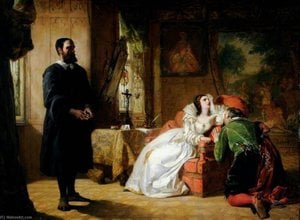
Initially, Frith’s artistic focus leaned towards portraiture and literary subjects, capturing the likenesses of prominent figures and illustrating beloved works of literature like those by Shakespeare and Scott. These early endeavors provided a valuable foundation, allowing him to develop his technical proficiency and cultivate an appreciation for detail – qualities that would later become hallmarks of his celebrated genre paintings.
The Clique and Influences
Frith’s artistic development was inextricably linked to the influential group known as “The Clique,” a coterie of artists who gathered in London during the mid-19th century. This exclusive circle, comprised of figures such as Richard Dadd, Augustus Egg, and Henry O’Neil, fostered a spirit of experimentation and collaboration, pushing the boundaries of artistic expression. Membership in The Clique provided Frith with access to invaluable insights, shared techniques, and a stimulating environment for creative growth.
Significantly, Frith was profoundly influenced by Sir David Wilkie, a celebrated painter known for his masterful depictions of domestic scenes. Wilkie’s ability to capture the nuances of everyday life – the interactions, emotions, and social dynamics within ordinary settings – served as a guiding inspiration for Frith. He particularly admired Wilkie's approach to portraying crowds, meticulously rendering each individual with remarkable detail and capturing the energy and movement of the scene.
Furthermore, Frith’s work demonstrates an awareness of contemporary photographic techniques, notably those pioneered by Robert Howlett. He skillfully utilized photographs as reference material, employing them to achieve a heightened level of realism and accuracy in his paintings – particularly evident in works like The Derby Day, where the sheer number of figures requires incredible precision.
Masterpieces: Capturing Victorian Life
Frith’s artistic career blossomed during the height of the Victorian era, a period characterized by rapid social and technological change. He seized upon this opportunity to document the vibrant tapestry of London life, creating a series of iconic paintings that offer unparalleled glimpses into the customs, fashions, and social interactions of the time. His most celebrated works include Ramsgate Sands (1854), a lively depiction of seaside revelry; The Derby Day (1858), a meticulously rendered panorama of Epsom Downs Racecourse teeming with elegantly dressed spectators; and The Railway Station (1862), a detailed portrayal of Paddington Station’s bustling activity.
Among his most poignant works is The Sleeping Model (1853), presented as his Diploma work at the Royal Academy. This painting, which explores the stark contrast between wealth and poverty, remains a powerful commentary on Victorian society. Similarly, The Crossing Sweeper (1858) powerfully illustrates the inequalities of the era, depicting a wealthy gentleman’s indifference to the plight of a street sweeper.
Later Years and Legacy
William Powell Frith lived a remarkably long life, witnessing significant transformations in the art world during the Victorian period. He continued to paint prolifically until his death on November 2, 1909, at the age of 90. Throughout his career, he maintained a strong sense of tradition and expressed reservations about the emerging trends of modern art.
Frith’s legacy extends far beyond his individual achievements. His paintings provide invaluable historical documentation of Victorian society, capturing its social dynamics, fashion, leisure activities, and prevailing attitudes. His meticulous attention to detail and masterful rendering of crowds set a new standard for genre painting in Britain, elevating it to a respected art form. Today, Frith’s works are exhibited worldwide, offering viewers a captivating window into the sights and sounds of 19th-century London – a testament to his enduring artistic vision.



 Előnézet
 Kézzel festett másolat vásárlása
 Megosztás
 Megosztás
 Részletek
 Útmutató

 Letöltés
 Hasonló darabok
 X-ray felvétel
 Diavetítés
 Statisztika
 Tovább olvasom






































 Az üvegkeretes opció csak 110 cm alatti méretben érhető el