A Geometric Dance of Color: The Pulsating Vision of Victor Vasarely’s “Terek”
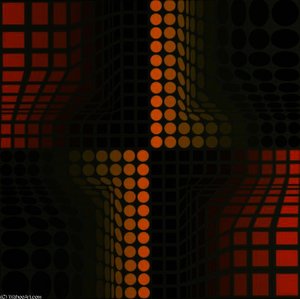
To encounter Victor Vasarely’s 1951 masterpiece, “Terek,” is to step away from the static world of traditional representation and enter a realm where the canvas itself seems to breathe, pulse, and vibrate. This seminal work stands as a cornerstone of the Op Art movement, acting as an intellectual investigation into the very mechanics of human perception. Rather than attempting to mirror the physical world, Vasarely utilizes a meticulously crafted language of geometric abstraction to challenge our understanding of space and form. The painting does not merely sit upon a wall; it interacts with the viewer’s gaze, creating a rhythmic energy that transforms a flat surface into a kinetic experience.
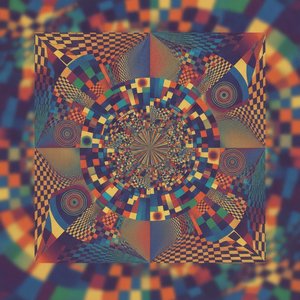
The composition is a sophisticated arrangement of interlocking blocks and sharp angles, where primary hues of red, yellow, and blue collide in a structured yet dynamic dance. At first glance, the work presents a deceptive simplicity—a square format filled with precise angular patterns. However, as the eye wanders across the canvas, the illusion of depth begins to emerge from the interplay of color and shape. Through the strategic layering of geometric planes, Vasarely creates a sense of movement that feels almost architectural, as if the shapes are shifting and sliding beneath one another in a silent, mathematical ballet.
The Intersection of Bauhaus Precision and Constructivist Spirit
The soul of “Terek” is deeply rooted in the rigorous intellectual currents of the mid-20th century. Vasarely’s artistic DNA was profoundly shaped by the Bauhaus school, where he mastered the principles of functional design and the beauty of rational forms. This influence is evident in the painting's disciplined structure and its rejection of unnecessary ornamentation. There is a clear lineage here to Constructivism, a movement that championed industrial logic and the use of geometric building blocks as tools for a new visual language. In “Terek,” every line and color choice feels intentional, serving a larger purpose in the construction of an optical phenomenon.
Technically, the piece reveals a fascinating tension between precision and texture. While the overall effect is one of mathematical exactitude, a closer inspection reveals the artist’s hand through deliberate brushwork. The application of paint is relatively thick, creating visible strokes within each geometric cell. This subtle texture prevents the work from feeling sterile or purely mechanical; instead, it lends a tactile quality to the colors, adding a layer of organic warmth to the otherwise austere arrangement. It is this marriage of mathematical precision and painterly touch that allows the artwork to achieve such a profound emotional resonance.
An Invitation to Modern Elegance and Visual Discovery
For the discerning collector or interior designer, “Terek” offers much more than mere decoration; it provides a focal point of intellectual stimulation and modern sophistication. The artwork’s ability to command attention through optical illusion makes it an extraordinary addition to contemporary spaces, where its bold colors and structured energy can breathe life into minimalist or avant-garde environments. It serves as a conversation piece that invites onlookers to pause, observe, and question the stability of what they see.
Choosing a high-quality reproduction of this masterpiece allows one to bring the revolutionary spirit of 1950s abstraction into the modern home. Whether placed in a sunlit gallery or a curated living space, “Terek” continues to perform its original function: to act as a window into the fascinating mechanics of sight. It remains an enduring testament to Vasarely’s vision—a world where art is not just something to be looked at, but something to be felt through the very movement of our eyes.
Gyakran Ismételt Kérdések
Mennyi volt Vasarely életkora, amikor a "Terek" készült?
Vasarely 45 éves volt, amikor 1951 évben megalkotta a "Terek" alkotást. A korúsítás az alkotó születési évéből, 1906 fel основании került kiszámítva.
Hogyan írják le „Terek”, Vasarely alkotása színezetét?
A "Terek" színei egy Earthy palettát alkotnak. Ez a besorolás a domináns színek családjait írja le.
Mikor készült a "Terek"?
A „Terek”, Vasarely alkotása alkotása 1951-ben készült.



 Előnézet
 Váltás nyomtatványra
 Megosztás
 Megosztás
 Részletek
 Útmutató

 Letöltés
 Hasonló darabok
 X-ray felvétel
 Diavetítés
 Statisztika


 Tovább olvasom






































 Az üvegkeretes opció csak 110 cm alatti méretben érhető el