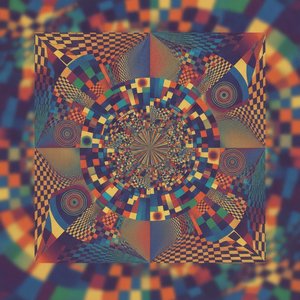
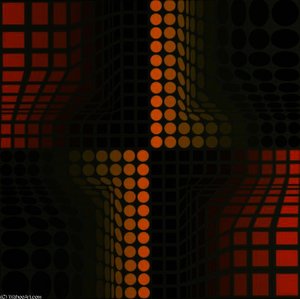
A Symphony of Circles: Unveiling Victor Vasarely’s “Molnar”
Victor Vasarely's "Molnar" is more than just a painting; it’s an invitation into the mesmerizing world of Op Art, a realm where perception itself becomes the subject. This striking composition – a dominant red circle enveloped by a constellation of smaller circles in vibrant hues – immediately captivates with its dynamic energy and illusionistic depth. The work, echoing Vasarely's pioneering explorations of optical art, demonstrates a masterful manipulation of color and form to create an experience that transcends simple visual representation.
The Genesis of Optical Illusions
Born in 1906 in Pécs, Croatia (then part of Austria-Hungary), Károly Vaszary – later known as Victor Vasarely – initially pursued a medical career before dedicating himself to the burgeoning field of visual art. His formative years were deeply influenced by the Bauhaus movement and Sándor Bortnyik’s “Műhely” workshop, where he absorbed the principles of functional design and geometric abstraction. This training provided the foundation for his revolutionary approach: to explore how the human eye perceives and interprets shapes and colors. "Molnar" exemplifies this philosophy perfectly, drawing upon techniques developed by Vasarely and other pioneers of Op Art – artists who sought to challenge traditional notions of representation by directly engaging with the viewer’s visual system.
Decoding the Composition
The painting's intricate arrangement is a deliberate exercise in controlled chaos. The large, red circle acts as an anchor, drawing the eye inward while simultaneously creating a sense of space and depth. The smaller circles, rendered in a spectrum of colors – green, yellow, pink, brown, and blue – are not randomly scattered; they’re meticulously positioned to create a dynamic interplay of light and shadow, further enhancing the illusion of three-dimensional form. This technique, characteristic of Vasarely's work, relies on the principles of optical mixing, where adjacent colors appear to blend together due to the way our eyes perceive them. The overall effect is one of constant movement and shifting perspective, a testament to the artist’s understanding of visual perception.
Symbolism and Emotional Resonance
"Molnar" transcends mere aesthetic appeal; it speaks to fundamental questions about reality and perception. Vasarely's work often explored themes of order and chaos, suggesting that these two forces are inextricably linked within the human experience. The circles themselves can be interpreted as representing wholeness, unity, or even the infinite – concepts frequently explored in geometric abstraction. Beyond its intellectual depth, "Molnar" evokes a powerful emotional response, inviting viewers to lose themselves in its mesmerizing patterns and contemplate the nature of visual reality. It’s a piece that demands attention, stimulating the senses and challenging our assumptions about how we see the world.
Gyakran Ismételt Kérdések
Milyen technika és stílus jellemzi „Molnar”, Vasarely alkotása alkotást?
A "Molnar" alkotásban a Acrylic On Canvas technika találkozik a Op Art irányzattal.
Hol találhatok egy útmutatót a(z) "Molnar" alkotáshoz?
A „Molnar”, Vasarely alkotása Útmutató oldala egy kinyomtatható, kétoldalas információs adatlapot kínál: magát a művészeti alkotást az azonosító táblázattal, egy évtizedes időrenddel, amely a művész életkorába helyezi a alkotást, a művész további treballatait, a megmért színpalettát, valamint négy különböző stílusban, azonnal másolható idézeteket.
Mit ábrázol a „Molnar”, Vasarely alkotása, és milyen hangulatot közvetít?
A „Molnar”, Vasarely alkotása a geometric shapes, optical illusion, color field, circle pattern, victor vasarely, op art style, abstract design elemeit ötvözi egy Elegant hangulatú környezettel.
Mekkora méretű nyomtatás Molnar alkotást a szobámba?
A(z) „Molnar”, Vasarely alkotása ajánlott párosítása: egy Large méretű nyomat egy Living Room-ban.
Mennyire fényes „Molnar”, Vasarely alkotása?
A „Molnar”, Vasarely alkotása alkotás Soft Shadow fényerőséggel rendelkezik. A fényerő azt mutatja meg, hogy a színek mennyire tűnnek visszafényesnek.
Melyik országból származik a Op Art irányzat Molnar című műve?
A "Molnar" a alkotó születésihelyén keresztül köti össze a Op Art irányzatot Kroatia-val.
Melyik szín tűnik ki leginkább a(z) "Molnar" alkotásból?
A(z) "Molnar" alkotásban leginkább a Clay (#ad533d) szín tűnik ki. A domináns szín hasznos, amikor egy műalkotást össze kell egyeztetni egy belső térrel.
Hogyan tekinthetném meg a(t) „Molnar”, Vasarely alkotása alkotást diaváltogatással?
Elérhető egy diaváltó: a Diaváltás oldala a(z) „Molnar”, Vasarely alkotása alkotáshoz.



 Előnézet
 Kézzel festett másolat vásárlása
 Megosztás
 Megosztás
 Részletek
 Útmutató

 Letöltés
 Hasonló darabok
 X-ray felvétel
 Diavetítés
 Statisztika

 Tovább olvasom






































 Az üvegkeretes opció csak 110 cm alatti méretben érhető el