A művész életrajza
Pietro Longhi (Pietro Falca) – A Venetian Chronicler of Daily Life
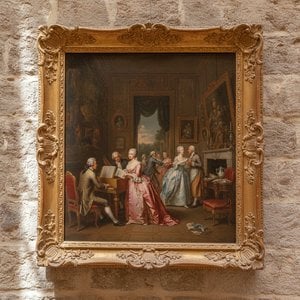
Pietro Longhi, born Pietro Falca in Venice on November 5th, 1701, wasn’t painting grand historical narratives or mythological scenes; he was capturing the quiet dramas unfolding within the city's elegant homes and bustling streets. He became renowned for his witty genre paintings – intimate glimpses into the lives of 18th-century Venetians, a departure from the prevailing artistic trends of his time. The son of Alessandro Falca, a silversmith, Longhi’s early training began under the Veronese painter Antonio Balestra, who recognized and nurtured the young artist's talent. This foundation in traditional technique would later serve as a subtle counterpoint to the innovative spirit he brought to his chosen subject matter – a spirit that anticipated the groundbreaking work of William Hogarth, cementing Longhi’s place as “the Venetian Hogarth.”
Early Influences and Artistic Training
Antonio Balestra's mentorship proved invaluable, instilling in Longhi a mastery of Venetian painting traditions. Balestra championed broken brushwork and vibrant color glazes—techniques that would become hallmarks of Longhi’s distinctive style. Recognizing Longhi’s exceptional aptitude, Balestra recommended him to Giuseppe Maria Crespi, Bolognese artist who was highly regarded for both religious and genre painting. This connection exposed Longhi to the burgeoning social and cultural shifts of his era – a fascination with the private lives of the bourgeoisie and a growing appreciation for domestic rituals. Crespi's influence encouraged Longhi to explore new artistic avenues while retaining the core principles of Venetian art.
Religious Beginnings and Transition Towards Genre Painting
Longhi’s initial artistic endeavors focused on religious commissions, producing altarpieces that demonstrated his technical skill and adherence to established conventions. His 1732 depiction of Saint Pellegrino for San Pellegrino church exemplifies this early period, showcasing the meticulous application of color glazes and a careful attention to detail—characteristics typical of Venetian painting at the time. However, around 1737 Longhi embarked on a transformative journey, decisively shifting his artistic focus towards genre scenes – small-scale depictions of everyday life that would define his legacy. This pivotal decision wasn’t merely stylistic; it represented a conscious engagement with the evolving sensibilities of the century and signaled a departure from the grand narratives favored by many of his contemporaries.
The Venetian Hogarth: Observation, Wit, and Social Commentary
Longhi quickly earned the moniker “the Venetian William Hogarth,” reflecting his remarkable ability to infuse seemingly mundane subjects with astute social commentary—a skill that distinguished him from other artists of his time. Like Hogarth, Longhi eschewed moralizing pronouncements, preferring instead to present observations of human behavior with a subtle irony and an unwavering commitment to truth. He didn’t simply record what he saw; he interrogated it, prompting viewers to consider the complexities and contradictions inherent in Venetian society. His canvases are populated by figures engaged in various activities—gambling parlors (*Ridotti*) teeming with patrons, masked balls celebrating Carnival, and intimate interiors capturing domestic life—each scene imbued with a nuanced perspective that anticipates Hogarth’s groundbreaking approach.
Notable Works and Lasting Legacy
Longhi's oeuvre comprises approximately 150 paintings, many of which are celebrated for their exquisite detail and psychological insight. Among his most iconic creations are *The Tailor*, *The Baptism*, *Painter in His Studio*, *The Concert*, *The Charlatan*, and *Exhibition of a Rhinoceros*—each piece offering a captivating glimpse into Venetian life and culture. The *Exhibition of a Rhinoceros*, commissioned by the Dutch sea captain Douvemont van der Meer, stands out as particularly noteworthy – Longhi’s depiction captures the spectacle of the rhinoceros's arrival in Venice with remarkable accuracy and understated humor. His masterful technique—characterized by broken brushwork, luminous color glazes, and meticulous attention to texture—established him as a cornerstone of Venetian painting and cemented his reputation as “the Venetian Hogarth.” Pietro Longhi died peacefully in Venice on May 8th, 1785, leaving behind an enduring artistic legacy that continues to inspire admiration and scholarly study.



 Előnézet
 Kézzel festett másolat vásárlása
 Megosztás
 Megosztás
 Részletek
 Útmutató

 Letöltés
 Hasonló darabok
 X-ray felvétel
 Diavetítés
 Statisztika


 Tovább olvasom






































 Az üvegkeretes opció csak 110 cm alatti méretben érhető el